How to Efficiently Unlock Investment Alpha With an Outsourced CIO
Unlocking alpha-oriented growth, without the proper tools and services, can be difficult, time-consuming, and expensive. That’s why Helios developed...
.png?width=258&height=145&name=Helios%20Web%20Images%20800x450%20(9).png)
How Advisors Can Use Market Commentary to Strengthen Client Relationships — Not Overwhelm Them
11 min read

Every advisor faces a pivotal decision as their practice grows: how to select an outsourced CIO partner that will not only manage portfolios but also protect the firm’s reputation, client trust, and long-term growth.
The OCIO industry has exploded, as assets under management reached an all-time high of $135 trillion in 2024, and projections point to USD $200 trillion by 2030.
Yet, as more firms enter the market, the real risk isn’t missing out on the biggest name or the largest AUM—it’s choosing a partner whose structure can’t deliver the discipline, customization, and accountability your clients demand.
This guide covers:
P.S. Helios partners with advisors who want more than just outsourced investment management. Our quantitative research, portfolio oversight, compliance support, and technology integration are designed to help you scale with confidence, deliver institutional-grade outcomes, and protect your firm’s reputation. Book a call with Helios to see how our structure, process, and support can help you achieve your investment goals.
|
Factor |
What to Evaluate and How to Verify |
|---|---|
|
Firm Structure |
Assess governance, decision rights, team composition, and process discipline. Request org charts, committee charters, and review cadence documentation. Structure should enable alignment, customization, and accountability. |
|
Governance and Oversight |
Review who makes investment decisions, how oversight is documented, and escalation protocols. Ask for sample compliance logs and audit trails. |
|
Customization and Flexibility |
Evaluate how portfolios are tailored to your goals, asset classes, and constraints. Request case studies and scenario analyses. |
|
Risk Management Framework |
Examine risk monitoring cadence, escalation triggers, and documentation standards. Ask for sample risk reports and escalation histories. |
|
Service Model and Team Access |
Identify your dedicated team, their accessibility, and communication cadence. Request bios, escalation contacts, and reporting samples. |
|
Technology and Reporting |
Review portfolio management platforms, reporting transparency, and integration with your workflows. Request demo access and sample reports. |
|
Fee Structure and Value |
Analyze fee transparency, value for cost, and alignment with outcomes. Request a full fee breakdown and performance attribution reports. |
|
Manager Selection & Asset Access |
Assess the manager's due diligence, performance monitoring, and access to alternative and global asset classes. Request documentation and examples of manager transitions. |
|
Fiduciary Alignment & Partnership |
Review code of ethics, conflict of interest policies, and evidence of long-term partnership support. Ask for regulatory guidance materials and client references. |
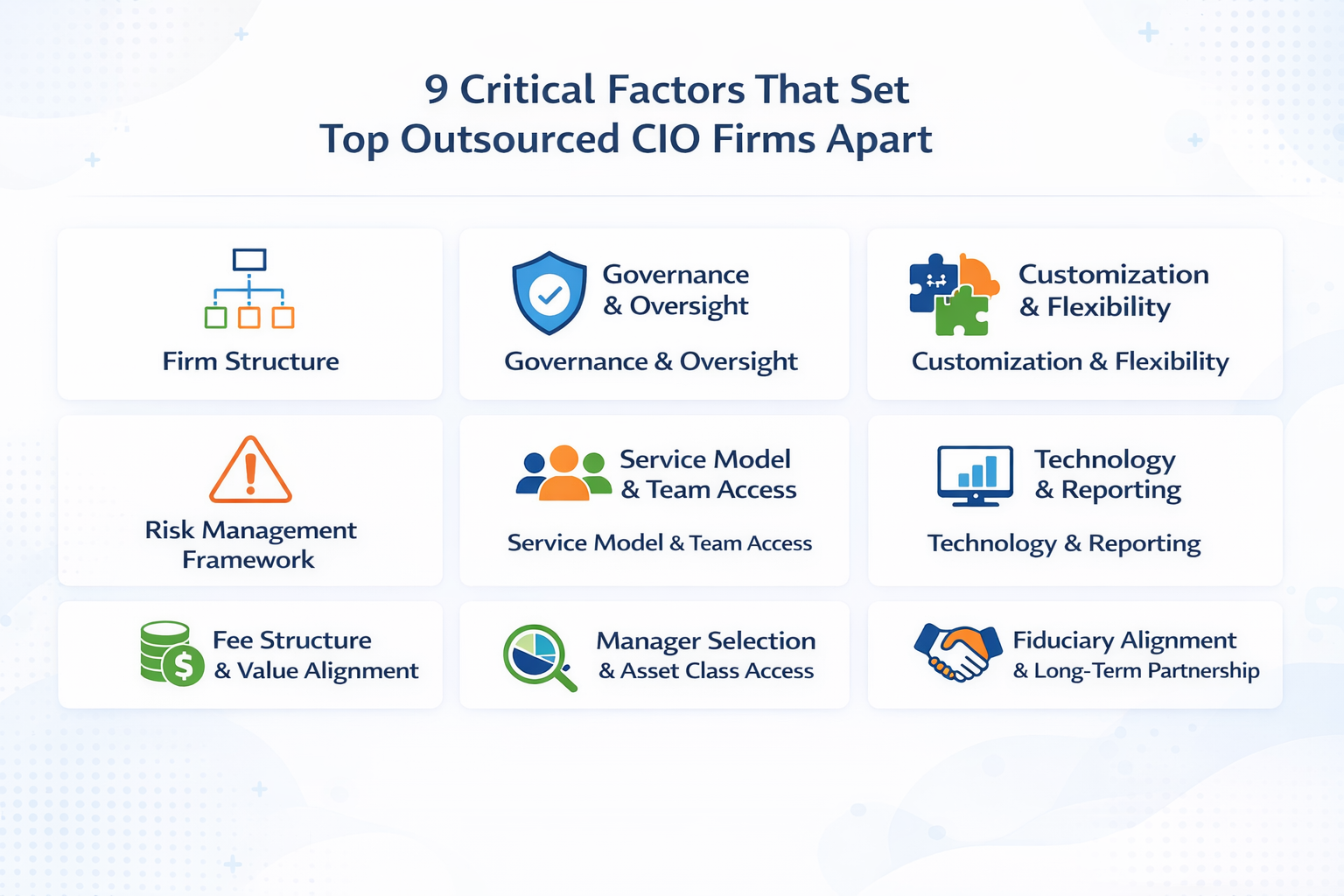
Selecting an outsourced CIO firm is one of the most consequential decisions an advisor can make. The right OCIO partnership can transform your investment management, streamline oversight, and unlock new growth opportunities.
But, with so many OCIO providers competing for your attention, and each promising proprietary investment solutions, global investment platforms, and institutional-grade expertise, the real challenge is knowing what actually matters.
The most successful advisors look beyond surface-level metrics like firm size or brand and focus on the structural, operational, and strategic factors that drive long-term value.
A firm’s internal structure is the single most important determinant of its ability to deliver on its promises. Structure defines how investment decisions are made, who is accountable, and how your needs are prioritized. When evaluating OCIO firms, advisors should look for a governance framework that is transparent, disciplined, and tailored to support both customization and accountability.
A robust structure includes clear lines of authority, documented decision rights, and a repeatable process for portfolio oversight. This is what enables an OCIO to adapt to your evolving requirements, maintain alignment with your investment philosophy, and ensure that risk management and compliance are not afterthoughts. In contrast, a firm that relies on size or brand alone often struggles to provide the focus and agility required for complex or fast-growing practices.
To verify structure, request organizational charts, committee charters, and documentation of review cadences. Examine how decisions are escalated, who signs off on model changes, and how oversight is documented. The right structure will be visible in every aspect of the relationship, from onboarding to ongoing reporting.
Read next: How the Outsourced Chief Investment Officer Model Evolved
A strong governance system is the backbone of a resilient OCIO relationship. Advisors must ensure that the provider’s governance framework is not just a formality, but a living system that drives accountability, transparency, and regulatory compliance.
The right governance structure will support your fiduciary duties, protect client assets, and ensure that every investment decision is defensible.
Read next: Outsourced Portfolio Management: When Control Creates More Risk Than Protection
Customization is a non-negotiable for advisors managing diverse client needs and complex portfolios. The ability to tailor investment solutions is what allows you to deliver differentiated value and meet specific client objectives.
Read next: Beyond CIO Services: What Modern Advisors Need
A disciplined risk management framework is essential for protecting client assets and meeting fiduciary obligations. Advisors should expect a provider to have a formal, transparent process for identifying, monitoring, and escalating risks. The best OCIOs provide scenario analysis, stress testing, and enterprise risk management as part of their service.
|
Risk Management Element |
What to Look For and How to Verify |
|---|---|
|
Monitoring cadence |
Confirm that risk reviews occur at least monthly, with additional reviews during periods of market stress. Request sample risk reports and monitoring schedules that show both quantitative and qualitative analysis. |
|
Escalation triggers |
Review escalation protocols for clear thresholds (e.g., drawdown limits, asset allocation drift, concentration risk). Ask for recent examples where these triggers led to action, and verify that the process is consistently applied. |
|
Documentation standards |
Request audit trails and compliance logs for recent risk events. These should be detailed, timestamped, and show a clear chain of responsibility from identification to resolution. |
|
Oversight roles |
Identify the individuals responsible for risk monitoring, action, and documentation. Request bios and role descriptions to confirm expertise and accountability. |
The quality of your day-to-day experience with an OCIO is shaped by the provider’s service model and the accessibility of your dedicated team. A high-quality OCIO relationship is built on proactive communication, deep expertise, and a commitment to supporting your practice’s unique needs.
Read next: When OCIO Solutions Make Sense
Technology is the engine that powers modern investment management, oversight, and client communication. The right technology stack enables better oversight, faster decision-making, and a superior client experience.
Read next: Investment Control Risk: The Hidden Cost of Being the Smartest Investor in the Room
Fee structure is a critical component of any OCIO relationship, but the focus should always be on value delivered, not just cost. Advisors must ensure that fees are transparent, aligned with outcomes, and free from hidden charges that can erode long-term value.
Understanding the factors that influence OCIO fees is essential for advisors who want to ensure value and transparency in their investment management partnerships. Fee structures can vary widely between providers, and the true cost often depends on a combination of portfolio complexity, service scope, and the level of customization required.
|
Fee Component |
What to Evaluate and How to Verify |
|---|---|
|
Base fees |
Request a full fee breakdown, including all base charges for investment management services. Compare across providers for similar service levels. |
|
Performance fees |
Analyze how performance fees are calculated and ensure they are tied to outcomes that matter to your clients. Request historical performance attribution reports. |
|
Additional charges |
Identify any extra fees for customization, reporting, or special services. Request examples and scenarios to understand the total cost of ownership. |
|
Value alignment |
Request performance attribution reports and examples of how fees are tied to delivered outcomes. Look for alignment with your investment goals and client needs. |
|
Hidden costs |
Watch for low headline fees with extra charges for essential services. Request a comprehensive fee schedule and ask for references who can speak to billing transparency. |
Read next: What It Takes to Run Investments In-House vs Outsourced CIO Cost
Manager selection and access to a broad range of asset classes are essential for building resilient portfolios and supporting long-term investment goals. A strong outsourced CIO provider will have a clear, disciplined process for identifying and evaluating investment managers, using both quantitative performance data and qualitative assessments of team stability and investment philosophy.
Advisors should expect transparency in how managers are chosen and replaced, with documentation that demonstrates a proactive approach to maintaining high standards.
Ongoing oversight is equally important. Leading OCIO firms conduct regular reviews of all managers in the portfolio, ensuring that performance and risk controls remain aligned with client objectives. Advisors should ask about the frequency of these reviews and request sample reports to confirm that monitoring is consistent and actionable.
Access to alternative investments, private markets, and global strategies can further enhance diversification and risk management. Advisors benefit most when their OCIO partner can demonstrate experience in sourcing and integrating these asset classes, resulting in portfolios that are both diversified and tailored to specific client needs.
Fiduciary alignment is non-negotiable in any OCIO relationship. The provider must demonstrate a commitment to acting in your clients’ best interests, with clear policies for avoiding conflicts of interest and maintaining regulatory compliance. Regulatory guidance is increasingly important as the investment landscape grows more complex. The best OCIOs provide ongoing education, scenario analysis, and support for navigating new regulations and industry standards.
Read next: Investment Management Outsourcing: When It Becomes a Strategic Advantage
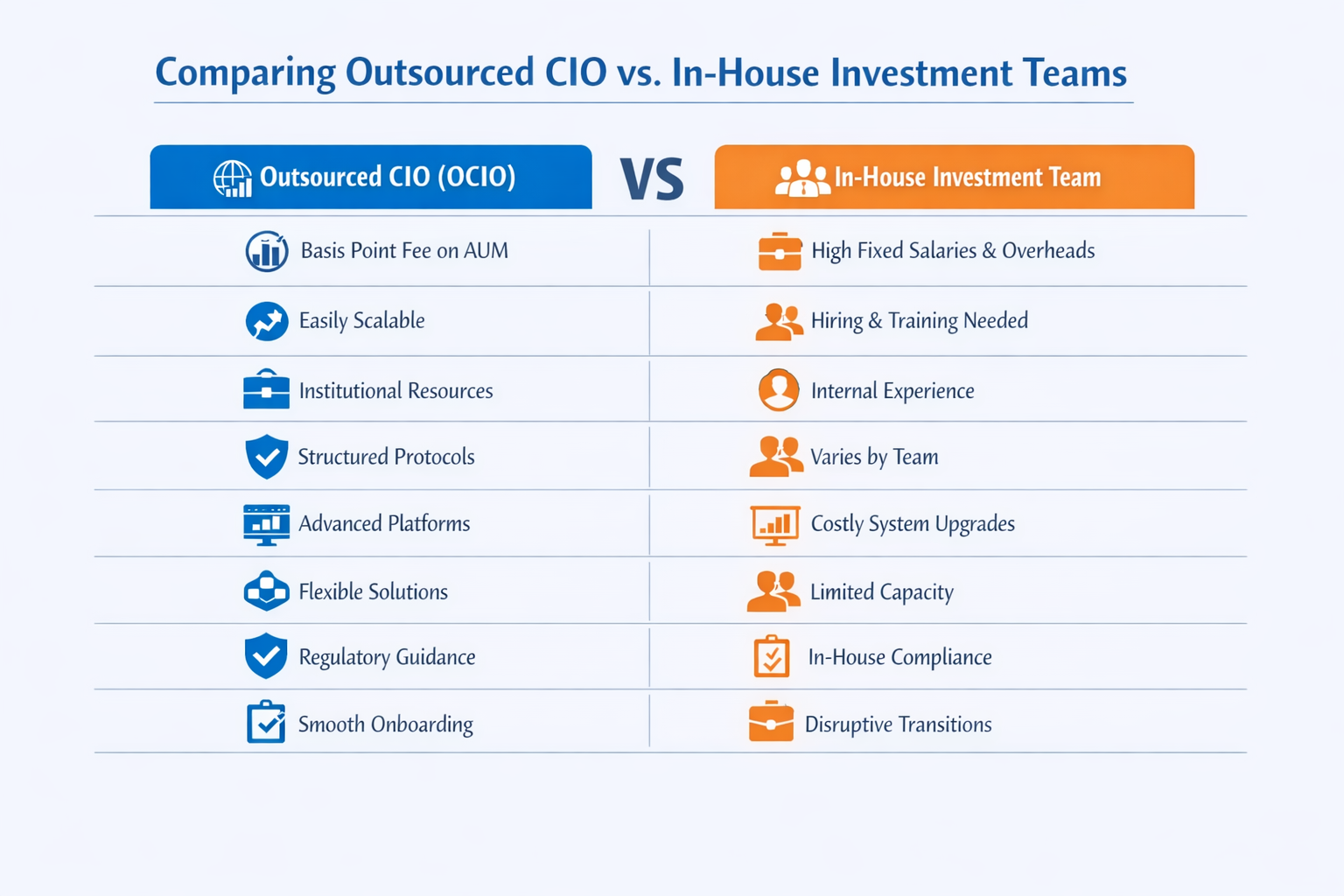
Choosing between outsourced CIO services and building an in-house investment team is a strategic decision that impacts cost, scalability, risk management, and client outcomes. A detailed comparison can help clarify which model best supports your practice’s growth and fiduciary responsibilities.
|
Criteria |
Outsourced CIO Firm (OCIO) |
In-House Investment Team |
|---|---|---|
|
Cost |
Typically, a basis point fee on AUM includes research, oversight, and reporting. |
High fixed costs for salaries, bonuses, technology, and research subscriptions. |
|
Scalability |
Easily scales with AUM growth and new client segments. |
Scaling requires hiring, training, and managing additional staff. |
|
Investment Expertise |
Access to institutional-grade research, global managers, and proprietary models. |
Dependent on the internal team’s experience and network. |
|
Risk Management |
Formalized, documented risk management and escalation protocols. |
Varies by team discipline and available resources. |
|
Technology |
Integrated platforms for portfolio management, reporting, and compliance. |
Requires ongoing investment in systems and integration. |
|
Customization |
Ability to deliver customized investment solutions and reporting at scale. |
Customization limited by team bandwidth and expertise. |
|
Regulatory Support |
Ongoing regulatory guidance and compliance documentation. |
Requires dedicated compliance staff and ongoing training. |
|
Transition/Onboarding |
Structured onboarding process with minimal disruption. |
Internal transitions can be slow and disruptive. |
|
Long-Term Value |
Focused on partnership, scalability, and measurable outcomes. |
Value depends on team retention and the ability to adapt to change. |
Choosing an outsourced CIO firm is a foundational decision that influences your practice’s growth, client outcomes, and operational efficiency. Advisors who prioritize governance, customization, risk management, and operational fit are best positioned to achieve consistent results and strengthen their firm’s reputation.
A disciplined selection process, supported by transparent evaluation and ongoing partnership, creates the conditions for long-term success in a competitive advisory landscape.
A disciplined OCIO selection process is the foundation for sustainable success. Helios delivers quantitative research, portfolio oversight, compliance support, and technology integration designed to help advisors achieve their investment goals and scale with confidence. Book a call to see how Helios can help you build a partnership that drives measurable value and protects your reputation.
An outsourced CIO firm is a third-party provider that assumes responsibility for investment management, portfolio oversight, and risk management for advisory practices, endowments, foundations, and other institutional investors. These firms offer a range of investment solutions, from model portfolios to fully customized investment strategies, and often provide additional services such as compliance support, reporting, and client communication materials.
OCIO fees are typically based on a percentage of assets under management (AUM), with rates varying by portfolio size, service scope, and customization level. For portfolios between $51 million and $100 million, advisory fees often range from 0.21% to 0.30% of AUM. Some providers may charge additional fees for specialized services or performance-based incentives. It’s important to request a full fee breakdown and understand what is included.
Outsourcing investment management allows advisors to access institutional-grade research, risk management, and portfolio construction without the cost and complexity of building an internal team. Benefits include improved governance, better risk control, access to a broader range of asset classes, and the ability to focus on client relationships and growth.
OCIOs manage risk through formal monitoring cadences, predefined escalation triggers, and comprehensive documentation standards. Advisors should expect regular risk reports, transparent escalation protocols, and audit-ready compliance logs. The best OCIOs provide scenario analysis, stress testing, and enterprise risk management as part of their service.
Advisors should prioritize firm structure, governance, customization, risk management, service model, technology, and fee transparency. The right partner will have a documented process, dedicated team, and technology that fits your workflow.
Transitioning to an OCIO involves a structured onboarding process, including data migration, system integration, and operational readiness checks. Advisors should request a detailed transition plan, timelines, and references from recent onboardings to ensure a smooth and disruption-free experience.

Unlocking alpha-oriented growth, without the proper tools and services, can be difficult, time-consuming, and expensive. That’s why Helios developed...

If you're an advisor, you've seen the surge. Outsourced CIO services used to be niche. Now they’re everywhere, and everyone claims to offer the same...

Is your firm still built to manage investments internally, or are you starting to feel the cracks?