Outsourced CIO: The Hidden Cost of Being the Smartest Investor in the Room
Learn how an outsourced chief investment officer provides investment expertise, OCIO governance, and investment management to help organizations...
.png?width=258&height=145&name=Helios%20Web%20Images%20800x450%20(9).png)
How Advisors Can Use Market Commentary to Strengthen Client Relationships — Not Overwhelm Them
10 min read

Leadership transitions in multi-partner firms often reveal weaknesses in investment oversight, capital allocation, and risk controls. About half of leadership transitions fail within the first 18 months, often due to weak succession planning and insufficient leadership readiness. Most firms underestimate the operational complexity and financial risk that surface when decision rights are unclear, or processes are undocumented.
OCIO investment management provides a framework for institutional discipline, capital efficiency, and risk mitigation.
This guide covers:
P.S. For multi-partner firms preparing for succession or seeking to institutionalize investment governance, Helios delivers OCIO investment management solutions designed for strategic readiness, risk control, and operational continuity. Our approach integrates quantitative research, advanced oversight, and white-labeled support to help your firm transition leadership without disruption. If your organization is evaluating the next step in investment management, book a strategic conversation to explore how Helios can tailor an OCIO framework to your objectives.
| Area | Actionable Takeaway |
|---|---|
| Succession Risk | Identify governance gaps and document decision rights before leadership transitions to prevent operational disruption. |
| Governance Structure | Define who proposes, approves, and implements model changes; log all decisions for audit-ready oversight. |
| Delegation & Oversight | Establish clear delegation protocols, oversight cadence, and escalation paths to maintain accountability. |
| Customization | Tailor OCIO strategies to firm objectives, asset classes, and regulatory needs for maximum alignment. |
| Cost/Benefit | Compare in-house vs. OCIO costs, including hidden and opportunity costs, to clarify value and ROI. |
| Capital Optimization | Use OCIO to improve liquidity, cash flow, and capital deployment for long-term objectives and resilience. |
| Risk Mitigation | Leverage OCIO’s quantitative risk management and compliance systems to reduce fiduciary and operational risk. |
| Stakeholder Impact | Map how OCIO adoption affects partners, committees, finance teams, and clients to ensure buy-in and clarity. |
| Readiness Assessment | Use a strategic checklist to confirm your firm’s readiness for governance, delegation, and integration before the transition. |
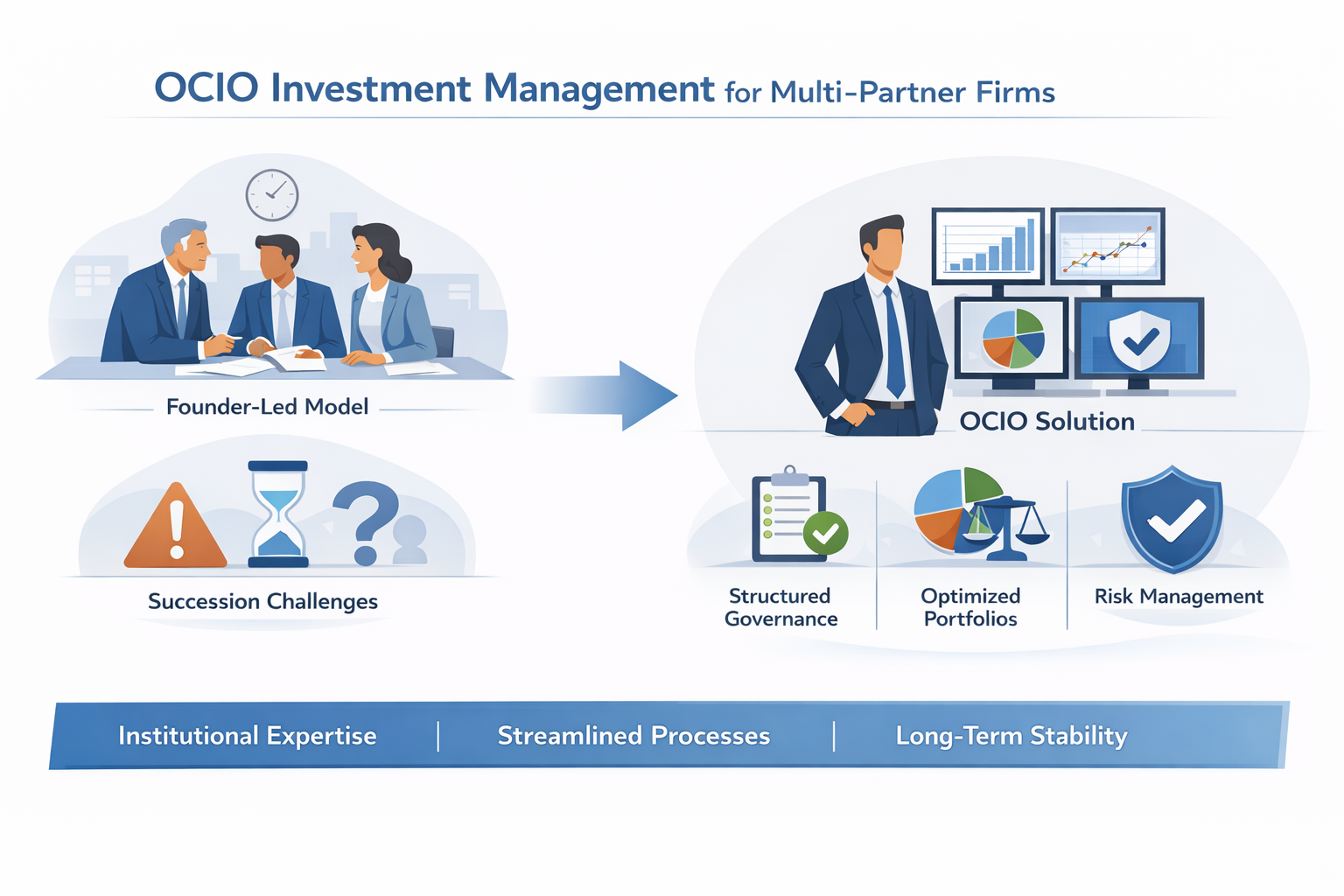
Every multi-partner firm faces a tipping point where investment complexity, succession risk, and operational demands outpace the capacity of founder-led or committee-driven models.
OCIO investment management institutionalizes governance, clarifies decision rights, and optimizes capital for long-term resilience. This section details the mechanics, controls, and outcomes that define a succession-ready OCIO model for multi-partner organizations.
OCIO investment management refers to the full or partial outsourcing of an organization’s investment function to a third-party provider with institutional expertise. For multi-partner firms, this model replaces fragmented, in-house investment expertise or ad hoc committees with a disciplined, quantitative process.
The outsourced chief investment officer (OCIO) assumes responsibility for strategic asset allocation, investment manager selection, risk management, and ongoing oversight, freeing partners to focus on core business activities and strategic leadership.
The OCIO model is especially relevant for succession, as it ensures continuity, reduces key-person risk, and makes investment decisions regardless of leadership changes.
A robust governance framework is the backbone of any successful OCIO engagement. The table below compares traditional and OCIO models across key governance areas, highlighting how OCIO investment management reduces succession risk and enforces accountability.
| Governance Area | Traditional Model | OCIO Model | Succession Risk | OCIO Control Mechanism |
|---|---|---|---|---|
| Model Change Approval | Committee or founder-driven | Defined delegation to OCIO, with board input | High (key-person dependency) | Documented approval matrix, quarterly review |
| Manager Selection | In-house research, slow cadence | OCIO-led, data-driven, rapid response | Moderate (delayed action) | Pre-set criteria, transparent reporting |
| Documentation | Inconsistent, manual | Automated, audit-ready, centralized | High (loss of records) | Digital logs, compliance integration |
| Oversight Cadence | Irregular, meeting-dependent | Scheduled, systematic, real-time | High (gaps during transition) | Automated alerts, regular reporting |
| Fiduciary Accountability | Diffuse, unclear | Centralized, contractually defined | High (regulatory exposure) | OCIO contract, fiduciary reporting |
Read Next: How the Outsourced Chief Investment Officer Model Evolved
Delegation and oversight are the linchpins of a successful OCIO transition. Multi-partner firms must clarify who holds authority, how oversight is maintained, and how boards or committees retain strategic input without operational burden.
Delegating investment authority to an OCIO requires a formal process that documents who can initiate, approve, and implement changes. This process should be codified in governance charters and reviewed at least annually. Clear delegation reduces ambiguity, prevents bottlenecks, and ensures that investment strategies align with the firm’s objectives even as leadership evolves.
Oversight in an OCIO model is structured around regular, scheduled reviews—often quarterly—where performance, risk, and compliance are assessed. Escalation protocols must be defined for exceptions or breaches, ensuring that issues are addressed promptly and transparently. This cadence prevents oversight gaps during transitions and supports informed decision-making.
Boards and investment committees retain a critical role in setting strategic direction, approving policy, and monitoring OCIO performance. However, they are relieved of day-to-day operational tasks. This separation allows committees to focus on high-level governance and long-term objectives, while the OCIO manages execution and reporting.
Audit-ready documentation is a hallmark of institutional investment management. OCIO consultants maintain centralized, digital records of all decisions, changes, and reviews. This not only streamlines compliance but also ensures that the firm can demonstrate fiduciary discipline to regulators, auditors, and stakeholders at any time.
Multi-partner firms require investment solutions that reflect their specific objectives, liquidity needs, and regulatory environment. OCIO services must design portfolios that align with the organization’s mission, risk tolerance, and operational realities. Customization is not limited to asset management; it extends to the selection of investment vehicles, integration of alternative assets, and the ability to adapt to changing governance or compliance requirements.
Multi-partner firms face hidden expenses and opportunity costs when maintaining in-house investment teams, technology, and compliance infrastructure. OCIO models can restructure the firm’s financial and operational profile, reducing key-person risk and supporting scalability.
The table below provides a detailed comparison of in-house and OCIO models, highlighting the financial and operational consequences for succession and long-term growth.
| Cost Area | In-House Model | OCIO Model | Hidden Costs | Opportunity Costs | Succession Impact |
|---|---|---|---|---|---|
| Staff | Salaries, turnover | Flat fee, scalable support | Recruiting, training | Lost partner time | Reduces key-person risk |
| Technology | Purchase, maintenance | Included in the OCIO fee | Upgrades, downtime | Delayed innovation | Ensures continuity |
| Research | Internal, limited | Institutional, broad access | Missed opportunities | Slow manager selection | Maintains research discipline |
| Compliance | Manual, reactive | Automated, integrated | Audit failures, fines | Regulatory distraction | Strengthens audit readiness |
| Transition | Ad hoc, disruptive | Structured, managed | Learning curve, errors | Delayed implementation | Smooths leadership transitions |
Read Next: What It Takes to Run Investments In-House vs Outsourced CIO Cost
An OCIO investment manager delivers measurable improvements in capital efficiency for multi-partner firms. By centralizing cash management, optimizing liquidity, and aligning asset allocation with long-term objectives, OCIO providers help organizations deploy capital more strategically.
This approach reduces idle cash, improves funding for pension plans, endowments, and foundations, and ensures that investment vehicles are selected for both performance and risk control.
In volatile markets, OCIO services can rebalance portfolios quickly, preserving capital and capturing opportunities that in-house teams may miss due to bandwidth constraints. The result is a more resilient financial structure that supports both day-to-day operations and generational transitions.
Fiduciary and regulatory risk intensify during leadership transitions. OCIO investment management reduces these risks by embedding quantitative oversight, automated documentation, and compliance protocols into the investment process.
Providers assume contractual fiduciary responsibility, ensuring that all actions are documented, reviewed, and aligned with best practices. This structure not only protects the firm from regulatory penalties but also reassures stakeholders that investment decisions remain disciplined and defensible, regardless of who sits at the leadership table.
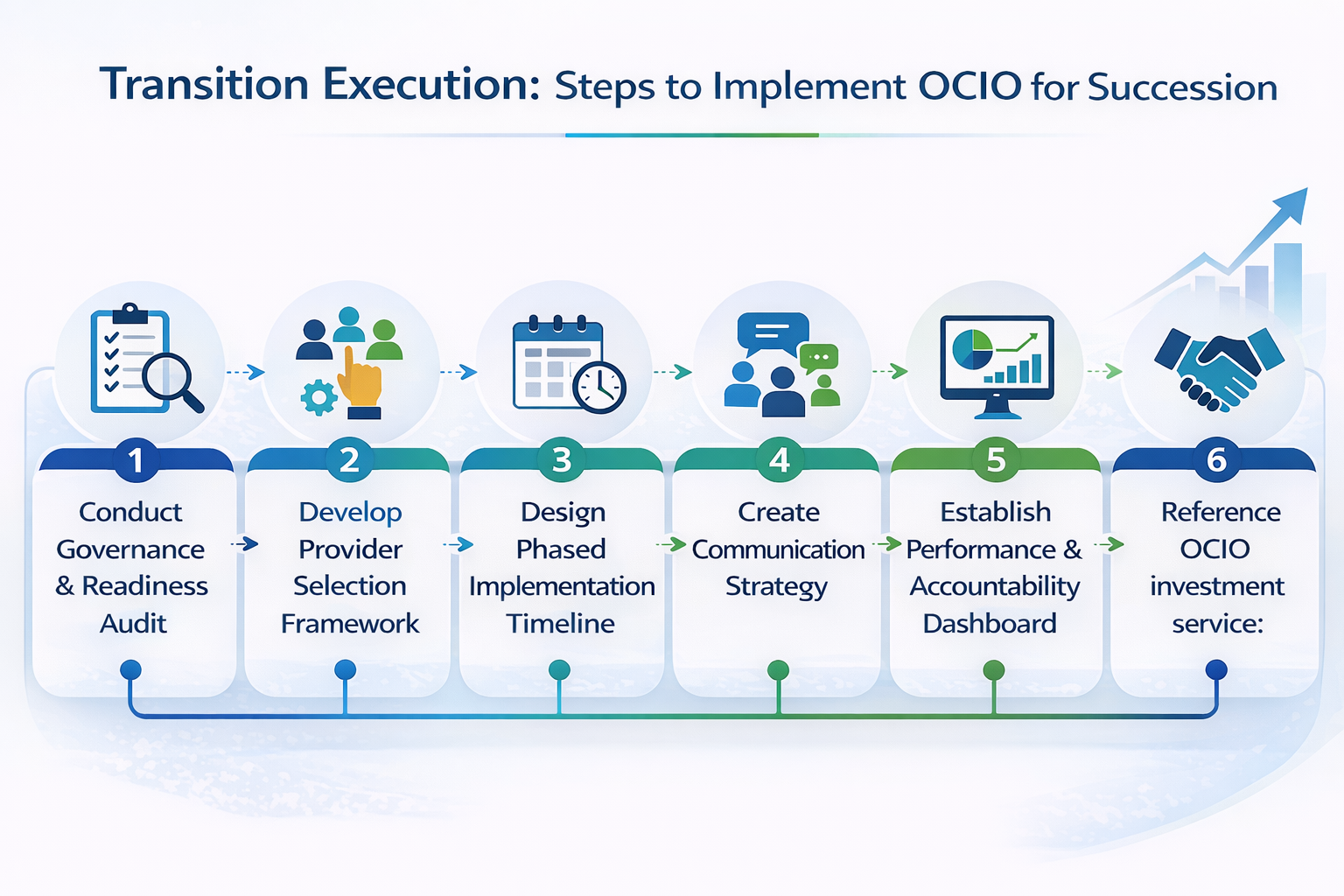
Transitioning to an OCIO model requires a structured, multi-phase approach. Each step must clarify ownership, maintain accountability, and address the concerns of all stakeholders. The following actions provide a framework for executing a successful OCIO transition in a multi-partner firm.
For firms ready to evaluate or implement this transition, explore OCIO investment management to see how Helios can tailor a solution to your objectives.
Successful OCIO adoption depends on seamless integration with existing staff and committees. Clear communication protocols, defined roles, and regular joint reviews ensure that in-house teams remain engaged and informed.
The OCIO should complement—not replace—internal expertise, providing institutional resources and analytics while respecting the firm’s culture and legacy knowledge. This collaborative approach accelerates adoption, builds trust, and maximizes the value of both internal and external investment capabilities.
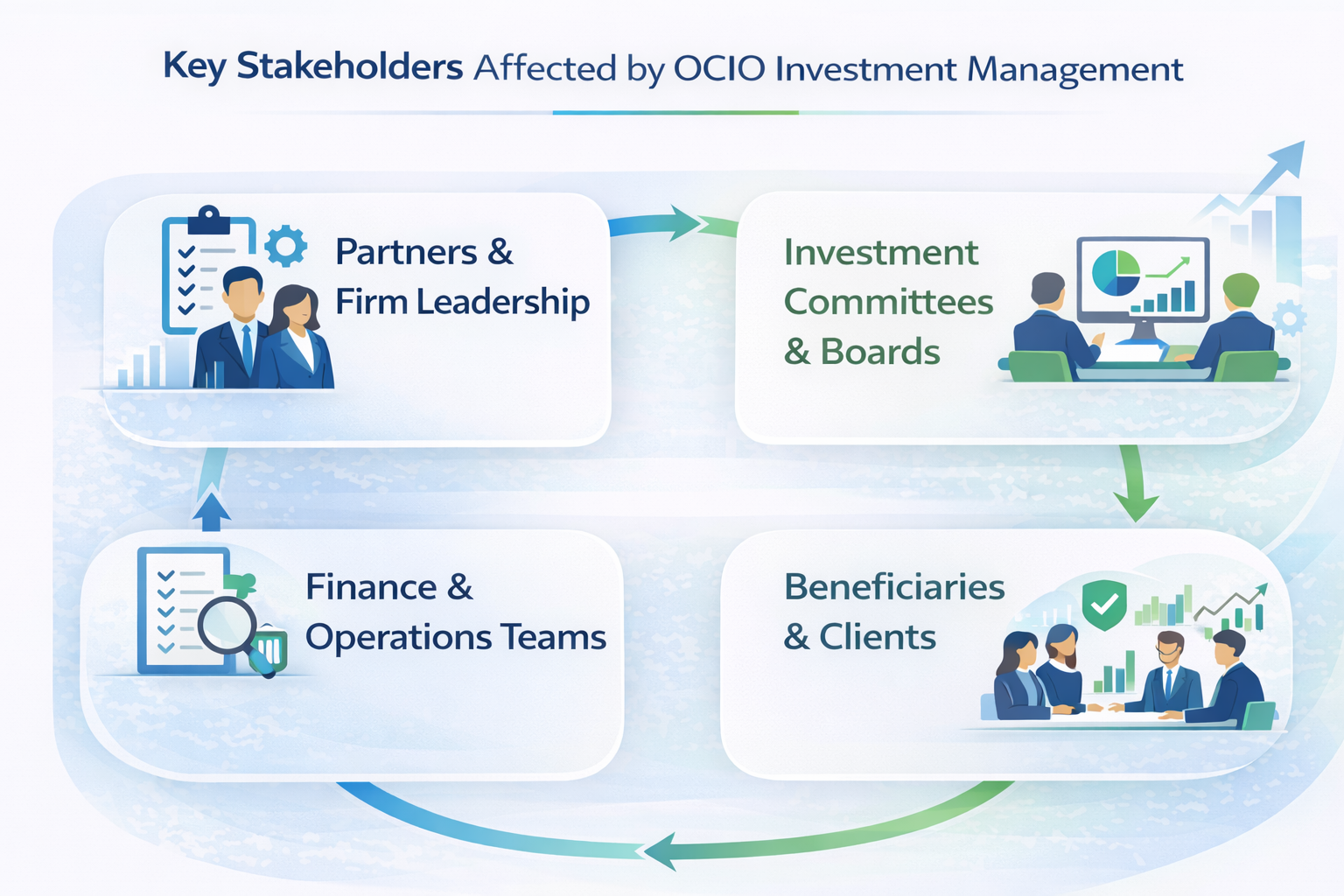
OCIO investment management introduces a new operating model that reshapes how authority, accountability, and information flow through a multi-partner firm. Each stakeholder group faces new responsibilities and opportunities, and the firm’s ability to communicate these shifts will determine whether the OCIO model delivers on its promise of continuity and risk reduction.
Understanding these changes is essential for anticipating resistance, clarifying expectations, and ensuring that the benefits of institutional discipline are realized across the organization.
For partners and firm leaders, OCIO adoption marks a shift from informal, personality-driven decision-making to a documented, process-oriented structure. This change reduces the risk of key-person dependency and ensures that investment oversight does not stall during leadership transitions or absences.
Partners gain the ability to focus on strategic growth and client relationships, knowing that investment decisions are governed by clear protocols and external accountability. However, this transition also requires leaders to relinquish some direct control, which can be uncomfortable if not supported by transparent reporting and regular review.
Rather than managing day-to-day investment tasks or reacting to market events, these groups set policy, approve strategic changes, and monitor the OCIO’s adherence to the firm’s objectives. This shift allows committees to operate at a higher level, focusing on risk oversight and long-term planning rather than operational details.
The risk, if not managed, is that committees may feel disconnected from the investment process or uncertain about how to evaluate the OCIO’s performance. To address this, firms must establish clear reporting standards and regular review cycles, ensuring that governance remains active and informed.
Finance and operations teams move from manual investment administration to a role centered on process management, data validation, and compliance monitoring. The OCIO model reduces the burden of routine tasks such as trade execution, reconciliation, and ad hoc reporting, freeing staff to focus on higher-value activities.
This transition can improve job satisfaction and reduce turnover, but it also requires new skills in data analysis and vendor management.
If training and documentation are neglected, operational gaps or errors may emerge, undermining the efficiency gains promised by the OCIO model. Ongoing education and clear escalation protocols are essential to maintain operational integrity.
Beneficiaries and clients are the ultimate recipients of the changes brought by OCIO investment management. They benefit from more consistent performance, improved transparency, and faster responses to market volatility. Regular, data-driven reporting replaces sporadic updates, and the firm’s ability to explain investment decisions is strengthened by institutional documentation.
However, the transition may initially raise questions about continuity, accountability, or the rationale for outsourcing. Proactive communication and education are critical to maintaining trust and demonstrating that the new model is designed to protect client interests and support the achievement of long-term objectives.
OCIO adoption is based on the experience of institutional investors and regulatory requirements. Multi-partner firms that follow these protocols achieve greater continuity, risk control, and operational efficiency. The following recommendations are designed to support a disciplined and successful transition to OCIO investment management.
Read Next: The Strategic Advantage of Outsourced Investment Committees
Institutional investment management is a structural necessity for succession, growth, and resilience for succession. OCIO models deliver the governance, risk control, and capital efficiency required to navigate leadership transitions without disruption. By clarifying decision rights, optimizing operational costs, and embedding fiduciary discipline, firms can unlock new capacity for growth and client service.
A disciplined OCIO framework transforms investment management from a constraint into a growth lever. To explore how Helios can help your firm institutionalize governance and prepare for succession, book a strategic conversation today.
OCIO investment management is the outsourcing of an organization’s investment function to a third-party provider with institutional expertise. The OCIO assumes responsibility for asset allocation, manager selection, risk management, and ongoing oversight, enabling firms to focus on core business activities and strategic leadership.
OCIO models institutionalize governance, clarify decision rights, and ensure continuity of investment oversight during leadership transitions. By reducing key-person risk and embedding quantitative processes, OCIOs help firms maintain performance and compliance through succession events.
OCIOs provide structured delegation, audit-ready documentation, and regular oversight, reducing ambiguity and ensuring that investment decisions are disciplined, transparent, and defensible to regulators and stakeholders.
OCIO models typically offer cost savings by eliminating the need for in-house investment staff, technology, and research infrastructure. They also reduce hidden and opportunity costs associated with turnover, compliance failures, and delayed decision-making.
OCIO investment management reduces fiduciary, operational, and succession risks by embedding quantitative oversight, automated compliance, and contractual accountability into the investment process.
Firms should evaluate OCIO providers based on institutional expertise, customization capabilities, transparency, and track record with similar organizations. Due diligence, reference checks, and alignment with firm objectives are essential for a successful partnership.

Learn how an outsourced chief investment officer provides investment expertise, OCIO governance, and investment management to help organizations...

Explore how an outsourced chief investment officer (OCIO) can help your firm optimize strategic investment decisions, improve allocation, streamline...

Discover why investment process documentation helps RIAs strengthen governance, improve oversight, reduce risk, and scale more effectively.