Investment Process Documentation: The Missing Link Between Performance and Governance
Discover why investment process documentation helps RIAs strengthen governance, improve oversight, reduce risk, and scale more effectively.
.png?width=258&height=145&name=Helios%20Web%20Images%20800x450%20(9).png)
How Advisors Can Use Market Commentary to Strengthen Client Relationships — Not Overwhelm Them
13 min read

Most founder-led RIAs don’t realize they’re waiting too long to partner with an outsourced CIO until the warning signs are impossible to ignore.
According to the SEC, deficiencies related to the Investment Advisers Act Compliance Rule have been among the most common issues cited in examinations of advisers. By the time operational strain or compliance risk becomes visible, the cost of delay is already compounding—lost growth, mounting risk, and founder burnout.
The real threat isn’t just operational, but the silent erosion of governance and capacity that can take years to repair, especially for firms responsible for sophisticated institutional portfolios and client mandates.
This guide covers:
P.S. Helios partners with founder-led RIAs to institutionalize investment governance before growth stalls or risk compounds. Our insourced CIO model delivers quantitative research, portfolio oversight, compliance documentation, and white-labeled support. Contact us to make the transition to OCIO, freeing founders to lead, not just manage.
| Area | Actionable Takeaway |
|---|---|
| Founder Psychology | Audit your own decision-making: If you’re still the bottleneck for asset allocation or manager selection, document every hour spent and compare it to your highest-value activities. Shift from execution to oversight before burnout sets in. |
| Cultural/Team Dynamics | Map team roles and internal resistance: Hold a meeting to clarify how an outsourced chief investment officer can support, not replace, your team’s value. Address loyalty and job security concerns directly to prevent hidden resistance. |
| Operational Bottlenecks | Track rebalancing delays, compliance gaps, and founder workload: Set a threshold (e.g., two missed rebalancing cycles or 10+ hours/week on investment admin) as an objective trigger for change. |
| Governance Drift | Audit decision rights and documentation: Review the last 12 months of investment decisions. If the rationale or approval is unclear, formalize oversight and record-keeping before ambiguity erodes accountability. |
| Peer/Industry Influence | Benchmark against best practices, not peers: If you’re waiting for others to act, set your own governance review cadence and use industry standards as your guide. |
| Persistent Myths | List and debunk OCIO myths in your next leadership meeting: Assign a team member to research and present how modern OCIOs handle customization, cost, and brand alignment. |
| Regulatory/Compliance Triggers | Schedule a compliance review before your next audit: Use findings as a proactive governance check, not a crisis response. |
| Financial/ROI Concerns | Build a total cost model: Include founder time, staff hours, and missed growth in your analysis. Use scenario planning to verify OCIO ROI before making a decision. |
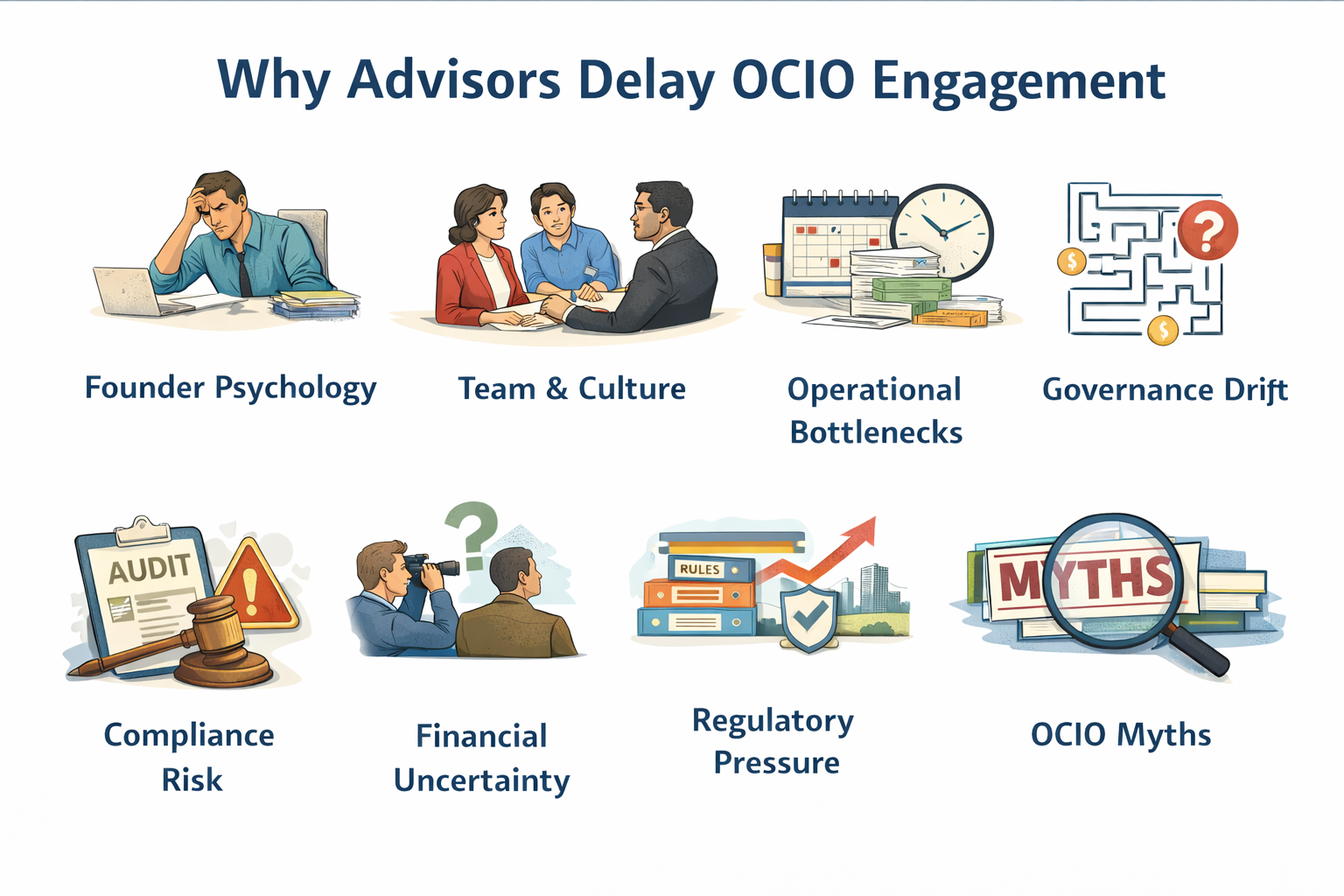
Every founder-led RIA eventually faces a moment when the investment process becomes a source of constraint rather than a lever for growth. Yet, most advisors don’t recognize this inflection point until the warning signs are undeniable—missed opportunities, mounting compliance risk, and a founder who is stretched thin.
The reasons for waiting are rarely about lack of information or technical capability. Instead, they are rooted in deeply held beliefs, cultural inertia, and the invisible costs of maintaining the status quo within a traditional governance model.
To move forward, founders must confront not just the operational realities but the psychological and structural barriers that keep them anchored to outdated models. Only by surfacing these hidden drivers can a firm make a proactive, strategic shift to an outsourced chief investment officer before risk becomes reality.
Founder-led RIAs are often built on the founder’s investment philosophy, personal relationships, and hands-on approach to asset allocation. This identity becomes a double-edged sword as the firm grows.
The founder’s sense of control, pride in proprietary strategies, and belief that “no one knows my clients like I do” create powerful emotional resistance to outsourcing. Even as client numbers and asset complexity grow, founders often double down on direct involvement, rationalizing that hands-on oversight is a value-add in delivering personalized Investment advice.
The risk is subtle but real: as decision fatigue sets in and execution slows, the founder’s bandwidth becomes the bottleneck. The firm’s ability to scale, adapt to market volatility, or respond to regulatory change is limited by one person’s capacity. By the time the need for change is acknowledged, the firm’s growth and resilience have already suffered.
Firm culture and team expectations can reinforce founder reluctance. Internal dynamics, loyalty, and perceived staff displacement often slow the move to an OCIO model. These barriers are rarely discussed openly, but they shape decision-making at every level.
As RIAs grow, the complexity of managing portfolios, compliance, and reporting increases exponentially. What starts as a manageable workload for a founder or small team quickly becomes a web of competing priorities, manual processes, and mounting risk.
These bottlenecks are rarely obvious at first; they build quietly, often rationalized as “just a busy season” or “something we’ll fix next quarter.”
But the cumulative effect is profound: performance drifts, compliance gaps widen, and the founder’s time is consumed by tasks that add little strategic value.
| Operational Area | Early Warning Signs | Typical Rationalizations | What’s Really Happening | Consequences of Delay |
|---|---|---|---|---|
| Research & Due Diligence | Manager reviews skipped, new products not vetted, asset class research delayed | “We’ll get to it after tax season.” | Research backlog grows, new opportunities missed, risk of holding outdated or underperforming funds increases | Portfolios lag benchmarks, clients question value, and regulatory scrutiny if due diligence is not documented |
| Compliance & Documentation | Regulatory filings late, policy updates postponed, audit prep rushed | “We’ve never had an issue before.” | Compliance tasks become reactive, not proactive; documentation is incomplete or inconsistent | Higher audit risk, potential fines, reputational damage, and increased scrutiny from regulators |
| Trading & Rebalancing | Trades delayed, cash not deployed, drift from model allocations | “Markets are volatile, better to wait.” | Tactical decisions replace strategic discipline, rebalancing is inconsistent, and cash drag increases | Performance lags, clients see uneven results, risk profile of portfolios shifts away from stated objectives |
| Oversight & Monitoring | Founder working nights/weekends, no time for strategic planning, investment committee meetings skipped | “It’s just a temporary crunch.” | Oversight becomes fragmented, the founder is the single point of failure, no backup or succession plan | Burnout, missed growth opportunities, key-person risk, inability to scale or sell the business |
| Client Reporting & Communication | Reports delayed, explanations inconsistent, client questions go unanswered | “Clients trust us; they don’t need all the details.” | Communication becomes reactive, not proactive; transparency suffers | Erosion of client trust, increased attrition, and difficulty attracting new business |
Without a formal OCIO structure, governance and decision rights often become diffuse. Founder-led oversight can lead to inconsistent documentation, unclear accountability, and increased risk as AUM grows.
As the firm scales, decisions that were once made in a single office become spread across multiple advisors or committees. Without clear documentation and review cadence, oversight becomes reactive, not proactive.
The decision to engage an outsourced chief investment officer is rarely made in a vacuum. Founder-led RIAs often look to their peers for cues on when and how to evolve their investment process.
This benchmarking instinct is natural—no one wants to be the first to make a move that could be perceived as risky or unnecessary. Yet, this herd mentality can be a trap. When everyone waits for someone else to act, inertia becomes the norm, even as operational strain and risk quietly escalate.
Industry adoption rates can reinforce the illusion that waiting is prudent, but best practices are rarely set by the slowest adopters. The real risk is that by the time a “tipping point” is reached, the firm is reacting to a crisis, not leading with strategy.
Advisors who benchmark against industry standards, rather than peer inertia, are better positioned to make proactive, value-driven decisions that protect their clients and their business.
Misconceptions about OCIOs are among the most persistent barriers to timely adoption. These myths are not just harmless misunderstandings; they actively shape decision-making, stall progress, and keep firms locked into inefficient models. Many founders believe that OCIOs are only for large institutions, or that outsourcing means surrendering all investment input and losing the firm’s unique identity.
Others assume that OCIOs are prohibitively expensive or that clients will perceive the move as a sign of weakness. In reality, modern OCIOs offer a spectrum of engagement models, from full delegation to collaborative partnerships, and can be tailored to firms of any size. Fees are often offset by time savings, improved outcomes, and reduced risk. White-labeled solutions ensure that the advisor’s brand remains front and center.
By surfacing and directly addressing these myths in leadership meetings, firms can move past fear and make decisions based on facts, not folklore.
Regulatory and compliance pressures are often the catalyst that finally forces a founder-led RIA to consider an OCIO. Yet, waiting for an audit finding or regulatory change to prompt action is a risky and reactive approach.
As the regulatory environment becomes more complex, the burden of documentation, oversight, and reporting grows. Many firms rationalize that “we’ve never had an issue before,” but this mindset ignores the reality that compliance standards are always evolving. When a compliance incident does occur, such as a late filing, incomplete documentation, or a flagged audit, it can trigger a rushed and stressful transition to an OCIO.
This reactive approach is more costly, disruptive, and damaging to morale than a planned, proactive governance review. Firms that schedule regular compliance audits and use findings as a governance check, rather than a crisis response, are better positioned to maintain control and protect their reputation.
Financial uncertainty is a powerful brake on change, especially when the costs and benefits of an OCIO are not fully understood. Many founders focus on explicit fees, overlooking the hidden costs of maintaining the status quo—founder time, staff hours, missed growth, and increased risk.
The decision to outsource is often framed as a binary choice: pay an OCIO or save by doing it in-house. In reality, the true cost of in-house investment management is rarely tracked or analyzed. Scenario planning, which includes opportunity cost and risk-adjusted outcomes, provides a more accurate picture of ROI.
Firms that build a total cost model, including founder time, staff hours, and missed growth, are able to make data-driven decisions that align with their long-term goals. Transparent performance reporting and regular review cadence ensure that the OCIO relationship delivers measurable value over time.
Read Next:
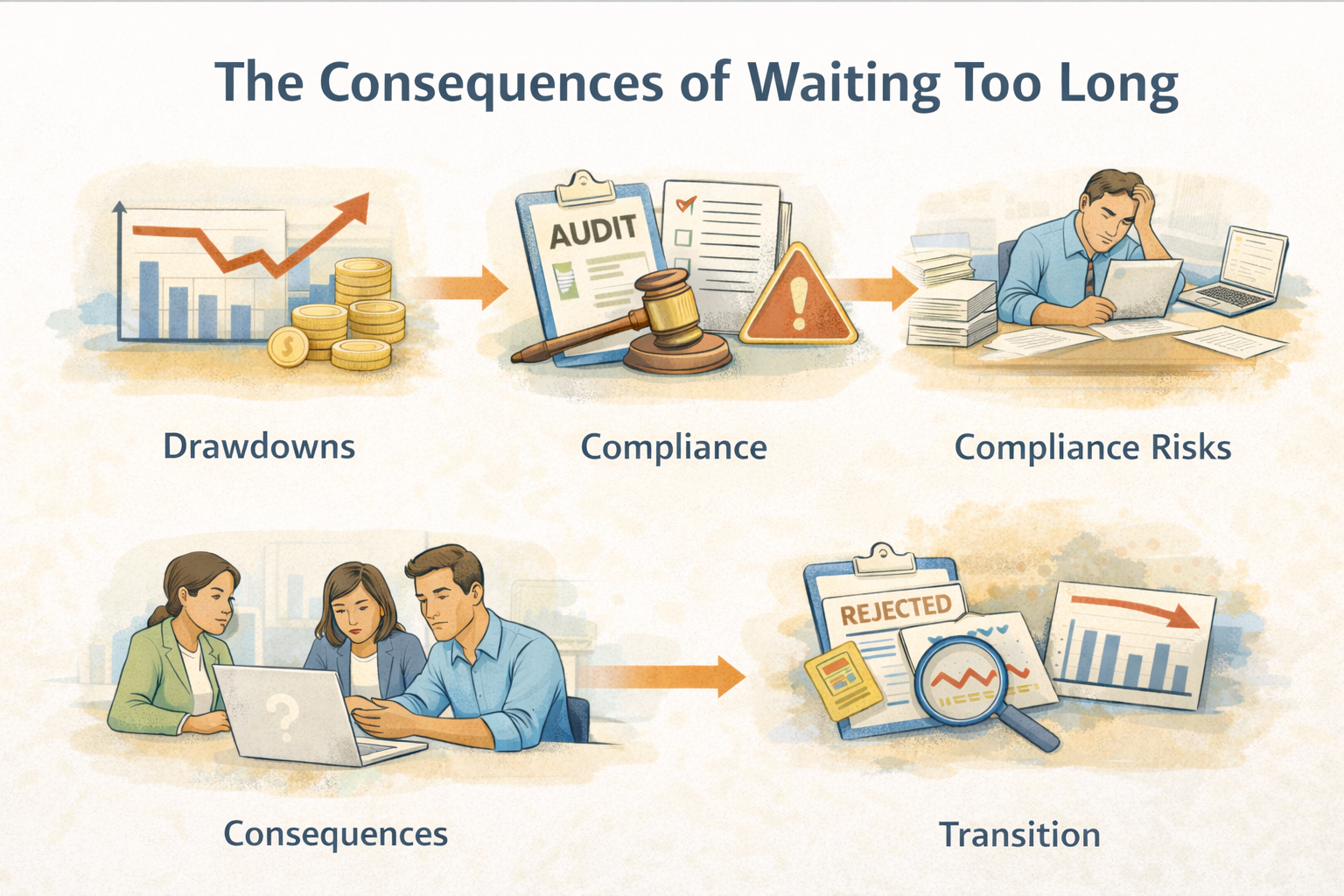
Delaying OCIO engagement is a decision with compounding consequences that can quietly undermine a firm’s growth, resilience, and reputation. When operational bottlenecks are ignored, performance begins to drift from stated objectives.
Portfolios become more vulnerable to drawdowns and drift because rebalancing is inconsistent, tactical decisions replace strategic discipline, and risk exposures are not systematically monitored.
Compliance gaps widen as documentation falls behind, increasing the likelihood of audit findings and regulatory penalties. The founder’s time is consumed by administrative tasks, leaving little room for strategic leadership or client development.
Additionally, clients may notice missed opportunities, delayed responses, or inconsistent reporting, eroding trust and increasing attrition. By the time a transition is forced—often by a compliance incident or market shock—the process is reactive, rushed, and more disruptive than a planned, proactive change.
The firm’s investment model, once a source of differentiation, becomes a drag on its long-term strategy and enterprise value.
Read next: Investment Management Outsourcing: When It Becomes a Strategic Advantage
The most successful transitions happen before risk or complexity becomes unmanageable, not after a crisis has forced the issue. Inflection points are subtle signals that, if ignored, can lead to compounding problems.
These include rapid AUM growth that outpaces governance, repeated compliance incidents, missed rebalancing cycles, founder burnout, and rising client complaints. Each signal is a prompt to review governance, assess operational capacity, and consider whether the current model is fit for scale.
| Inflection Point | What to Watch For | How to Verify | What to Do Next |
|---|---|---|---|
| AUM Threshold | Rapid asset growth, new client segments, or the acquisition of another practice | Compare the current oversight structure to the new scale; review whether existing processes can handle increased volume and complexity | Conduct a governance audit; consider OCIO engagement to institutionalize oversight before growth exposes gaps |
| Compliance Incidents | Audit findings, delayed documentation, or repeated regulatory reminders | Track frequency and severity of compliance issues over the past 12–24 months; review audit logs and regulatory correspondence | Schedule a formal compliance review; use findings to inform governance improvements or OCIO evaluation |
| Missed Rebalancing | Inconsistent execution, performance drift, or unexplained cash balances | Review trade logs, performance attribution, and model drift reports; compare actual allocations to policy targets | Assess operational capacity; if rebalancing is repeatedly delayed, evaluate OCIO support for execution discipline |
| Founder Burnout | Long hours, decision fatigue, or inability to delegate investment tasks | Track founder time spent on investment admin, nights/weekends worked, and frequency of missed strategic meetings | Delegate routine tasks; explore OCIO options to free founder capacity for leadership and growth |
| Client Complaints | Service delays, communication gaps, or questions about portfolio changes | Monitor client feedback, retention rates, and frequency of performance-related inquiries | Evaluate process gaps; consider OCIO engagement to improve reporting, communication, and client experience |
Transitioning to an OCIO model is a structured process that requires careful planning, clear communication, and disciplined execution. The stakes are high: a well-managed transition can unlock growth, reduce risk, and strengthen client relationships, while a rushed or poorly communicated change can create confusion and erode trust.
Founders must approach the transition as a strategic initiative, not a tactical fix. This means mapping current governance, selecting the right OCIO partner, aligning team and client messaging, and setting clear milestones for implementation and review.
Each step requires buy-in from leadership, transparency with staff, and a commitment to ongoing oversight.
A successful OCIO transition begins with a thorough mapping of current governance structures, decision rights, and oversight processes. This step is often overlooked, but it is essential for preventing confusion and ensuring accountability during and after the transition.
Founders should document who currently approves model changes, manager selection, and risk reviews; how decisions are recorded; and what the review cadence is for each process. This mapping exercise surfaces gaps, clarifies roles, and provides a baseline for evaluating OCIO proposals. It also helps identify areas where the firm wants to retain authority versus delegate execution.
By formalizing governance before engaging an OCIO, the firm sets clear expectations and reduces the risk of misalignment or loss of control.
Selecting the right OCIO partner is a critical decision that shapes the firm’s investment process for years to come. Founders should evaluate providers based on track record, customization capabilities, integration with existing workflows, and transparency in reporting and fees.
Due diligence should include scenario analysis—how the OCIO has handled market shocks, firm transitions, or rapid growth for other clients. References from similar-sized RIAs can provide insight into the provider’s flexibility and responsiveness.
It is also important to clarify how the OCIO will support, not replace, the firm’s brand and client experience. A robust selection process ensures that the OCIO relationship is a true partnership, not a one-size-fits-all solution.
Clear, proactive communication is the linchpin of a successful OCIO transition. Founders must align internal teams and client messaging early in the process, addressing concerns about job security, changes in workflow, and the rationale for outsourcing.
Regular team meetings, transparent discussions about the transition timeline, and opportunities for staff input build buy-in and reduce resistance.
For clients, communication should focus on the benefits of the new model—improved oversight, risk management, and reporting—while emphasizing continuity in the advisor relationship. Change management requires ongoing updates, feedback loops, and a willingness to adapt as the transition unfolds.
The transition to OCIO services requires a series of implementation milestones and a commitment to ongoing oversight. Key steps include data migration, portfolio transition, integration of reporting systems, and the first joint investment committee meeting. Each milestone should have a clear owner, deadline, and success metric.
After the initial transition, the firm should establish a regular review cadence with the OCIO, including performance attribution, risk monitoring, and compliance documentation.
Ongoing oversight ensures that the OCIO relationship continues to deliver value, adapts to changing firm needs, and supports long-term growth and resilience.
Read Next:
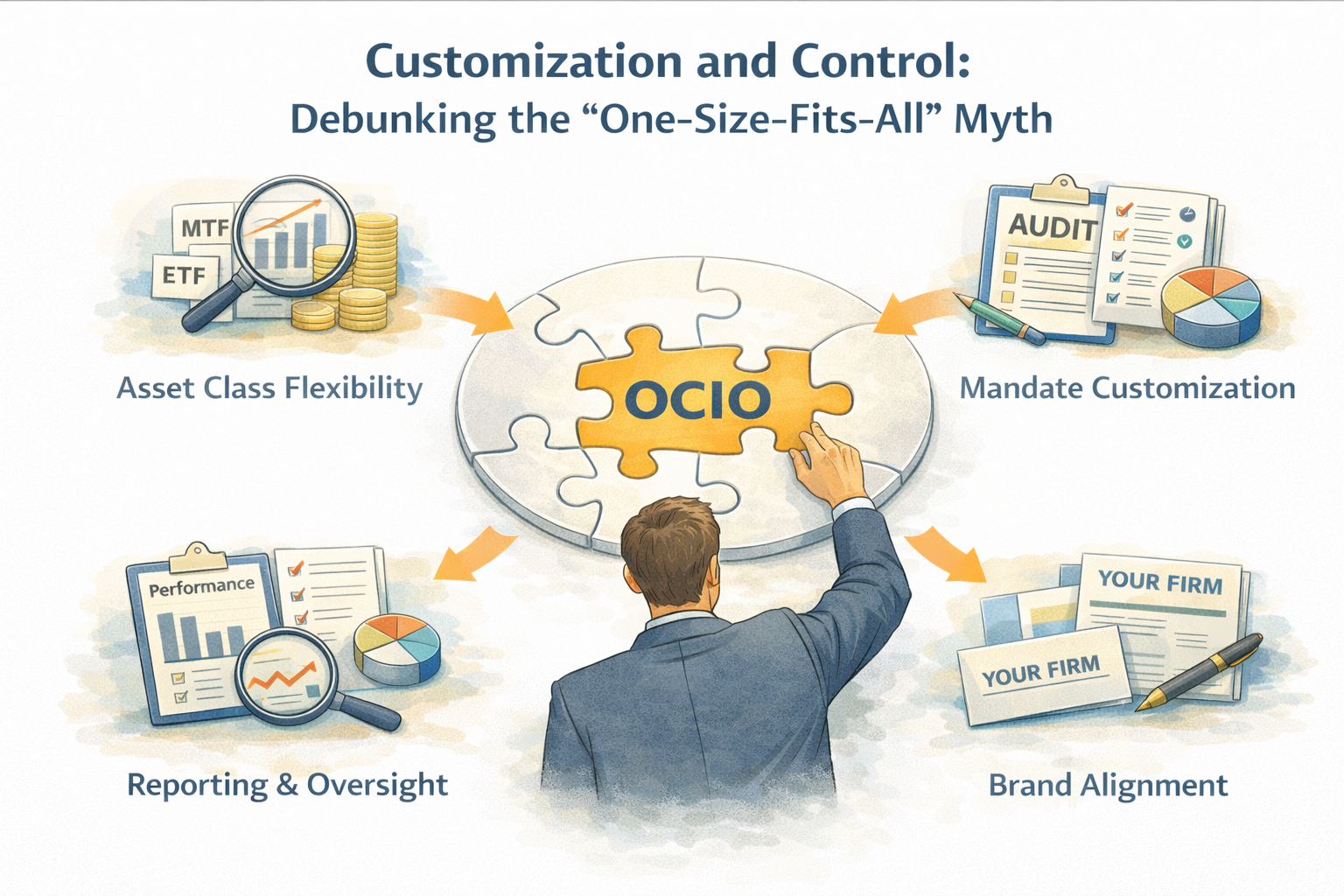
Many founders fear that outsourcing means losing control or accepting generic solutions. In reality, modern OCIOs tailor investment strategies, governance, and reporting to each firm’s needs.
Customization can include asset classes, mandates, and reporting formats. Firms retain authority over strategic decisions, with the OCIO executing within defined parameters. White-labeled solutions ensure the advisor’s brand and client experience remain front and center.
Read Next: What It Takes to Run Investments In-House vs Outsourced CIO Cost
The decision to engage an outsourced chief investment officer is less about giving up control and more about institutionalizing growth, risk management, and governance. Recognizing and addressing the real barriers, before a crisis hits, positions founder-led RIAs to scale with confidence.
A disciplined OCIO transition is a strategic move to unlock capacity, reduce risk, and position the firm for long-term success. Helios partners with RIAs to deliver an institutional-grade investment process, risk management, and white-labeled support. Contact us to make the transition.
An outsourced chief investment officer (OCIO) provides investment management, research, portfolio oversight, asset management, and risk management for advisory firms. The OCIO team operates within mandates set by the firm, executing asset allocation, manager selection, and reporting, while the firm retains strategic oversight.
An RIA should consider an OCIO management when operational complexity, compliance risk, or founder workload outpace internal capacity. Inflection points include rapid AUM growth, audit findings, missed rebalancing, or founder burnout.
No. Most OCIO models retain founder or committee oversight, with the OCIO executing within defined parameters. Firms set strategic direction and retain authority over key decisions.
OCIO fees are often offset by time savings, improved outcomes, and reduced operational risk. When factoring in founder time, staff costs, and missed growth, OCIOs can be cost-effective compared to in-house models.
Delaying OCIO engagement can lead to governance drift, operational bottlenecks, compliance risk, and missed growth opportunities. Reactive transitions are often more disruptive and less effective than proactive planning.
A smooth transition requires clear governance mapping, careful provider selection, proactive communication with the team and clients, and defined implementation milestones. Early planning and accountability are key.

Discover why investment process documentation helps RIAs strengthen governance, improve oversight, reduce risk, and scale more effectively.

Compare OCIO models that outsource investment management and show how an outsourced chief investment officer supports governance model decisions,...

Learn how to choose a white label investment platform that supports scalable portfolio management, governance, branding, and long-term RIA growth.