The Complete Guide to White Label Investment Platforms for RIAs
Learn how to choose a white label investment platform that supports scalable portfolio management, governance, branding, and long-term RIA growth.
.png?width=258&height=145&name=Helios%20Web%20Images%20800x450%20(9).png)
How Advisors Can Use Market Commentary to Strengthen Client Relationships — Not Overwhelm Them
10 min read

The right model portfolio approach for an RIA is a core-plus-customization framework: standardized core models for consistency and scale, with structured personalization layers for taxes, cash needs, concentrated positions, restrictions, legacy holdings, and client-specific planning goals.
Pairing institutional-quality model support with the advisor’s own investment philosophy, client relationships, and planning process provides a balanced and sustainable approach. This helps create a disciplined model architecture that supports fiduciary oversight, operational efficiency, and real client-level customization as the firm grows.
Ad HOC portfolios don't scale; RIAs need core models and structured customization layers to address unique needs.
Better models align risk tolerance, asset allocation, and tax management while simplifying portfolio management and rebalancing.
Institutional-quality investment processes don't require hiring a full-time chief investment officer; outsourced CIO solutions deliver this capability.
Third-party and OCIO solutions streamline investment management while advisors retain control of client relationships and investment philosophy.
AI-powered and quantitative tools effectively standardize decisions, document processes, and support fiduciary oversight for registered investment advisors.
Strong model adoption processes free advisors for client service, planning, and business development instead of daily portfolio management.
Most RIAs start with the best intentions: build custom portfolios for every client to show personalization and care. Over time, as the firm grows from 30 households to 150, that approach becomes a liability. Financial advisors layer partial models on top of legacy portfolios, adopt some third-party investment solutions for certain clients, and keep a few fully custom accounts for high-net-worth clients with concentrated stock or unique investment preferences.
The result is a fragmented book of business where portfolio management becomes inconsistent, operational efficiency suffers, and fiduciary documentation falls behind. Growth stalls because the investment management infrastructure cannot support more clients without adding more staff or overwhelming the back office.
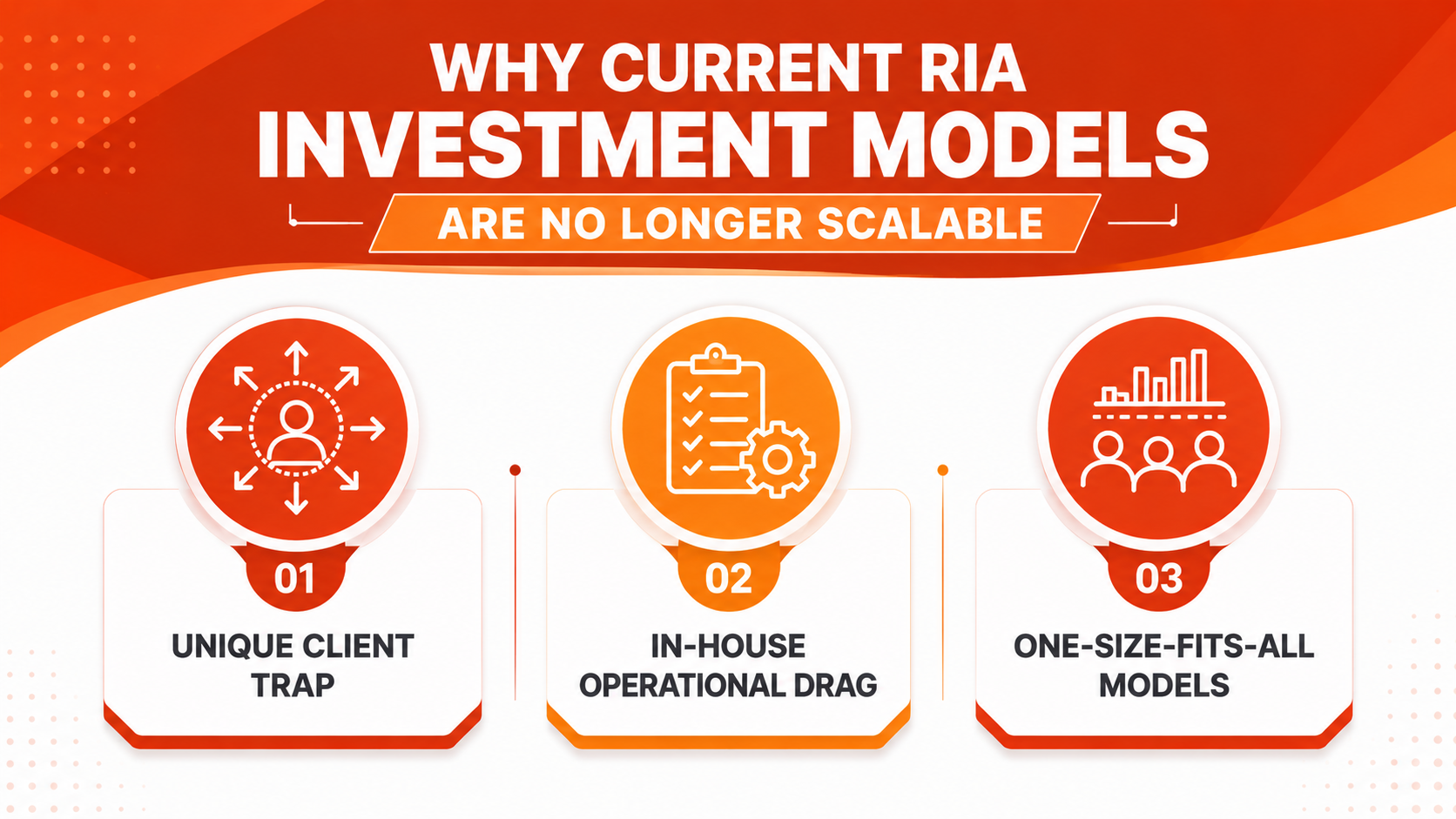
The belief that every client deserves a completely unique portfolio sounds client-centric, but in practice, it creates operational chaos and hidden risk.
Customization Overload: Customizing every portfolio from scratch consumes advisor time and overwhelms the back office with rebalancing, tax management, and performance reporting across dozens or hundreds of unique allocations.
Inconsistent Risk Alignment: Risk tolerance and asset allocation become inconsistent across a fragmented book of business, making it harder to explain why two "moderate" clients hold completely different portfolios.
Undocumented Decision-Making: Portfolio management decisions live in advisors' heads, increasing fiduciary and documentation risk when clients ask why their portfolio differs from a neighbor's or when compliance reviews surface inconsistencies.
Many RIAs end up with advisors acting as de facto chief investment officer, trader, and service advisor all at once. They manage daily investment decisions, rebalance schedules, ETF and fixed income changes, and client communication around market volatility.
This triple role reduces time for clients, growth, and strategic work. Advisors spend hours each week researching mutual fund changes, monitoring asset allocation drift, and manually rebalancing accounts when they should be deepening client relationships, bringing in new clients, or executing growth strategies.
The lack of a clear investment management framework means every portfolio decision feels custom, every rebalance feels manual, and every market downturn triggers a flood of one-off client communication instead of a systematic process.
On the other end of the spectrum, some RIAs over-rely on generic third-party investment solutions to escape the operational drag of custom portfolios. They adopt standardized models from custodial platforms like Schwab, or they use third-party money managers who provide model portfolios with little room for customization
The problem is that these one-size-fits-all approaches often create a mismatch between the firm's investment philosophy and what ends up in clients' portfolios. A firm that prides itself on tax management and personalized service may find itself using models that ignore tax-loss harvesting, fail to account for concentrated stock positions, or treat all "moderate growth" clients identically.
This dilutes differentiation among RIA firms using the same model portfolio lineups and makes it harder to explain to high-net-worth clients why the firm's investment model approach is worth the fee-based advisory relationship.
A "better" investment model structure helps RIAs move from ad hoc portfolio management to a repeatable, institutional-quality investment process that supports growth, reduces operational friction, and strengthens fiduciary alignment without losing the ability to customize for client needs.
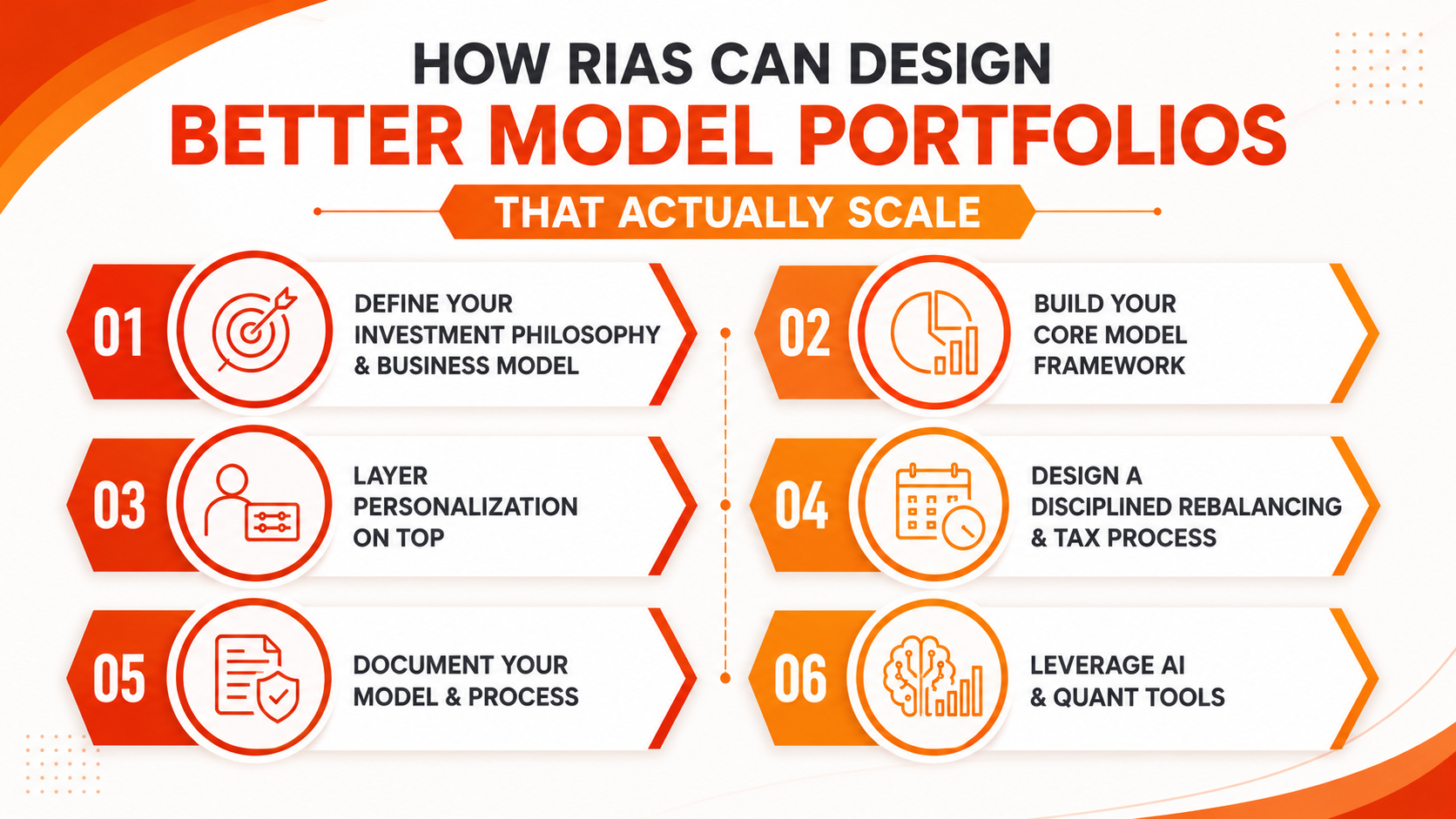
Better investment models for RIAs begin with clarity about the firm's investment philosophy, client segment, and business models. A firm serving mass affluent retirees with straightforward wealth management needs will design models differently from an ensemble RIA managing high-net-worth clients with concentrated stock, business ownership, and complex tax management requirements. Independent advisors running solo practices need simpler, more automated model adoption processes than multi-advisor RIA firms with dedicated investment management staff.
The investment philosophy should drive model design choices: passive indexing versus active management, tactical asset allocation versus strategic buy-and-hold, ESG integration versus traditional diversification.
The business model should determine how many core models the firm can realistically support, how much customization the back office can handle, and whether the firm has the technology infrastructure and staffing to manage portfolios in-house or needs to leverage third-party or outsourced CIO solutions.
Read Next: How the Outsourced Chief Investment Officer Model Evolved
Once the investment philosophy and business model are clear, the next step is to define a set of core models based on risk tolerance, time horizon, and client objectives.
Risk-Based Model Lineup: Define a set of core models based on risk tolerance bands—conservative, moderate, growth, aggressive—with clearly documented asset allocation targets for equities, fixed income, and cash that align with each risk profile.
Diversified, Cost-Effective Vehicles: Use ETFs, mutual funds, and fixed income instruments to build diversified, cost-effective core allocations that support the firm's investment philosophy without requiring constant security selection or manager research.
Documented Investment Management Rules: Ensure each model portfolio has clearly documented asset allocation targets, rebalance triggers, and investment management rules so portfolio decisions are repeatable, explainable, and defensible during client reviews or compliance audits.
The "core plus sleeve" approach is the key to balancing scalability and personalization. RIAs build standardized core models that handle 70-80% of the portfolio, then add customized sleeves for client-specific needs—such as ESG tilts, concentrated stock management, tax-loss harvesting, or unique investment preferences—without building portfolios from scratch again.
A high-net-worth client with a large position in a single stock can use the firm's "growth" core model for the diversified portion of the portfolio, plus a custom sleeve that manages the concentrated position with tax management and gradual diversification over time. A client with strong ESG preferences can use the same core model as other "moderate" clients, but with an ESG-focused equity sleeve layered on top.
This approach preserves operational efficiency because the core models are standardized, rebalanced systematically, and managed at scale, while the customization layers address unique investment needs without creating dozens of completely unique portfolios.
Better investment models for RIAs require a disciplined rebalancing and tax management process that is documented, systematic, and integrated into the firm's technology infrastructure.
Explicit Rebalance Triggers: Set explicit rebalancing triggers based on drift thresholds (e.g., 5% deviation from target asset allocation), calendar schedules (quarterly or semi-annual), or cash flow events (contributions, withdrawals, required minimum distributions).
Tax-Aware Rebalancing: Integrate tax-aware rebalancing and tax management into model rules, especially for taxable accounts, by prioritizing tax-loss harvesting, avoiding short-term capital gains, and coordinating rebalancing with client tax planning.
Technology-Enabled Execution: Leverage technology infrastructure and rebalancing tools to streamline execution and documentation across your book of business, reducing manual work and ensuring consistent application of the firm's investment management process.
Clearly documenting model portfolios, risk profiles, and investment approaches supports fiduciary duty, audit readiness, and client communication around investment philosophy and process. RIAs should maintain written investment policy statements or model documentation that explains the rationale for each model portfolio, the asset allocation targets, the rebalance process, and how the firm evaluates and selects ETFs, mutual funds, and fixed income holdings.
This documentation serves multiple purposes: it helps advisors explain portfolio decisions to clients in a consistent way, it supports the firm's fiduciary duty to act in clients' best interests, and it provides a clear audit trail for compliance reviews.
When clients ask why their portfolio performed differently from a friend's, or why the firm rebalanced during a market downturn, the documented process provides the answer. When regulators review the firm's investment management practices, the documentation demonstrates that the RIA has a repeatable, risk-aware, and client-centered approach.
AI-powered and quantitative tools are increasingly accessible to RIAs and can strengthen model portfolios without requiring deep technical expertise or large investment management teams.
Quantitative Research for Security Selection: Use quantitative research to support ETF, mutual fund, and asset allocation decisions inside your models, relying on data-driven analysis of risk, return, correlation, and cost rather than subjective manager selection.
AI-Powered Risk Monitoring: Employ AI-powered analytics to monitor risk, performance dispersion, and correlation across model portfolios, identifying when models drift from targets or when market conditions create unexpected risk concentrations.
Transparency and Advisor Control: Prioritize tools that improve transparency and advisor control, not black-box money managers or investment trusts that obscure how portfolio decisions are made or limit the firm's ability to customize for client needs.
There is no universal "best" method for implementing better investment models for RIAs. The right choice depends on RIA business models, risk appetite, staffing, technology infrastructure, and growth strategy. The table below compares the three main approaches.
Read Next: What It Takes to Run Investments In-House vs Outsourced CIO Cost
Before choosing a path, RIAs should diagnose where they stand today and what constraints or opportunities shape the decision.
Portfolio Fragmentation: How many distinct portfolios do you actually manage relative to households, AUM, and fee-based revenue? If the answer is "almost as many portfolios as clients," the firm is likely suffering from operational drag and inconsistent risk alignment.
Time Allocation: How much advisor and back-office time goes into managing portfolios versus client service and growth strategies? If senior advisors spend more time researching ETFs and rebalancing accounts than meeting with clients or bringing in new clients, the investment management process is limiting growth.
Consistency Across the Book: How consistent are your risk tolerance, asset allocation, and rebalance practices across your book of business? If two "moderate" clients have completely different portfolios and rebalance schedules, the firm lacks a repeatable investment management framework.
Technology and Business Model Alignment: Are your current RIA business models and technology infrastructure aligned with your growth ambitions? If the firm wants to double AUM in three years but the investment management process requires manual work for every new client, the infrastructure will not support the growth plan.
An outsourced CIO makes sense when firms want institutional-quality model portfolios and processes but do not want to build internal CIO capacity. This is common for RIAs in the $100 million to $1 billion AUM range, where the firm is too large to rely on ad hoc portfolios or generic third-party models, but not large enough to justify hiring a full-time chief investment officer, investment analysts, and trading staff.
The outsourced CIO provides quantitative investment research, customized model ecosystem design, ongoing portfolio oversight, and rebalancing support that the RIA can deploy under its own brand through a white-labeled framework. Advisors stay in control of client relationships, investment philosophy, and client communication, while the outsourced CIO handles the investment management heavy lifting behind the scenes.
This approach streamlines portfolio management and oversight, reduces key-person risk, and frees advisors for wealth management, client service, and bringing in new clients.
Better investment models for RIAs align risk tolerance, asset allocation, and tax management within a clear, documented framework that supports both standardization and personalization. They reduce operational friction and improve consistency across model portfolios, rebalancing, and portfolio management, making it easier to serve more clients without adding proportional staff or technology costs.
Most importantly, they free advisors from constant investment management tasks so they can deepen client relationships, execute growth strategies, and focus on the wealth management and business development activities that drive long-term success.
Core Plus Customization: Better RIA models blend standardized core portfolios with tailored customization and tax management layers, avoiding both the operational chaos of fully custom portfolios and the rigidity of one-size-fits-all third-party solutions.
Institutional Process, Scalable Execution: Institutional-quality investment processes support fiduciary duty, streamline portfolio management, and enhance client communication without requiring a full in-house chief investment officer and investment management team.
Outsourced CIO as Growth Enabler: Outsourced CIO solutions can deliver scalable, quantitative investment models while advisors focus on clients and business development, creating a sustainable path to growth and operational efficiency.
Stronger models are the foundation for a more scalable, resilient, and client-centric RIA practice.
Helios provides outsourced CIO services for RIAs, delivering quantitative investment research, customized quantitative model ecosystems, and ongoing portfolio oversight through a white-labeled framework that advisors can deploy under their own brand. This approach helps RIAs streamline portfolio management, rebalancing, and compliance documentation while maintaining control of their investment philosophy and client relationships.
Book a consultation to see how outsourced CIO services can upgrade your RIA's investment models and free your team for deeper client relationships and growth.
A better investment model gives RIAs a repeatable portfolio framework without removing client-level flexibility. Instead of choosing between fully custom portfolios and rigid third-party models, better models use standardized core portfolios with customization layers for taxes, concentrated stock, ESG preferences, and unique client needs.
Most RIAs can start with 4 to 6 core models based on risk tolerance, such as conservative, moderate, growth, and aggressive. Personalization should come through customization layers, not dozens of separate portfolios that create operational complexity.
Third-party models are usually standardized portfolios that RIAs adopt with limited customization. An insourced or outsourced CIO provides investment research, model design, and portfolio oversight behind the scenes, while the RIA keeps control of client relationships, investment philosophy, and communication.
RIAs can start with a core model that matches the client’s risk profile, then add customization layers for tax needs, concentrated positions, ESG preferences, legacy holdings, or other client-specific factors. The rationale should be documented so the approach is consistent and defensible.
RIAs commonly rebalance on a calendar schedule, when allocations drift beyond set thresholds, or after major cash flow events. Many firms combine quarterly reviews with threshold-based rebalancing, while factoring in taxes for taxable accounts.
Yes, when the arrangement is structured as an outsourced CIO partnership with white-labeled support rather than a full delegation to third-party money managers. An outsourced CIO provides quantitative investment research, customized model ecosystem design, and portfolio oversight that the RIA can deploy under its own brand, while the RIA retains control of investment philosophy, client communication, and the overall client experience.
Model portfolios can strengthen fiduciary oversight when they are documented, consistently applied, and aligned with each client’s risk tolerance and objectives. Clear documentation around model selection, asset allocation, rebalancing, and customization helps support client reviews and compliance processes.
AI-powered tools can support RIAs through quantitative research, risk monitoring, portfolio drift alerts, and rebalancing workflows. They are most useful when they improve transparency and efficiency while leaving advisors in control of client-specific decisions.

Learn how to choose a white label investment platform that supports scalable portfolio management, governance, branding, and long-term RIA growth.

Explore how advisors outsource investment management, compare asset management platforms, and evaluate portfolio support options.

Learn how to scale a financial advisory firm with the right clients, pricing, processes, and OCIO support.