How Financial Advisors Can Outsource Investment Management More Effectively
Explore how advisors outsource investment management, compare asset management platforms, and evaluate portfolio support options.
.png?width=258&height=145&name=Helios%20Web%20Images%20800x450%20(9).png)
How Advisors Can Use Market Commentary to Strengthen Client Relationships — Not Overwhelm Them
17 min read

Outsourced asset management is commonly priced through flat fees, AUM-based or basis-point fees, or a combination of the two. What an advisory firm pays depends largely on the scope of support, from investment research and portfolio construction to trading, due diligence, compliance documentation, and ongoing portfolio oversight.
Cost is a common reason firms reconsider their investment operating model. In a 2025 Citi and CREATE-Research Survey of 269 asset managers overseeing $37.7 trillion in AUM, 59% reported reduced unit costs from outsourcing, while 53% reported improved operating leverage as the business grew.
For RIAs and financial advisory firms, the practical comparison should include the provider’s fee and the investment workload that remains in-house. Staff, technology, research, trading, portfolio monitoring, and governance all contribute to the total cost of managing investments. This guide breaks down the common pricing structures and the factors advisors should evaluate before choosing an outsourced asset management provider.
No single standard price exists for outsourced asset management. Costs depend on the provider’s pricing model, the amount of investment work being transferred, and the level of customization the advisory firm needs.
A firm outsourcing only investment research or model portfolios may pay a relatively predictable service fee. A broader OCIO or outsourced investment management relationship can include portfolio construction, asset allocation, trading, due diligence, compliance documentation, client-facing materials, and investment committee support. That wider scope usually carries a higher fee because the provider is taking on more of the firm’s investment infrastructure.
Flat-fee pricing is often attractive to advisory firms that want predictable operating costs. Instead of paying more simply because AUM increases, the firm pays for a defined level of investment management support.
That can make cost planning easier for RIAs that want to scale without adding investment staff as quickly as revenue grows. The main issue to review is scope. A flat fee may cover research, models, portfolio analysis, and documentation, while trading, implementation, or specialized portfolio work may be priced separately.
For firms comparing a flat-fee outsourcing partner with an internal hire, the relevant comparison includes salary, benefits, technology, research tools, management time, and the risk of depending on a small number of investment personnel.
Under an AUM-based structure, the provider charges a percentage of the assets it manages, trades, or oversees. This is common when the outsourcing provider has direct responsibility for portfolio implementation or ongoing account management.
This structure allows pricing to scale with mandate size. The tradeoff is that fees can grow materially as the firm gathers more assets, even if the underlying service model changes very little. Advisors should model the cost at current AUM and at realistic future asset levels. A structure that looks economical at $50 million may look different at $250 million.
Some outsourcing providers combine pricing methods. A firm may pay a flat fee for research and investment committee support, then pay a basis-point fee for trading or assets that require direct implementation.
This type of model can make sense when different services carry different levels of operational responsibility. It also makes due diligence more important. Advisors should understand which services sit inside the base fee, which trigger additional charges, and how pricing changes as the practice grows.
Two providers can quote very different prices while offering very different levels of support. The largest cost differences usually come down to who is responsible for:
Investment research and manager due diligence
Asset allocation and model portfolio construction
Portfolio monitoring and rebalancing
Trading and implementation
Compliance documentation
Investment committee preparation and follow-up
Client-facing investment communications
Advisor and team support
Custom portfolio work
Ongoing governance and oversight
A lower fee can be appropriate when the firm wants limited support. It can also leave more work with the advisor’s internal team. Before comparing prices, firms should define the investment activities they want to outsource and the responsibilities they intend to keep in-house. That creates a clearer cost comparison between asset managers, OCIO providers, and other investment management outsourcing models.
Outsourced asset management pricing usually reflects the amount of work, responsibility, and customization the provider takes on. Two advisory firms with similar AUM can pay very different fees if one needs basic research support while the other wants help with portfolio design, trading, documentation, and ongoing investment committee work.
A practical cost comparison starts with the functions being transferred and the internal effort they currently require:

Practice size matters because larger firms usually need support across more advisors, households, models, and workflows. Some providers price based on AUM, while others account for the number of active advisors, the level of service required, or both.
For a growing RIA, that distinction matters. A fee tied to assets can rise quickly as the practice grows, while a pricing model tied more closely to advisor count or service scope may behave differently over time.
Standardized model portfolios are generally less resource-intensive than highly customized portfolio management. Costs can increase when a firm needs multiple model families, custom asset allocation frameworks, tax-sensitive design, specialized risk constraints, or deeper security-level research.
Customization also affects ongoing workload. A provider that adapts its process around the advisor’s existing investment philosophy may need to devote more time to implementation, monitoring, and governance than one using a largely standardized model set.
The depth of research support can materially change the economics of an outsourcing relationship. Some providers offer portfolio implementation with limited research support. Others provide a broader research infrastructure that includes fund, ETF, and stock analysis, holdings review, market research, due diligence, and investment committee preparation.
For firms that already pay for research platforms or rely on senior staff to perform this work internally, those costs should be included in the comparison. The outsourced fee may replace several expenses and time commitments that do not appear as a single line item today.
Trading is another major cost driver because it shifts the provider from an advisory role into a more operational one. A firm receiving model recommendations still has to implement them. A provider that also handles rebalancing, cash management, and ongoing account-level trading is taking on more responsibility and usually charges accordingly.
Advisors should confirm whether trading is included in the base fee, priced separately, or tied to assets being traded. This is also where basis-point pricing is more common.
Investment management creates a recurring communication workload. Market updates, portfolio explanations, review materials, and advisor talking points all require time and consistency.
Some outsourcing partners include white-labeled client communication and advisor support as part of their service. That can be valuable for team practices because the same investment process and research can be translated into repeatable materials across multiple advisors and client relationships.
Documentation is easy to underprice internally because the work is often spread across advisors, operations staff, and compliance resources. A more comprehensive provider may support investment committee materials, due diligence records, documentation of investment decisions, portfolio monitoring, and other governance processes. That broader scope can increase the provider fee, but it can also reduce internal administrative burden and improve consistency.
For firms that want greater consistency around this work, Helios’ Compliance Documentation Support can help establish a more repeatable record of the research, holdings, models, and portfolio decisions behind the investment process.
Outsourcing can also involve implementation work across custodians, portfolio systems, trading platforms, and internal workflows. Data setup, model mapping, and ongoing system maintenance may be included in the recurring fee or charged separately.
Firms should ask how technology and onboarding costs are handled before comparing providers. A lower recurring fee can look less attractive if implementation costs are high or if the advisory team still has to manage most of the technology stack internally. The most useful cost question is simple:
What work will this provider actually remove from our team, and what will we still need to manage ourselves?
That answer gives advisors a clearer view of whether the outsourcing model becomes more efficient as the firm grows.
Outsourced asset management can cover anything from a narrow research function to a much broader investment management relationship. The service scope determines how much of the investment process actually moves outside the firm.
For advisors, the most important question is whether the provider is supplying isolated investment tools or taking responsibility for a meaningful portion of the investment workflow.
Research support may include mutual fund, ETF, stock, or manager analysis, along with ongoing monitoring of existing holdings. The practical value is consistency. Instead of relying on ad hoc research or a small internal team, the firm can work from a repeatable due diligence process with supporting documentation.
Helios, for example, provides quantitative research across funds, ETFs, and individual stocks as part of its broader outsourced CIO offering.
Many outsourcing providers also support asset allocation, portfolio construction, model design, and ongoing portfolio oversight.
Some use standardized models, while others build around the advisory firm’s investment philosophy and client segmentation. For firms that want to preserve their own investment story, that distinction is important. A customized model ecosystem can help advisors maintain consistency across client types without rebuilding the investment process for each account.
In some arrangements, the provider stops at research and recommendations. In others, it also handles implementation. That can include rebalancing, model changes, cash deployment, and other ongoing portfolio activity. This is often where outsourcing removes more day-to-day work from the advisor’s team.
Helios treats trading as a distinct service capability, separate from its core research and investment committee support. For RIAs that want to offload more of the implementation workload, Helios’ Trading Services can support model rebalancing, cash management, and related portfolio execution responsibilities.
A broader OCIO relationship may also support the governance process behind portfolio decisions. That can include investment committee preparation, due diligence records, documentation of model changes, and supporting materials for holdings and portfolio decisions.
For growing RIAs and team practices, this can improve continuity across the organization. The investment process becomes easier to review, explain, and maintain when the supporting rationale is documented rather than dependent on one person’s memory.
Some providers also support the communication that follows the investment decision. This may include market commentary, portfolio explanations, advisor talking points, or white-labeled client materials. For multi-advisor firms, that can help create a more consistent investment message across client meetings and market environments.
Helios includes practice and client-facing content within its broader investment support model. The main takeaway is that outsourced asset management is not a single, standardized service. One provider may deliver research and models, while another may support research, portfolio management, implementation, governance, and communication.
That is why advisors should compare service scope carefully. The clearer the provider’s responsibilities are, the easier it is to judge whether the fee reflects meaningful operational value.
Read More: How to Choose the Right Asset Management Services for Your Advisory Firm
For advisory firms, the better cost comparison is often outsourcing versus maintaining equivalent investment capabilities in-house. An internal team brings direct control, but the cost extends beyond compensation to research, technology, trading infrastructure, compliance support, and management time.
Outsourced asset management can shift some of those fixed costs and responsibilities to an external provider. The economics depend on how much work actually moves outside the firm.
Internal investment management also consumes senior advisor time. Portfolio reviews, committee meetings, model changes, market events, and client explanations can pull advisors away from prospecting, relationship management, and leading the practice.
That opportunity cost grows with the practice. Outsourcing repetitive investment activities can allow advisors and internal investment managers to focus on work where their direct involvement adds the most value.
A heavily in-house process may also depend on one CIO, portfolio manager, or founder. If that person leaves or retires, the firm can lose both expertise and institutional knowledge.
A documented outsourced process can help distribute that dependency across a broader investment infrastructure, which can support business continuity and succession planning. The most useful comparison is therefore the total cost of maintaining the same level of investment capability under each model. That gives advisors a clearer basis for judging cost efficiency, capacity, and long-term scalability.
Read More: What It Takes to Run Investments In-House vs Outsourced CIO Cost
Outsourcing tends to become more attractive when the cost of maintaining the investment function internally starts rising faster than the firm’s growth.
That usually happens when advisors are spending more time on portfolio work, the firm is considering another investment hire, or the current process depends on too many disconnected tools and manual workflows. At that point, the comparison shifts from a simple provider fee to the cost of preserving the same level of capability in-house.

A growing practice can reach a point where research, model updates, trading, and portfolio reviews begin competing with client and prospect work.
If senior advisors are regularly pulled into investment tasks that could be handled through a repeatable process, outsourcing can improve operating leverage by freeing that time for activities tied more directly to growth and client relationships.
Outsourcing can also become more cost-effective when the next step internally is hiring another analyst, trader, portfolio manager, or investment operations employee.
The comparison should include the full cost of that hire, along with the technology, training, supervision, and workflow support required around the role. For some firms, outsourced investment management can provide broader coverage than a single additional hire.
Cost efficiency can also come from replacing fragmented processes with a more consistent operating model. If due diligence, documentation, investment committee preparation, and portfolio oversight are handled differently across advisors, outsourcing can help streamline those activities and reduce the amount of internal coordination they require.
More clients, more advisors, more models, and more customization all create additional investment workload. For RIAs, team practices, OSJs, and aggregators, that complexity can make an in-house process harder to scale. Outsourcing can be useful when the firm wants to support more assets and advisors without adding investment infrastructure at the same rate.
Firms reaching this point may also want to evaluate how their investment operating model can Improve Efficiency and Scale without requiring investment headcount and infrastructure to increase at the same rate.
Some firms also revisit outsourcing when they are paying multiple third-party managers, SMA providers, or other external investment fees.
In that situation, the question becomes whether a different operating model could consolidate more of the investment process, improve control, or reduce duplicated costs. The answer will depend on the firm’s portfolio structure and the responsibilities it is prepared to bring under one investment framework.
Outsourcing is generally most cost-effective when it replaces a meaningful amount of internal work, not when it simply adds another layer of expense. Firms should look for clear reductions in workload, duplication, or infrastructure before treating outsourcing as a cost-saving measure.
Read Next: Five Signs It’s Time to Outsource Investment Management
The quoted fee is only part of the cost of outsourced asset management. Advisors should also review the expenses that sit around the relationship, especially those tied to implementation, technology, trading, customization, and the work that remains with the internal team.
Some providers charge separately for onboarding, data migration, model setup, account mapping, or integration work. Even when those costs are included, implementation can require meaningful internal time from operations, compliance, and investment staff.
Advisors should ask what the transition requires, how long it typically takes, and which responsibilities remain with the firm during implementation.
Outsourcing does not always eliminate the firm’s existing technology stack. An RIA may still need portfolio accounting, reporting, CRM, compliance, or trading systems even when an external provider handles part of the investment process.
The useful comparison is whether the outsourcing relationship allows the firm to consolidate tools or avoid future investments in technology, rather than assuming those costs disappear entirely.
Trading services may be priced separately or available only through certain custodians and platforms. That can affect both cost and operational flexibility. Before comparing providers, firms should understand whether trading is included, whether basis-point fees apply to traded assets, and whether the service works with the firm’s existing custodial relationships.
A base price may cover standard models and research but exclude custom portfolios, specialized asset allocation work, additional advisor support, or other services outside the core agreement. These charges are not necessarily a problem, but they should be clear enough for the firm to estimate costs as its needs grow more complex.
This is often the most overlooked cost. Even with an outsourcing partner, the advisory firm retains responsibility for vendor oversight, client relationships, fiduciary responsibilities, and internal coordination. Some providers also leave trading, documentation, or portfolio decisions with the advisor.
A low provider fee can therefore produce limited cost savings if most of the investment workload remains internal. A better comparison is the all-in provider cost plus the people, systems, and processes the firm must still maintain internally.
Pricing only becomes meaningful once the scope of the relationship is clear. Before comparing asset managers, OCIO firms, or other outsourcing providers, advisors should understand exactly what they are buying and what responsibilities will remain in-house.
The strongest outsourcing partner is generally the one whose service model fits the firm’s actual investment process, operating needs, and growth plans. A lower fee may be appropriate for a narrow mandate, while a broader OCIO relationship can make more sense for a firm that wants to offload a larger share of its investment management workload.
Before signing an agreement, firms should also review service level agreements, implementation responsibilities, pricing adjustments, termination terms, and any custodian or platform limitations. These details can have as much impact on the long-term economics as the headline fee itself.
Read Next: What Actually Matters When Choosing an Outsourced CIO Firm
Helios structures its services around the level of investment support an advisory firm actually needs. Its Outsourced CIO Services can support research, portfolio oversight, investment committee processes, documentation, and advisor-facing resources without requiring the firm to build those capabilities internally.
For its core service levels, Helios uses a flat-fee structure rather than tying the full relationship directly to AUM. That can make costs easier to budget as a practice grows, particularly for firms that want to add investment capabilities without increasing internal headcount at the same pace.
Trading is treated separately because it carries a different level of operational responsibility. Helios uses a basis-point structure for model trading automation, while its research and investment committee services remain structured around flat fees.
The important distinction is scope. A firm that already has a functioning investment committee may need research, analytics, and model support. Another may want Helios to take on more of the tactical workload around portfolio analysis, committee preparation, documentation, advisor support, and implementation.
That allows the firm to choose an operating model based on the work it wants to offload rather than paying for capabilities it does not need.
Helios positions outsourced investment management as a way to add institutional-style capabilities without recreating an entire investment department internally. The economic case therefore depends on what the relationship replaces, including future hires, research tools, portfolio infrastructure, outside management fees, and advisor time.
For growth-oriented RIAs and advisory teams, the more useful question is whether the service structure supports the firm’s goals for scale, governance, and investment oversight.
Read More: How to Know If OCIO Solutions Make Sense for Your Advisory Firm
The return on outsourced asset management should be measured against the costs and capacity constraints it helps reduce. For most advisory firms, the strongest case is not a single expense line. It is the combined effect on staffing, technology, advisor time, portfolio oversight, and the ability to support growth without adding the same level of internal infrastructure.
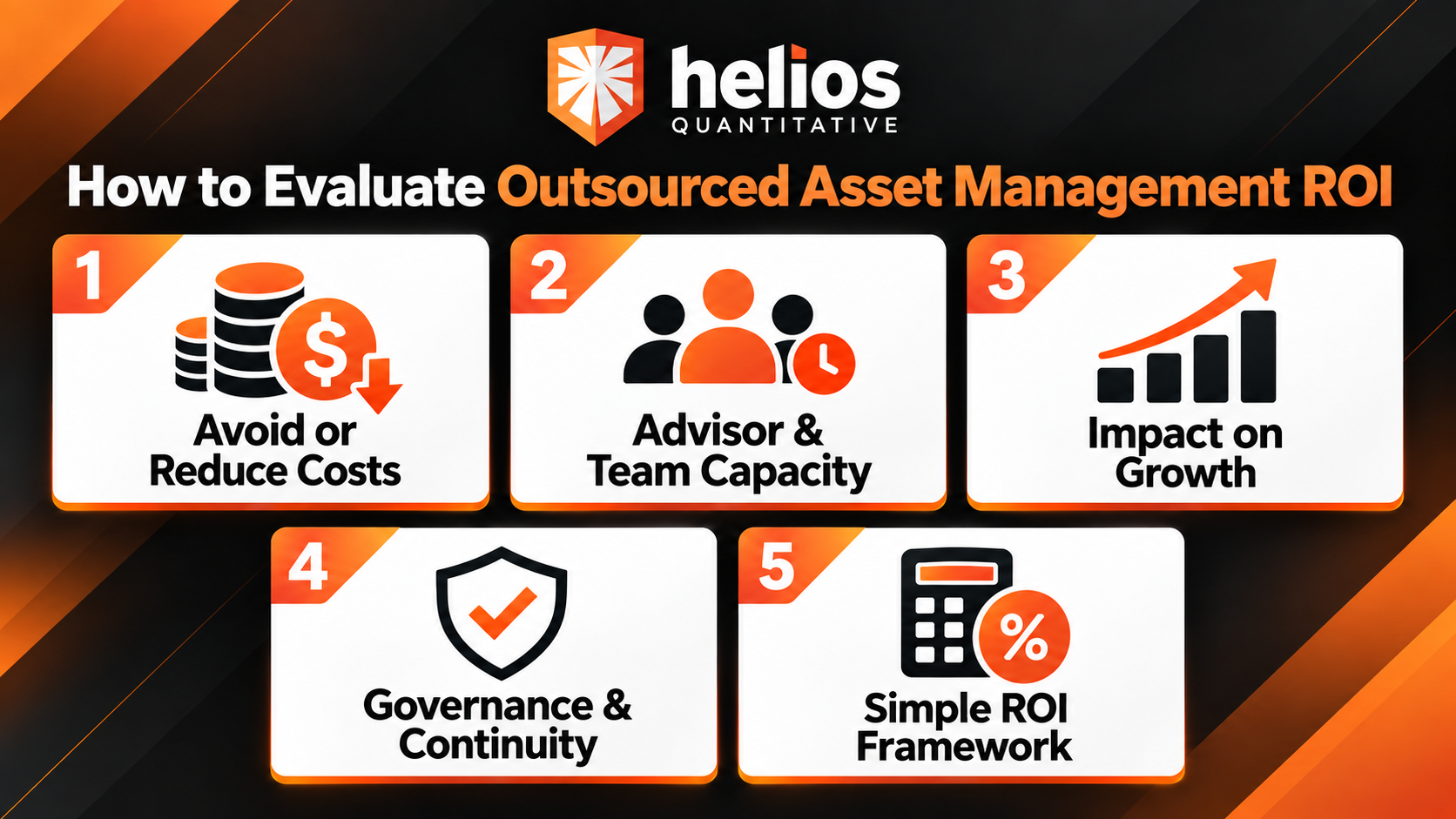
The first step is to identify which expenses outsourcing may replace. That can include future investment hires, research subscriptions, portfolio tools, trading support, and outside manager fees. Firms should be careful not to count savings that will remain in place after outsourcing. If the advisor still needs the same systems, staff, or operational support, those costs should stay in the calculation.
Time recovered can be one of the most valuable outcomes, particularly for firms where senior advisors remain heavily involved in research, portfolio decisions, or investment committee work.
If outsourcing frees advisors to spend more time with clients, prospects, junior advisors, or strategic initiatives, that recovered capacity has economic value. The firm should estimate how much time is actually being freed and where that time will be redeployed.
A scalable investment process can support growth without requiring every increase in assets or client count to be matched by additional investment headcount. For example, a firm adding another advisor or acquiring a book of business may be able to plug those relationships into an existing research, model, and governance framework rather than rebuilding the investment process for each new group of clients.
ROI also includes benefits that are harder to express as a direct cost reduction. Better documentation, a more repeatable investment process, and less dependence on one key person can improve operational resilience. These factors matter for succession planning and enterprise value because a documented, repeatable investment process is easier to transition.
A practical ROI review should compare the annual cost of outsourcing with the value it may create elsewhere in the firm. That can include costs avoided from future hires, research or technology expenses reduced, outside manager fees lowered, and advisor capacity redirected to client service, business development, or other higher-value work.
Where possible, firms should assign a reasonable dollar value to those benefits rather than treating time savings or operational improvements as abstract gains. The goal is to understand whether the outsourcing relationship improves the economics of the investment function enough to justify its cost.
For many advisory firms, the most meaningful return is greater capacity: supporting more clients and assets without requiring investment staff, systems, and internal complexity to grow at the same pace.
Read Next: How Outsourced Investment Management Increases Firm Value
Choosing how to outsource asset management comes down to finding the right balance of cost, control, and internal capacity. The right arrangement should provide the investment capabilities the firm needs without adding unnecessary fees, technology, or operational complexity.
For many advisory firms, the economics improve when outsourcing replaces work that would otherwise require additional staff, research resources, portfolio technology, and senior advisor time. The value becomes clearer when the provider supports a repeatable process that can accommodate more clients and assets without requiring investment infrastructure to grow at the same pace.
Helios’ Outsourced CIO Services are designed for firms that want broader support across portfolio oversight, investment governance, research, documentation, and advisor resources. Firms that want to strengthen the portfolio process itself can also use Helios’ Quantitative Investment Models to build a more consistent and scalable model ecosystem.
As you compare providers, look closely at what each fee actually covers, what responsibilities stay with your team, and how the pricing structure behaves as the practice grows. The right outsourcing model should fit the way your firm invests, operates, and plans to scale.
The benefits of outsourcing can include greater advisor capacity, more consistent portfolio oversight, access to specialized investment expertise, and less dependence on internal investment staff. For a growing RIA firm, outsourcing may also help reduce operational pressure around research, model management, due diligence, trading, and documentation. The value depends on how much meaningful work the provider actually takes on and whether the arrangement fits the firm’s investment process.
An OCIO, or outsourced chief investment officer, generally supports a broader portion of the investment process than a traditional asset manager. Depending on the relationship, an OCIO may help with asset allocation, research, portfolio construction, risk management, investment governance, documentation, and implementation. A traditional asset manager may focus more narrowly on managing a specific strategy or asset class. Advisors should compare the actual scope of management services rather than relying on the provider category alone.
Advisors may be able to offload research, due diligence, model management, portfolio monitoring, trading, investment committee support, compliance documentation, and client-facing investment communication. Outsourced portfolio management can also help centralize processes that otherwise sit across several internal roles. The amount transferred depends on the provider’s operating model, so firms should document which responsibilities move outside the practice and which remain with the financial advisor.
No. A registered investment adviser still retains its applicable fiduciary, oversight, and regulatory responsibilities even when using third-party investment management services. Outsourcing can support regulatory compliance through stronger documentation, repeatable due diligence, and clearer governance processes, but firms still need appropriate oversight of the provider. Service agreements should clearly define responsibilities, reporting, review procedures, and how the relationship supports the firm’s regulatory requirements.
It can make sense when investment workload creates capacity constraints, another internal hire becomes necessary, or growing market complexity makes the current process harder to maintain. Outsourcing is most useful when it addresses a defined need, such as improving operational efficiency, strengthening governance, or giving advisors more time for core activities. The management solution should fit the firm’s portfolio needs, growth plans, and desired level of internal control.

Explore how advisors outsource investment management, compare asset management platforms, and evaluate portfolio support options.

Learn what asset management services include and how to choose the right asset manager for your advisory firm.

Learn how virtual asset management helps financial advisors streamline investment management and scale wealth management.