.png?width=258&height=145&name=Helios%20Web%20Images%20800x450%20(9).png)
11 min read

Financial advisors can outsource investment management through third-party model portfolio providers, asset managers, TAMPs, or an outsourced CIO, depending on how much of the portfolio process they want to delegate. That support can range from research and portfolio construction to trading, rebalancing, due diligence, governance, and client-facing resources.
Outsourcing has become a significant part of how advisors manage client portfolios. Broadridge reported in 2025 that model portfolios held an estimated $7.7 trillion in assets, or 34.2% of the retail intermediary-sold investment market, with $4.4 trillion held in models delivered through financial advisors. That scale reflects how widely model portfolios are now used to support investment management.
For an advisory firm, the practical decision is which investment activities to keep in-house and which to delegate to an outside investment partner. This guide compares the main portfolio management service models and the trade-offs around control, customization, governance, technology, and internal workload.
What Are Portfolio Management Services for Financial Advisors?
Portfolio management services help financial advisors manage the investment work behind client portfolios. Depending on the provider, that support can include research, asset allocation, portfolio construction, risk management, trading, rebalancing, due diligence, governance, and client-facing investment communication.
The scope varies widely. Some providers focus on a specific function, such as model portfolios or third-party investment strategies. Others take on a broader share of the investment process, reducing the staff, technology, and management time required internally.
How much a financial advisor chooses to outsource usually depends on the firm’s investment philosophy, internal resources, client needs, and desired level of control. An RIA with an established investment team may use outside providers for selected functions, while a smaller or growing practice may outsource a larger portion of the portfolio management process.
Read More: Who Really Manages Portfolios for Financial Advisors?
Types of Portfolio Management Services Available to Advisors
Financial advisors can outsource investment management in several ways, and each model transfers a different level of responsibility. Some arrangements provide access to investment strategies or model portfolios, while others take on a broader role across research, portfolio construction, implementation, and governance.
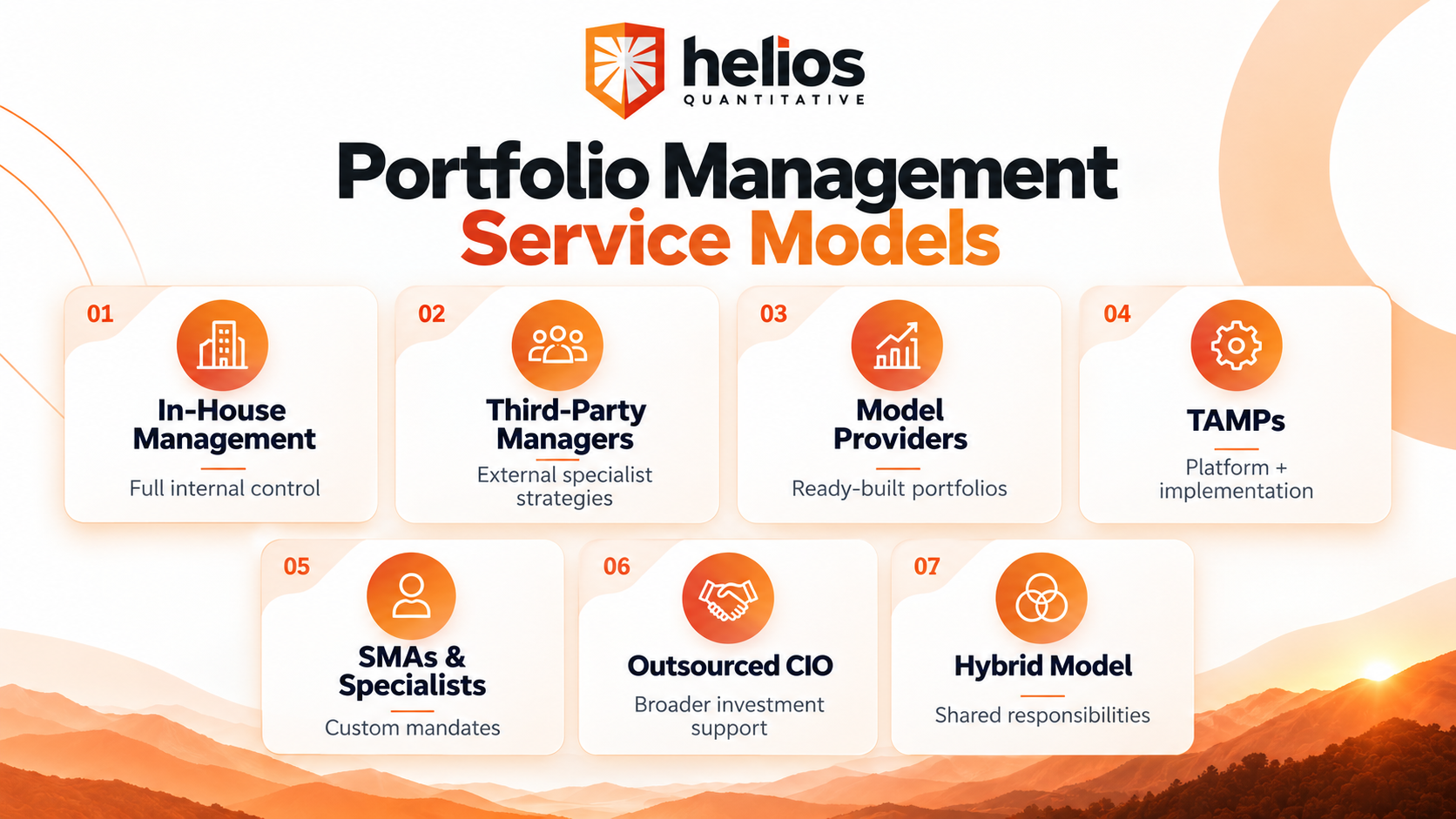
In-House Portfolio Management
An in-house model keeps investment decisions, research, portfolio construction, and oversight within the advisory firm. This gives the firm direct control over its investment philosophy and client experience, but it also requires staff, research resources, technology, documented processes, and ongoing management.
This approach can work well for firms with enough scale to support a dedicated investment team. Smaller practices may find it harder to maintain the same depth across research, trading, risk management, and governance as the business grows.
Third-Party Asset Managers
Third-party investment managers typically manage specific strategies, mandates, or asset classes on behalf of the advisor or client. Advisors may use them to access specialized expertise, expand investment options, or reduce the amount of security-level research performed internally.
The advisor still needs to oversee manager selection, due diligence, portfolio fit, and the ongoing relationship. Using multiple managers can also increase coordination if each provider operates independently.
Model Portfolio Providers
Model portfolio providers give advisors access to prebuilt or customizable investment allocations that can be implemented across client accounts. These services can simplify portfolio construction and make it easier to maintain consistency across a larger client base.
The level of support varies. Some providers focus mainly on model design and updates, while others also provide research, rebalancing guidance, risk analysis, and implementation support.
Turnkey Asset Management Platforms (TAMPs)
A TAMP typically combines investment management with operational and technology support. Depending on the platform, services may include model portfolios, third-party managers, trading, reporting, billing, account administration, and other back-office functions.
For advisors, the appeal is consolidation. The tradeoff is that the firm may need to work within the platform’s available managers, technology, custodial relationships, or portfolio structure.
Separately Managed Accounts and Specialist Managers
Separately managed accounts and specialist managers can give advisors access to specific investment strategies while allowing assets to remain directly owned in the client account.
These arrangements are often used when a firm wants specialized exposure, tax management, or greater customization within part of a portfolio. They can add useful investment capabilities, but they also create additional manager relationships that require due diligence and oversight.
Outsourced CIO Services
An outsourced chief investment officer, or OCIO, generally supports a broader portion of the investment process than a traditional third-party manager or model provider.
Depending on the relationship, an OCIO may support investment research, asset allocation, portfolio construction, risk management, investment committee processes, documentation, trading, and advisor resources. This model can be useful for firms that want to retain their investment philosophy and client relationships while reducing the infrastructure they maintain internally.
Hybrid Portfolio Management Models
Many advisory firms use a combination of internal and outsourced investment resources. A firm might keep asset allocation and investment committee decisions in-house while using third-party managers, model portfolios, or an OCIO for research, implementation, or specialized strategies.
A hybrid model can preserve control where the firm wants it while reducing workload in areas that require more time, technology, or specialized expertise. The main requirement is a clear division of responsibility so research, trading, oversight, and client communication do not fall through the gaps.
How Portfolio Management Service Models Differ
Portfolio management models mainly differ in how much investment responsibility moves outside the advisory firm. Some provide a specific capability, such as model portfolios or specialist strategies, while others support a broader share of research, implementation, and oversight.
The practical difference is the work that remains with the firm. A model provider can reduce the burden of portfolio construction while leaving due diligence, trading, and governance with the advisor. A TAMP may take on more implementation and operational responsibilities, while an OCIO can support a broader investment process.
Advisors should compare these models based on the responsibilities they want to retain, the level of customization their clients require, and the internal resources needed to oversee the relationship.
Read Next: How to Choose the Right Asset Management Services for Your Advisory Firm
What Capabilities Should Portfolio Management Services Provide?
Once the service models are clear, advisors can evaluate which parts of the investment process each provider can strengthen or take on.
-
Research and Due Diligence: The provider should have a repeatable process for evaluating investments and monitoring existing holdings. Depending on the mandate, that may include fund, ETF, stock, manager, or strategy research. For firms that want to supplement their internal due diligence process, our ETF, Mutual Fund, and Stock Research provides quantitative research across funds, ETFs, individual stocks, and portfolio holdings.
-
Asset Allocation and Portfolio Construction: Portfolio design should reflect the firm’s investment philosophy, client segmentation, and risk framework. Advisors should understand how much flexibility they retain over allocations, holdings, and model design.
-
Risk Management and Portfolio Monitoring: Ongoing oversight may include monitoring allocation drift, concentration, changing market conditions, and other portfolio risks that could require review or action.
-
Trading and Rebalancing: Some providers stop at recommendations, while others also handle implementation, including rebalancing, model changes, cash deployment, and account-level trading.
-
Governance and Documentation: Support may include investment committee materials, due diligence records, model-change documentation, and ongoing portfolio review. This can make the investment process easier to oversee and maintain as the firm grows.
-
Advisor and Client Support: Some providers also offer market commentary, portfolio explanations, advisor talking points, or white-labeled materials that help translate the investment process into client conversations.
The main question is how much of this work the provider can handle consistently and how much remains with the advisory firm.
Read More: Model Portfolio Management: Best Practices for Advisors to Improve Investment Oversight
Which Portfolio Management Model Fits Different Advisory Firms?
The right portfolio management model depends on firm size, internal investment resources, client complexity, and how much of the investment process the firm wants to retain. Those factors can lead to very different levels of outside support.
A solo advisor may prioritize simplicity and time savings, while a growing RIA may care more about reducing dependence on additional investment hires. Team practices often need a consistent portfolio process that multiple advisors can use without maintaining separate workflows.
Family offices may require more customization across asset classes, tax considerations, and alternative investments. OSJs and aggregators face a different challenge: creating enough structure and governance to support multiple advisors while preserving appropriate flexibility.
The best fit is usually the model that removes meaningful investment workload without creating unnecessary restrictions around portfolio construction, client service, or the firm’s investment philosophy.
Read Next: Virtual Asset Management for Financial Advisors: Scaling Wealth Management
What Should Advisors Evaluate When Comparing Portfolio Management Services?
Advisors should evaluate how well each provider fits the firm’s investment process, operating structure, and client needs. Focus on the responsibilities being transferred, the flexibility of the investment approach, and the resources the firm must still maintain internally.

Scope of Responsibility
Start by defining exactly which investment management activities the provider will own. Research, portfolio construction, trading, monitoring, documentation, and advisor support may all be handled differently depending on the relationship.
Two providers can appear similar on paper while leaving very different workloads with the advisory firm. Advisors should be able to identify what moves outside the firm and what still requires internal staff, technology, and oversight.
Investment Philosophy and Customization
Advisors should understand whether the provider can work within the firm’s existing investment philosophy or expects the practice to adopt a more standardized approach.
The right level of customization depends on client complexity, portfolio structure, and how much control the firm wants to retain. A highly customized process may support differentiation, but it can also require more coordination and oversight.
Governance and Due Diligence
Review how investment decisions are researched, documented, approved, and monitored over time. For firms with an investment committee, this includes the quality of supporting materials, the consistency of the review process, and whether the provider can help maintain a clear record of portfolio and manager decisions.
For firms that want to formalize this part of the process, our Compliance Documentation Support helps create a more consistent record around investment research, holdings, models, and portfolio decisions.
Technology and Custodian Compatibility
A provider should fit reasonably well with the firm’s existing custodians, trading systems, reporting tools, and operational workflows. Poor integration can create additional work even when the investment service itself is strong. Advisors should understand what implementation requires, which systems may need to change, and how well the provider fits the firm’s current technology environment.
Pricing and Internal Cost
The provider fee should be compared with the resources the firm will still need to maintain in-house. A lower price may offer limited value if advisors continue to handle most of the research, trading, oversight, and documentation themselves. The more useful comparison is the total cost of the relationship, including internal staff time, technology, and operational support.
Advisor and Client Support
Portfolio management services also affect how investment decisions are communicated across the practice. Advisors should consider the level of access they have to the investment team, the quality of market commentary and portfolio explanations, and whether the provider supplies client-facing resources that can support consistent communication.
A strong fit should leave the firm with a clear operating model:
Who makes decisions, who implements them, who documents them, and who supports the advisor when clients have questions.
Read Next: What Actually Matters When Choosing an Outsourced CIO Firm
Common Red Flags When Evaluating Portfolio Management Providers
Some portfolio management relationships create more operational work than they remove. Advisors should watch for service models that create oversight gaps, additional coordination, or constraints as the firm grows.
-
Unclear ownership of responsibilities. If it is difficult to determine who handles research, trading, rebalancing, documentation, or client communication, the relationship can create gaps and duplicated work.
-
Limited transparency into investment decisions. Advisors should be able to understand how portfolios are built, why changes are made, and how investment decisions are documented.
-
Too much standardization for the firm’s needs. A rigid model structure may be difficult to apply across different client segments, tax situations, or portfolio objectives.
-
Weak governance and due diligence support. Limited documentation can make it harder for the firm to maintain a consistent investment process and review decisions over time.
-
Poor technology or custodian fit. A provider that does not integrate well with existing systems can shift more work back to operations and advisor teams.
-
Pricing that becomes harder to justify as the firm grows. Advisors should understand how fees change with AUM, advisor count, service scope, and portfolio complexity.
-
Significant work remains in-house. Outsourcing delivers limited operating leverage when advisors continue to manage most of the research, implementation, monitoring, and documentation themselves.
A strong provider should make the investment process easier to operate and oversee. If the relationship adds more handoffs, systems, or internal coordination than it removes, it may create as much complexity as it solves.
Read More: Investment Process Documentation: The Missing Link Between Performance and Governance
How We Support Portfolio Management for Advisory Firms
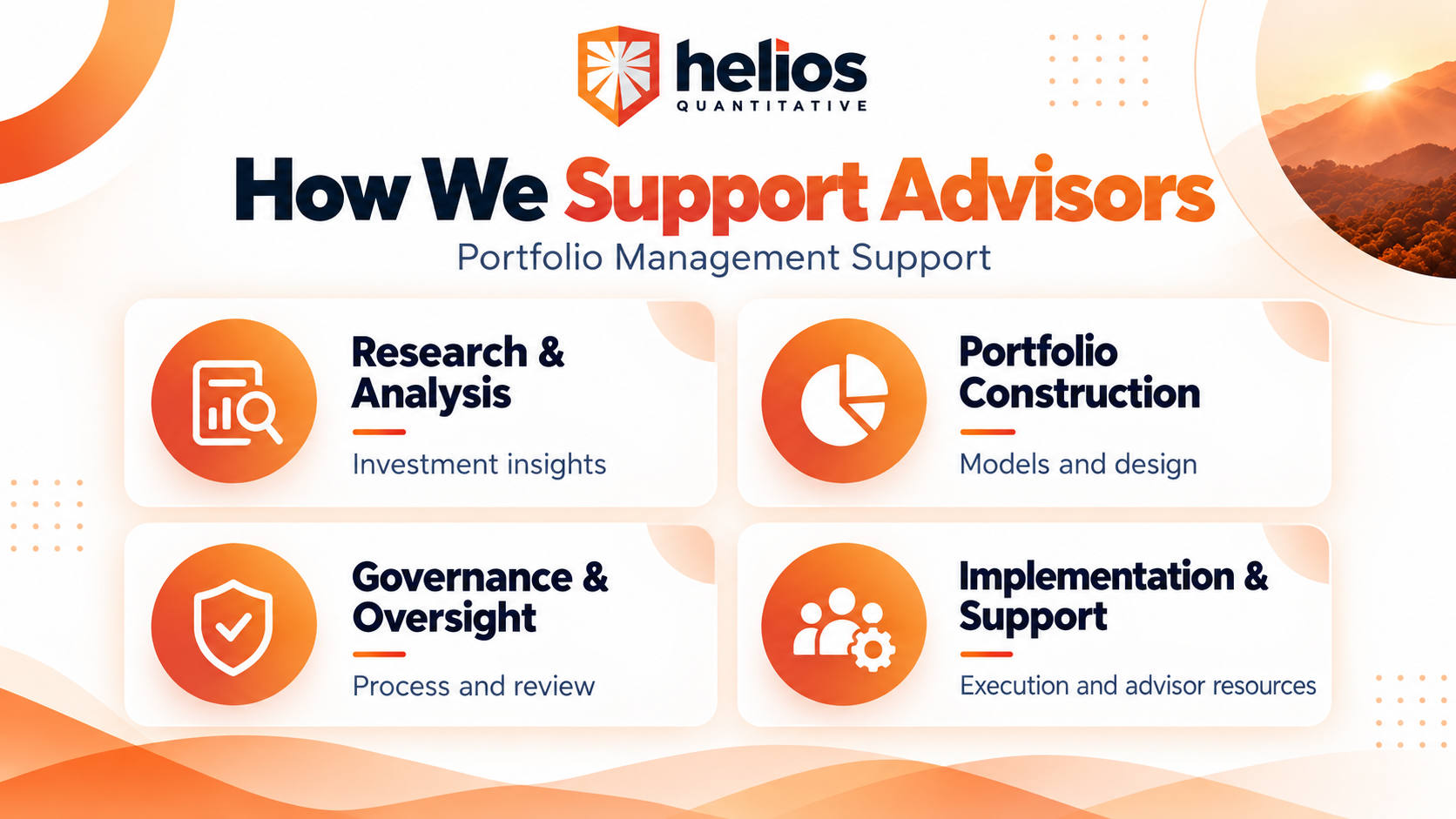
At Helios, we support advisory firms that want to strengthen their investment process without building every capability internally. Our model combines research, portfolio design, governance, implementation support, and advisor resources within a broader outsourced CIO relationship.
Research and Investment Analysis
We provide quantitative research across mutual funds, ETFs, individual stocks, and portfolio holdings. This gives advisors a more structured way to evaluate investments, monitor existing positions, and support firm-wide due diligence. For teams that want deeper research support, our ETF, Mutual Fund, and Stock Research can supplement the firm’s internal investment process.
Portfolio Construction and Model Management
We can help firms build and maintain model portfolios around their investment philosophy, client segments, and portfolio objectives. The goal is to create a repeatable structure advisors can apply across accounts without rebuilding the process for each client. Our Quantitative Investment Models provide an additional option for firms looking to formalize or expand their model portfolio approach.
Governance and Portfolio Oversight
Portfolio management also requires a clear process for reviewing and documenting investment decisions. We support investment committee preparation, portfolio analysis, due diligence, and documentation that can help firms maintain a more consistent governance process as they grow.
This is particularly relevant for multi-advisor firms where investment decisions need to remain understandable and repeatable across the organization.
Implementation and Advisor Support
Depending on the relationship, we can also support the operational work that follows an investment decision, including trading and rebalancing, along with advisor-facing and client-facing investment resources. Our broader Outsourced CIO Services bring these capabilities together for firms that want more support across the investment management process while retaining control of their client relationships and overall investment approach.
Building the Right Portfolio Management Structure for Your Firm
The right portfolio management structure should fit the way your firm invests, serves clients, and plans to grow. For some advisors, that means keeping investment decisions in-house while outsourcing research, trading, or implementation. For others, a broader relationship with a TAMP, specialist manager, or OCIO may provide the support needed to manage portfolios more efficiently.
As you compare options, focus on the responsibilities each provider will take on, the level of control your team wants to retain, and the internal resources required to manage the relationship. The right structure should make the investment process easier to operate, govern, and scale as the firm grows.
At Helios, we help advisory firms build a more repeatable approach around the responsibilities they want to retain and the work they want to delegate. Our Outsourced CIO Services can support research, portfolio oversight, governance, implementation, and advisor resources without requiring firms to recreate those capabilities internally.
The goal is a portfolio management model that supports your investment philosophy today while giving your firm room to grow without adding unnecessary operational complexity.
Frequently Asked Questions
How Can Outsourcing Investment Management Support a Wealth Management Practice?
Outsourcing can reduce the time advisors spend on research, portfolio construction, trading, and ongoing oversight. For a wealth management practice, that can create more capacity for financial planning, client service, business development, and other work that depends on direct advisor involvement.
How Does Risk Management Work When Advisors Outsource Investment Management?
A provider may support risk management through asset allocation, portfolio monitoring, rebalancing, diversification, and ongoing review. Advisors should still understand how risk is measured, how portfolio changes are made, and whether the provider’s process aligns with the firm’s investment philosophy and client needs.
Can Financial Advisors Outsource Investment Management Without Giving Up Their Investment Strategies?
Yes. Some providers rely on standardized models, while others allow firms to retain more control over asset allocation, model design, and investment philosophy. Advisors should confirm how much customization is available and which investment decisions remain with the firm.
What Is the Difference Between an OCIO and Other Investment Outsourcing Options?
An OCIO generally supports a broader share of the investment process, including research, portfolio construction, governance, risk management, and implementation. TAMPs, model providers, and third-party managers may focus more narrowly on platform access, specific investment strategies, or selected portfolio functions.
When Should a Registered Investment Advisor Consider Outsourcing Asset Management?
A registered investment advisor may consider outsourcing when investment management consumes too much internal capacity, requires another hire, or becomes harder to manage consistently as the firm grows. Common goals include gaining access to specialized expertise, improving portfolio oversight, and giving advisors more time to focus on clients and prospects.