.png?width=258&height=145&name=Helios%20Web%20Images%20800x450%20(9).png)
20 min read

Risk management is central to how advisors build portfolios and keep investment decisions aligned with long-term client goals. The challenge is not only identifying risk, but managing how asset allocation, diversification, liquidity needs, and concentration limits work together over time.
Portfolio setbacks rarely result from one issue alone. They often reflect a mix of market exposure, concentrated positions, changing assumptions, and weak oversight. In practice, portfolios with a single holding above the 10% to 20% range are often considered over-concentrated, highlighting the importance of diversification and regular review.
This guide covers:
- Practical risk management strategies tied to allocation, diversification, liquidity, and portfolio monitoring
- Portfolio review checks that reveal hidden financial risk before markets expose weaknesses
- Communication and documentation practices that help clients stay disciplined during volatility
P.S. Risk management becomes harder to manage when portfolio reviews, allocation changes, and client updates are handled inconsistently. Helios supports firms with quantitative research, model management, portfolio oversight, and compliance documentation that help keep the investment process more consistent as complexity grows.
Schedule a strategy call to review where your current process may be creating portfolio risk, documentation gaps, or avoidable strain.
TL;DR: Risk Management Priorities at a Glance
| Risk Management Strategy | Actionable Portfolio Guidance |
|---|---|
| Match Asset Allocation to Client Risk Profile | Set target allocation using risk tolerance, withdrawal needs, time horizon, and outside assets so the level of risk matches the client’s financial objectives. |
| Diversify Across Asset Classes and Regions | Spread investments across multiple asset classes, sectors, and geographic regions, then review overlap so diversification reduces the risk of one concentrated exposure driving losses. |
| Set Concentration Limits | Cap exposure to single stocks, sectors, issuers, or themes and define when appreciated positions must be reviewed before concentration risk affects the entire portfolio. |
| Rebalance With Defined Rules | Use drift bands, review triggers, and tax-aware rebalancing so portfolio risk stays close to target instead of changing with market fluctuations. |
| Use Scenario Analysis | Test client portfolios against a market downturn, rate shock, or liquidity event so the potential impact is reviewed before those risks affect investment decisions. |
| Plan for Liquidity Needs | Reserve enough liquid assets for withdrawals, taxes, and near-term spending so clients are not forced to sell risk assets during weak market conditions. |
| Separate Long-Term Policy From Short-Term Market Moves | Change allocation only when risk profile, cash needs, or portfolio exposures change materially, not because headlines or short-term volatility create pressure. |
| Review Risk at the Household Level | Combine taxable, retirement, business, and held-away assets in one risk assessment so the full risk exposure is measured across multiple accounts. |
| Communicate Risk Clearly During Volatility | Explain expected fluctuation, downside scenarios, and portfolio purpose before and during volatility so clients are less likely to make poor timing decisions. |
| Document Risk Decisions | Record risk assessment updates, allocation rationale, exceptions, and review activity so the investment process remains consistent and easier to supervise. |
10 Risk Management Strategies for Advisors That Support Stronger Portfolio Control
Risk management only matters when it changes how portfolios are built, reviewed, adjusted, and explained. A financial advisor needs a defined process to identify potential risks, measure risk exposure, and keep client portfolios aligned with financial goals across different market conditions.
The risk and investment strategies below focus on the parts of portfolio management that most directly affect downside control, client fit, and the ability to maintain a consistent investment process across multiple households.
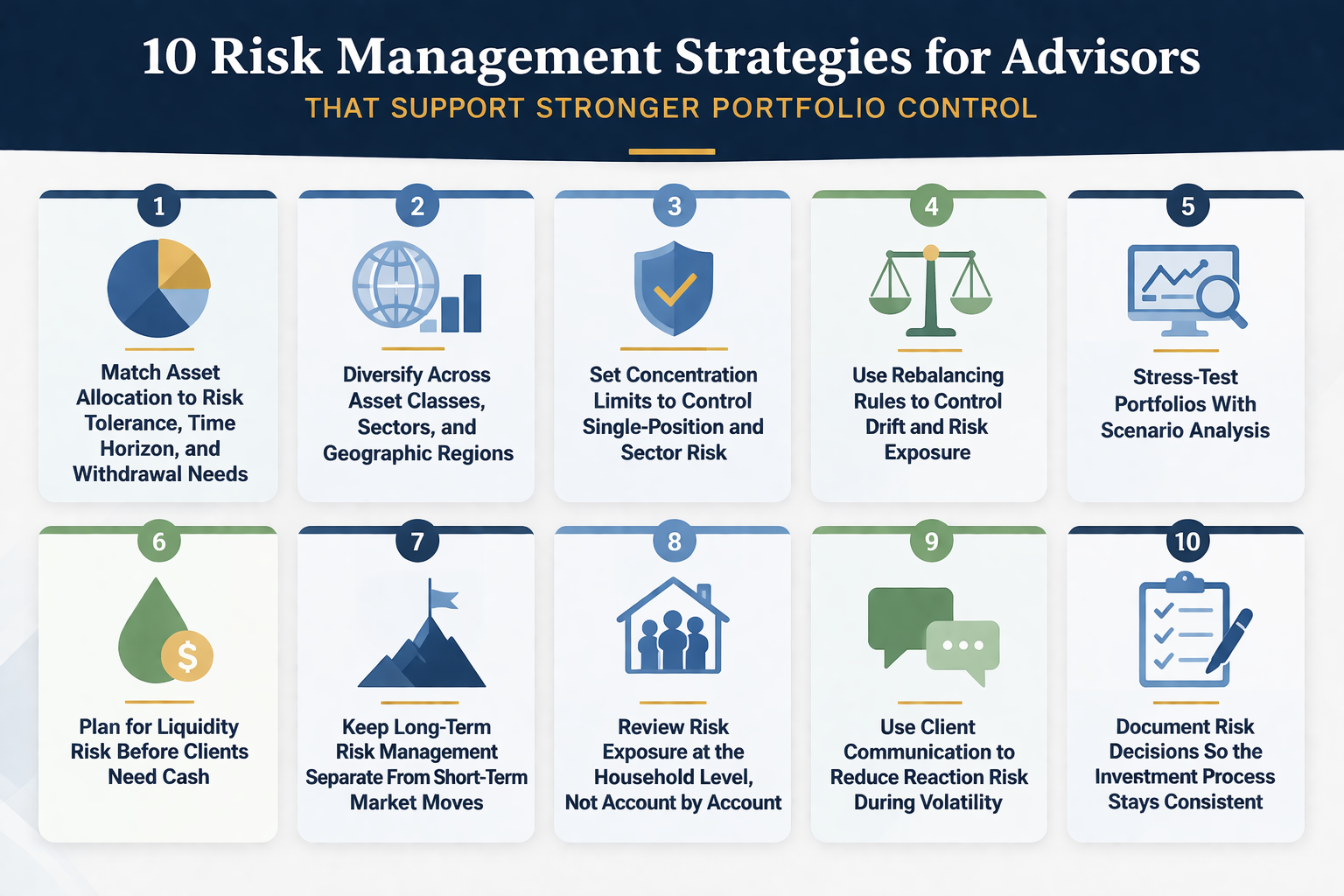
1. Match Asset Allocation to Risk Tolerance, Time Horizon, and Withdrawal Needs
Asset allocation is the first major risk decision because it sets the portfolio’s baseline exposure to market risk, interest rate risk, and liquidity risk before fund selection or security selection adds more complexity.
If the allocation is too aggressive, the portfolio may experience a drawdown that the client cannot tolerate financially or behaviorally. If it is too conservative, it may not provide enough growth to support long-term financial goals once inflation, taxes, and withdrawals are taken into account.
A proper allocation review should start with risk tolerance, but it also needs to test whether the portfolio fits the client’s full financial situation. That includes reviewing time horizon, expected withdrawals, liquidity reserves, tax profile, income stability, and the client’s ability to stay invested during a downturn without changing the plan at the wrong time.
For example, if a client expects to begin withdrawals within the next two years, the allocation should reflect those cash flow needs rather than relying entirely on long-term growth assets. If a large expense is expected in the near term, the review should confirm that enough lower-volatility or liquid assets are available to fund it without forcing sales during market weakness.
This is especially important for retirees, clients nearing retirement, and business owners whose balance sheet risk may already be concentrated outside the managed portfolio. In those cases, the portfolio may need less equity exposure than a standard questionnaire would indicate. A business owner with income tied to one sector, for example, may already have significant economic exposure outside the portfolio. A retiree taking regular distributions may also need an allocation that places greater weight on liquidity and drawdown control than a growth-focused model would suggest.
Allocation should also be reviewed when the client’s circumstances change. A portfolio that was appropriate during accumulation may no longer fit once distributions begin, a business is sold, a concentrated position is added, or spending flexibility declines. In practice, the review should confirm not only that the target mix still appears reasonable on paper, but that it still supports the client’s current financial objectives in both normal market conditions and a downturn.
2. Use Diversification Across Multiple Asset Classes, Sectors, and Geographic Regions
Diversification is one of the main risk management strategies used for financial risk mitigation, but it only helps when the exposures are meaningfully different. A portfolio can hold many securities and still carry concentrated market risk if those positions respond the same way to a downturn, an interest rate move, or a change in global growth expectations.
- Asset Class Diversification: Spread investments across multiple asset classes, including equity, fixed income, and cash or cash-equivalent reserves where appropriate, so one asset class does not control the entire portfolio outcome. This matters because portfolios built around one dominant risk source can become much more volatile than clients expect.
- Geographic Diversification: Review whether the portfolio includes investments across geographic regions rather than relying too heavily on one domestic market. This matters because leadership can shift quickly across global financial markets, and portfolios that ignore this may miss growth opportunities while carrying unnecessary concentration risk.
- Underlying Holdings Overlap: Compare what funds and managers actually own, not just the labels on the holdings. Different products can still create the same sector and issuer exposure, which reduces the risk benefits diversification is supposed to provide.
- Fixed Income Structure: Examine duration, credit quality, and issuer concentration inside bond allocations. Fixed income can help reduce the risk of equity-heavy portfolios, but only if the bond exposure itself is not carrying hidden interest rate risk or credit risk.
- Diversification by Economic Driver: Check whether return drivers are genuinely different across the portfolio. If growth-sensitive equity, high-yield credit, and cyclical sectors all dominate the same account, the portfolio may still fall together during a market downturn.
Read Next:
- The New Era of Portfolio Design: Why Mathematical Diversity Outperforms Traditional Diversification
- Quantitative Investing 101: Everything You Need to Know
3. Set Concentration Limits to Control Single-Position and Sector Risk
Concentration risk does not usually begin with an explicit decision to take excessive risk. More often, it builds gradually through appreciated legacy stock, repeated allocations to a familiar sector, equity compensation, private business interests, or outside holdings that were not fully incorporated into the household review. Over time, a portfolio that once appeared diversified can become heavily reliant on one issuer, one sector, one region, or one economic theme.
A practical concentration policy should define exactly what is being limited and how exposure will be measured. That includes setting limits for single-stock positions, sector weights, issuer exposure within fixed income, geographic concentration, and groups of correlated holdings that tend to move together. For example, an advisor may set a maximum percentage for any one stock, a separate cap for a single sector, and a review trigger when multiple holdings create overlapping exposure to the same market driver.
Outside assets should also be included where they materially affect household risk. If a client owns a business tied to commercial real estate, energy, or another cyclical sector, the managed portfolio may need lower exposure to that same part of the economy. The same applies when equity compensation, deferred stock, or legacy holdings already create significant exposure to one company or industry. Without that broader view, portfolio-level limits may appear reasonable while total household concentration remains too high.
The policy should also state what action is required when a limit is approached or breached. That may include trimming the position, directing new contributions to other assets, setting a staged reduction plan for tax-sensitive holdings, or documenting a temporary exception with a defined review date. This gives the advisor a process for responding before concentration risk becomes harder to manage.
The key issue is not simply that a position becomes large. It is whether the firm has defined the threshold, measured the exposure correctly, documented the reason for any exception, and established a clear plan to reduce risk when concentration continues to build.
4. Use Rebalancing Rules to Control Portfolio Drift and Risk Exposure
Market fluctuations can materially change asset allocation even when no discretionary trades are made. A portfolio that begins within policy can become more aggressive after an extended equity rally or more defensive after a sharp market decline.
Rebalancing is the process used to bring the portfolio back toward its intended asset allocation and risk exposure. For that process to work, the rules need to be specific enough to show when review is required, what action should be taken, and how implementation decisions are made across different account types and client circumstances.
| Rebalancing Element | What To Check | Why It Matters |
|---|---|---|
| Drift Thresholds | Confirm the percentage band that triggers review for each major asset class, such as equity, fixed income, and cash. | Without defined drift bands, portfolios can remain above or below their intended risk level for extended periods. |
| Review Frequency | Determine whether portfolios are reviewed monthly, quarterly, or on another schedule based on strategy and account complexity. | An infrequent review can allow allocation drift to build before corrective action is considered. |
| Cash Flow Use | Review how contributions, withdrawals, dividends, and interest are used to reduce drift before selling positions. | Using cash flows can help manage risk with less turnover and lower tax impact. |
| Tax Treatment | Confirm how realized gains, loss harvesting opportunities, and account type affect rebalance decisions. | A rebalance that ignores tax consequences may correct allocation drift while creating unnecessary tax costs. |
| Exception Handling | Check how accounts with restrictions, legacy holdings, or tax-sensitive positions are handled when they cannot be fully rebalanced. | Weak exception handling can leave portfolios outside target allocation without a clear documented rationale. |
Rebalancing rules should also reflect the type of portfolio being managed. A straightforward, balanced account may only require tolerance bands and periodic review. A more customized relationship with outside assets, concentrated holdings, or ongoing distributions may require tighter triggers and more account-specific handling.
If those differences are not built into the process, portfolio drift can persist, and risk exposure can move away from the client’s intended level, even when the firm believes allocation is being managed appropriately.
Read Next:
- Outsourced Portfolio Management: When Control Creates More Risk Than Protection
- Investment Management Outsourcing: When It Becomes a Strategic Advantage
5. Stress-Test Portfolios With Scenario Analysis
Scenario analysis is one of the most practical ways to turn risk assessment into planning. Rather than discussing market volatility in broad terms, it tests how a portfolio and financial plan may respond to defined conditions such as a 20% equity drawdown, a sustained rise in interest rates, tighter credit conditions, or slower economic growth.
For advisors, that means modeling the effect of those conditions on both portfolio value and the client’s broader financial position, then using the results to decide whether the current strategy is still appropriate.
A strong scenario review should go beyond estimating a temporary decline in account value. It should test how that decline would affect withdrawals, near-term spending, liquidity reserves, and the client’s ability to stay invested without changing the plan at the wrong time. For example, if a retired client is taking annual distributions, the analysis should show whether those withdrawals can continue during a potential market decline without forcing asset sales from growth positions.
If a client plans to buy a home, fund education, or meet another large cash need within the next two to three years, the review should test whether enough liquid assets are available without relying on depressed holdings. For a business owner, the analysis may also need to account for the possibility that portfolio losses and lower business income happen at the same time.
Scenario analysis should also lead to specific portfolio and planning decisions. If a downside case shows that the client would need to sell risk assets to meet spending needs, that may point to a need for higher cash reserves, a lower equity allocation, or a different withdrawal structure.
If rising rates expose too much duration risk in fixed income holdings, the advisor may need to revisit bond maturity exposure or liquidity positioning. Used properly, scenario analysis helps advisors identify where the plan may break under stress and make adjustments before market conditions force those decisions.
6. Plan for Liquidity Risk Before Clients Need Cash
Liquidity risk becomes more serious when it is discovered late. A portfolio may look suitable under normal market conditions and still become difficult to manage if the client needs cash during a downturn, owes taxes after a liquidity event, or faces large spending needs that were not built into the allocation plan. That is why liquidity planning should be reviewed as part of portfolio management, not treated as a separate administrative issue.
- Near-Term Spending Needs: Identify withdrawals expected over the next 12 to 24 months, including living expenses, tax payments, tuition, property purchases, or business funding needs. This matters because portfolios that do not account for near-term cash demands may force sales of risk assets during weak markets.
- Liquidity Reserve Structure: Confirm which holdings are intended to fund planned withdrawals and whether those assets are stable enough to serve that role. A reserve plan built from volatile holdings may not provide reliable downside protection when market volatility increases.
- Illiquid Or Hard-To-Trade Holdings: Review any private investments, restricted stock, thinly traded securities, or account structures that limit access to capital. These positions can create liquidity pressure even when overall portfolio value appears strong.
- Distribution Sequence: Determine whether withdrawals will come from income, cash balances, defensive assets, or selective sales of appreciated positions. Without a defined withdrawal order, liquidity decisions may be made under pressure and without regard to broader portfolio risk.
- Contingency Planning: Consider health costs, long-term care needs, business obligations, or family support demands that may require capital on short notice. This matters because unplanned cash needs often arise when market conditions are least favorable.
7. Keep Long-Term Risk Management Separate From Short-Term Market Moves
One of the hardest parts of effective risk management is deciding when market movement requires action and when it does not. Short-term price changes, economic headlines, and sudden volatility can make almost any portfolio feel wrong in the moment, even if it still matches the client’s financial plan and risk tolerance. Without a defined review framework, firms can end up making allocation changes that respond to discomfort rather than to actual changes in financial risk.
A stronger process separates strategic portfolio decisions from short-term market reactions by identifying the conditions that justify change. Those conditions may include a material shift in the client’s financial goals, a change in spending needs, a revised time horizon, new concentration risk, or a level of portfolio drawdown that is inconsistent with the client’s documented tolerance.
Some firms may also use risk metrics, valuation thresholds, or tactical signals, but those tools still need a documented role in the investment process so they are applied consistently.
The issue is rarely that markets have moved. The issue is that no one has defined what kind of move matters, what evidence should be reviewed, who decides whether a portfolio change is justified, and how that decision should be documented.
When those questions are not answered in advance, advisors can struggle to manage risk proactively and may instead make reactive changes that weaken long-term outcomes.
8. Review Risk Exposure at the Household Level, Not Account by Account
Risk exposure is often misread when accounts are reviewed one at a time. A retirement account may look appropriately diversified, a taxable account may appear conservative, and a business balance sheet may be reviewed separately, yet the total household may still be carrying more equity concentration, liquidity risk, or interest rate sensitivity than anyone realizes.
Household-level review corrects that problem by looking across multiple accounts and asset types as one investment profile.
| Household Risk Review Area | What Should Be Verified | Why It Matters |
|---|---|---|
| Managed And Held-Away Assets | Combine managed accounts with outside 401(k)s, stock plans, bank assets, and other held-away positions. | Without this broader view, the advisor may underestimate total market exposure or concentration risk. |
| Business And Private Asset Exposure | Include ownership stakes, partnership interests, and private holdings in the risk assessment. | A client may appear diversified in the portfolio while household wealth remains tied to one economic driver. |
| Asset Location | Review where equity, fixed income, and cash sit across taxable and retirement accounts. | Risk may be measured correctly, but implemented inefficiently or with unnecessary liquidity strain. |
| Withdrawal Sources | Confirm which accounts are expected to fund spending, distributions, or tax payments. | Clients may be forced to draw from the wrong account at the wrong time. |
| Household Constraints | Document restrictions, legacy holdings, family obligations, and legal or trust structures that affect portfolio management. | The overall strategy may look coherent, but account-level exceptions can undermine it in practice. |
This broader review matters most when the client has complex finances, multiple advisors, or assets that sit outside the main investment advisory relationship. In those cases, reviewing accounts separately can understate real portfolio risk and lead to decisions that look sound in one account but are misaligned across the household.
9. Use Client Communication to Reduce Reaction Risk During Volatility
Communication is a portfolio risk control because clients who do not understand the purpose of the allocation are more likely to want major changes at the wrong time. That is especially true in a market downturn, when losses feel immediate, and the long-term plan feels less certain. Clear communication reduces the chance that fear, confusion, or unrealistic expectations will drive investment decisions.
- Portfolio Purpose: Explain why the portfolio holds its current mix of equity, fixed income, cash, and any other exposures so the client understands how the strategy supports financial goals. This matters because clients are more likely to stay with an allocation when they understand its purpose.
- Expected Drawdown Range: Discuss the level of fluctuation that may occur in normal corrections and more severe downturns. Without this context, clients may interpret ordinary market volatility as evidence that the strategy has failed.
- Action Triggers: Clarify what would justify a portfolio change, such as a change in the financial plan, risk tolerance, withdrawal needs, or a specific portfolio issue. This helps distinguish disciplined review from reaction to headlines.
- Communication Timing: Prepare materials and talking points before volatility increases rather than waiting until markets are already down sharply. Advisors who communicate only after losses occur are often trying to rebuild confidence that could have been strengthened earlier.
- Financial Plan Link: Tie the discussion back to the client’s cash needs, reserve structure, and long-term goals so the conversation stays grounded in the plan rather than in market commentary alone.
10. Document Risk Decisions So the Investment Process Stays Consistent
Documentation is where many risk management approaches either become repeatable or start to break down. If the file does not show why a client portfolio is allocated a certain way, how risk tolerance was assessed, what exceptions were accepted, and when reviews occurred, then the process becomes difficult to apply consistently across households or explain later.
A sound documentation standard should preserve more than a broad note that the portfolio was reviewed. It should identify the client’s stated financial objectives, risk tolerance, liquidity needs, concentration issues, and any outside assets that affect allocation decisions. It should also show the reason for allocation changes, rebalance activity, and whether scenario analysis or other risk metrics were reviewed as part of the decision. When a client wants an exception, such as holding a concentrated stock position or avoiding a necessary rebalance for tax reasons, that choice should be recorded with its portfolio implications.
The issue is usually not the absence of any records. It is that the records are too thin to support future oversight. A later reviewer may be able to see that a decision was made, but not what risk was considered, what alternatives were rejected, or why the portfolio remained outside normal targets. Detailed records support consistency, supervision, and client communication, and they reduce the chance that important portfolio decisions become harder to explain over time.
Read Next: Why Advisors Are Turning to Quantitative Risk Management in 2025
How to Evaluate Whether Your Risk Management Process Is Working
A firm can reference sound risk management concepts and still have gaps in execution. The more useful test is whether the process can identify financial risk, respond appropriately to market conditions, and keep client portfolios aligned with financial goals on a consistent basis.
Evaluating that requires more than checking whether a policy exists. It requires reviewing how often portfolios are monitored, whether review triggers are defined clearly, how decisions are documented, how clients are prepared for market volatility, and whether the firm can still apply its process consistently when customization increases.
A workable evaluation should focus on whether the firm can detect changes in risk exposure early enough to act. For example, a portfolio management process may look disciplined if reviews occur every quarter, but that cadence may be too slow for a household with monthly withdrawals, a concentrated stock position, or a pending liquidity need.
In the same way, a firm may describe its approach as proactive, but the process is not truly proactive if allocation drift, concentration risk, or reserve shortfalls are identified only after they begin to affect investment decisions.
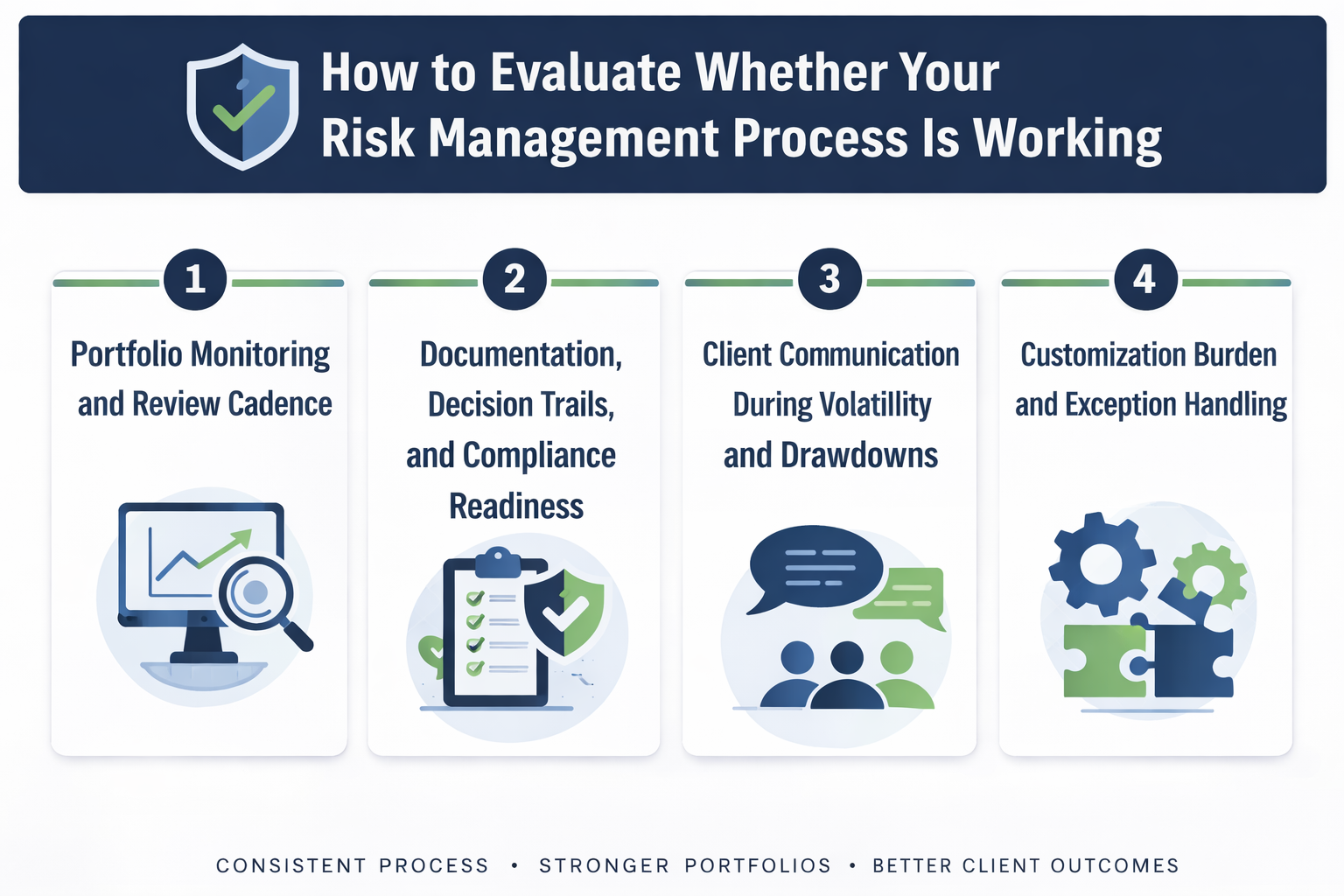
Portfolio Monitoring and Review Cadence
Portfolio monitoring should match the type of strategy, the level of risk, and the client’s circumstances. A household with regular withdrawals, concentrated positions, illiquid holdings, or complex outside assets usually needs more frequent review than a simpler accumulation account. Review timing should also reflect cash flows, tax events, required distributions, and material changes in market conditions rather than relying on a fixed schedule alone.
A useful review cadence should define who reviews the portfolio, what data is checked, and what conditions trigger action. That can include allocation drift beyond a set tolerance band, a change in concentration levels, higher cash needs, lower reserve balances, a deterioration in credit quality, or a material change in the client’s financial plan.
For example, if a client begins taking withdrawals from a portfolio that was originally managed for accumulation, the review process should test whether the existing allocation, liquidity structure, and downside exposure still fit that new use case. When those triggers are unclear, portfolios may stay misaligned longer than expected because no single review point requires action.
Documentation, Decision Trails, and Compliance Readiness
Documentation should show how the firm manages risk in practice. It should also make it easier to review decisions later, supervise client-specific exceptions, and explain how the investment process was followed.
It does not simply confirm that a review occurred. It should show what was reviewed, what conclusion was reached, what action was taken, and what follow-up is still required.
- Risk Assessment Records: Confirm that client risk tolerance, financial objectives, liquidity needs, concentration issues, withdrawal requirements, and relevant outside assets are updated and stored clearly enough to support future decisions. If a client’s financial goals or ability to withstand losses change, the file should show when that change was identified and how it affected portfolio management.
- Allocation And Rebalance Notes: Record why allocation changes or rebalancing decisions were made, what threshold was hit, and whether taxes, trading costs, account restrictions, or cash flows affected the outcome. For example, if a portfolio remained outside target allocation because the advisor used incoming cash rather than immediate sales to reduce drift, that should be documented clearly.
- Client-Specific Exceptions: Document employer stock, tax-sensitive holdings, restricted accounts, private investments, legacy positions, or other special cases so the effect on portfolio risk is clear. If a concentrated stock position is being reduced gradually for tax reasons, the file should show the rationale, the planned reduction path, and the review schedule.
- Review Evidence: Preserve portfolio review notes, scenario analysis outputs, rebalance records, and communication records so oversight can be verified later. This matters because a later reviewer should be able to see not only that a portfolio was discussed, but also whether market risk, liquidity risk, concentration risk, and withdrawal needs were evaluated in a specific way.
- Supervision Support: Maintain records that allow a reviewer, compliance lead, or firm owner to understand what was done, why it was done, and what still requires follow-up. A sound supervision trail should make it possible to identify whether an exception is temporary, whether a risk was accepted deliberately, and whether the next review has already been scheduled.
Read Next:
- Five Ways Outsourced Chief Investment Officers Simplify Compliance and Risk Management for Advisors
- The Strategic Advantage of Outsourced Investment Committees
Client Communication During Volatility and Drawdowns
Client communication should be reviewed as part of effective risk management because client reactions can change outcomes materially. A technically sound portfolio may still fail to safeguard long-term financial goals if the client loses confidence and asks for major changes during a downturn. In practice, a portfolio can be positioned appropriately from an investment perspective and still be vulnerable if the client does not understand expected fluctuation, the role of diversification, or how reserve assets are meant to support spending during stress.
A stronger communication process prepares clients before volatility rises. It explains expected fluctuation, how diversification works in practice, what a market downturn may look like, and how withdrawals or reserve assets are expected to work under stress.
For example, a retired client taking regular distributions should understand in advance which assets are expected to fund near-term withdrawals and why the entire portfolio is not intended to be spent from equities during a downturn.
The communication process should also define who communicates, what materials are used, and how quickly clients receive an explanation when markets are moving sharply. If the firm waits until clients are already anxious, it is usually working from a weaker position because expectations were not set before market conditions became more difficult.
Read Next:
- Navigating Market Volatility With Effective Client Communication
- Managing Client Expectations During Market Downturns
Customization Burden and Exception Handling
Portfolio customization can improve client fit, but it can also create operational risk when exceptions accumulate across many accounts. Restrictions, tax requirements, legacy holdings, concentrated stock positions, outside assets, and special withdrawal needs all create additional review work. If those exceptions are not governed carefully, the firm may lose consistency in how it manages risk across client portfolios.
The issue is not that customization is inherently problematic. The issue is whether the firm can still monitor, document, and supervise those variations with the same level of discipline used for standard portfolios.
A better evaluation starts with how exceptions are approved, documented, and monitored over time. It should also assess whether the number of customized positions, model variations, and account-specific rules is increasing faster than the team can review them properly.
For example, if one advisor is overseeing multiple households with unique concentration limits, custom withdrawal rules, and tax-driven restrictions, the firm should be able to show how those differences are tracked and when each exception is reviewed. Advanced portfolio customization can be useful, but only when staffing capacity, review cadence, and documentation standards are strong enough to support it.
Read Next: Five Ways Outsourced Chief Investment Officers Simplify Compliance and Risk Management for Advisors
Where Risk Management Often Breaks Down
Most risk management problems come from weak execution rather than a lack of awareness. A firm may understand the need to mitigate financial risk and still carry unnecessary exposure because the portfolio process is not specific enough or not followed consistently. Breakdowns usually happen when a portfolio remains in place after the client’s circumstances change, when monitoring identifies a risk, but no action follows, or when exceptions accumulate faster than the firm can supervise them.
- Outdated Client Profiles: Risk tolerance, withdrawal needs, liquidity needs, and financial goals can change, which means the original allocation may no longer match the client’s current situation. A portfolio that was appropriate during accumulation may no longer fit once distributions begin, spending flexibility declines, or the client’s time horizon shortens.
- Overlapping Holdings: Diversification can look stronger than it is when investments across various funds and managers still create the same market risk, sector exposure, geographic concentration, or interest rate sensitivity. For example, several different funds may still produce heavy exposure to large-cap U.S. growth stocks or long-duration fixed income.
- Portfolio Drift: Without rebalancing rules, asset allocation can move far from target and raise the level of risk without a deliberate investment decision. A long equity rally, for example, can leave a portfolio materially more aggressive than intended if no tolerance bands or review triggers are in place.
- Weak Liquidity Planning: Clients may be forced to sell risk assets during a market downturn if cash needs, reserve targets, and withdrawal sources were not planned in advance. This is especially relevant for retirees, clients with upcoming tax payments, or households expecting large near-term expenses.
- Concentration That Goes Unchecked: A single stock, issuer, sector, or correlated set of holdings can become too large through appreciation or repeated purchases and create avoidable downside risk. This can also happen when outside assets, such as business ownership or equity compensation, are not included in the household risk review.
- Poor Volatility Communication: Clients are more likely to make reactive changes when expectations were not set clearly before market conditions become more difficult. If the advisor has not explained likely drawdowns, recovery periods, and the role of reserve assets, market volatility can lead to decisions that interrupt the financial plan.
- Too Many Exceptions: Portfolio customization, if not monitored carefully, can make risk management harder to apply across multiple accounts and client portfolios. When exception handling becomes too broad, firms may lose consistency in review cadence, documentation, and follow-through.
A Practical Next Step for Stronger Risk Management
Risk management should protect more than investment returns. It should help keep client portfolios aligned with financial objectives, reduce avoidable financial risk, and support better decisions through changing market conditions. The most useful next step is often a disciplined review of whether your current allocation, monitoring, documentation, and communication standards are strong enough for the portfolios you manage today and the complexity you expect to manage next.
- Allocation Review: Confirm that asset allocation, liquidity reserves, concentration levels, and household exposure still match clients’ risk tolerance, withdrawals, and long-term financial goals.
- Process Review: Check whether rebalancing rules, scenario analysis, portfolio monitoring, and exception handling are defined clearly enough to manage risk across multiple client portfolios.
- Documentation Review: Identify where risk assessment, portfolio changes, and client-specific exceptions are recorded well and where the process still needs stronger records.
That review often makes it easier to see whether the current process is prepared for market volatility, growing portfolio complexity, and higher client expectations.
Helios works with firms that need a stronger investment structure as portfolio oversight, risk reviews, and documentation become harder to manage internally. Our Insourced CIO support combines quantitative research, model management, portfolio oversight, and compliance documentation to help firms keep portfolio decisions more consistent and easier to explain.
Schedule a strategy call to identify where your current investment process may be increasing portfolio risk or client communication pressure.
Read Next: Outsourced Portfolio Management: When Control Creates More Risk Than Protection
Frequently Asked Questions
What are risk management strategies in financial planning?
Risk management strategies in financial planning are the methods used to identify, assess, and manage risk that could interfere with a client’s financial goals. They can include asset allocation, diversification, liquidity planning, concentration limits, insurance planning, and portfolio review. In investment advisory work, they also include communication and documentation that help keep the portfolio aligned with the financial plan.
Why is risk management important for financial advisors?
Risk management is important for financial advisors because clients face more than one type of risk. Market risk, liquidity risk, concentration risk, interest rate risk, and operational risk can all affect financial outcomes. A structured process helps the advisor manage risk more consistently, explain investment decisions more clearly, and keep client portfolios aligned with financial objectives.
How can diversification reduce portfolio risk?
Diversification can reduce portfolio risk by spreading investments across multiple asset classes, sectors, issuers, and geographic regions so one source of loss does not dominate the entire portfolio. The benefit depends on the exposures being meaningfully different. If the holdings overlap heavily, diversification may be weaker than it appears.
What is concentration risk in a portfolio?
Concentration risk is the risk that a portfolio depends too heavily on one stock, one issuer, one sector, one geography, or one investment theme. If that exposure declines sharply, the effect on the entire portfolio can be significant. This risk often develops through appreciated legacy positions, employer stock, or repeated allocations to the same area of the market.
How often should a portfolio risk assessment be reviewed?
A portfolio risk assessment should be reviewed whenever there is a material change in financial goals, withdrawals, time horizon, liquidity needs, or ability to withstand losses. It should also be reviewed on a regular schedule based on portfolio complexity and risk exposure. More complex client portfolios often require more frequent review.
How do advisors help clients manage risk during market volatility?
Advisors help clients manage risk during market volatility by setting expectations before markets decline, explaining the role of asset allocation and diversification, reviewing whether portfolio risk still matches the client’s plan, and communicating clearly during periods of stress. That helps clients avoid reactive changes that can harm long-term financial results.