Model Portfolio Construction for Advisors: Building Consistent, Scalable Portfolios
Learn how advisors use model portfolios to improve consistency, strengthen governance, and scale portfolio management.
.png?width=258&height=145&name=Helios%20Web%20Images%20800x450%20(9).png)
How Advisors Can Use Market Commentary to Strengthen Client Relationships — Not Overwhelm Them
13 min read

Building model portfolios for clients requires more than selecting investments and assigning target allocations. Advisors need a repeatable process for assigning clients to models, managing customization, documenting exceptions, and maintaining consistency across client portfolios.
Model portfolios are no longer a niche portfolio-construction tool. In BlackRock's 2026 Advisor Trends Survey, roughly nine in ten advisors surveyed reported using model portfolios, and advisors expect model-portfolio assets to represent 50% of assets under management within the coming year. As models take on a larger share of client portfolios, firms need more than scalable investment frameworks. They need a scalable implementation discipline.
For many firms, the challenge is no longer building the model itself. The challenge is applying that model consistently across different client circumstances without creating operational complexity, governance issues, or excessive customization.
P.S. As model portfolio programs expand, many firms discover that customization, oversight, and documentation become operational challenges rather than investment challenges. Helios' Advanced Portfolio Design and Automation solutions help advisors create more scalable portfolio implementation processes while maintaining consistency across client accounts.
Building model portfolios for clients is often described as a portfolio construction exercise. In practice, it is an implementation exercise. Most advisory firms can design model portfolios. The greater challenge is applying those portfolios consistently across different client situations while maintaining appropriate customization, documentation, and oversight.
That challenge becomes more pronounced as firms grow. More clients, more advisors, and more exceptions naturally create additional complexity. The most effective firms address this challenge through a repeatable workflow. Rather than treating model portfolio implementation as a series of individual decisions, they establish a structured process for evaluating clients, assigning models, managing customization, monitoring outcomes, and documenting decisions.
The following framework outlines seven steps advisors can use to build model portfolio workflows that support consistency, governance, and long-term scalability.
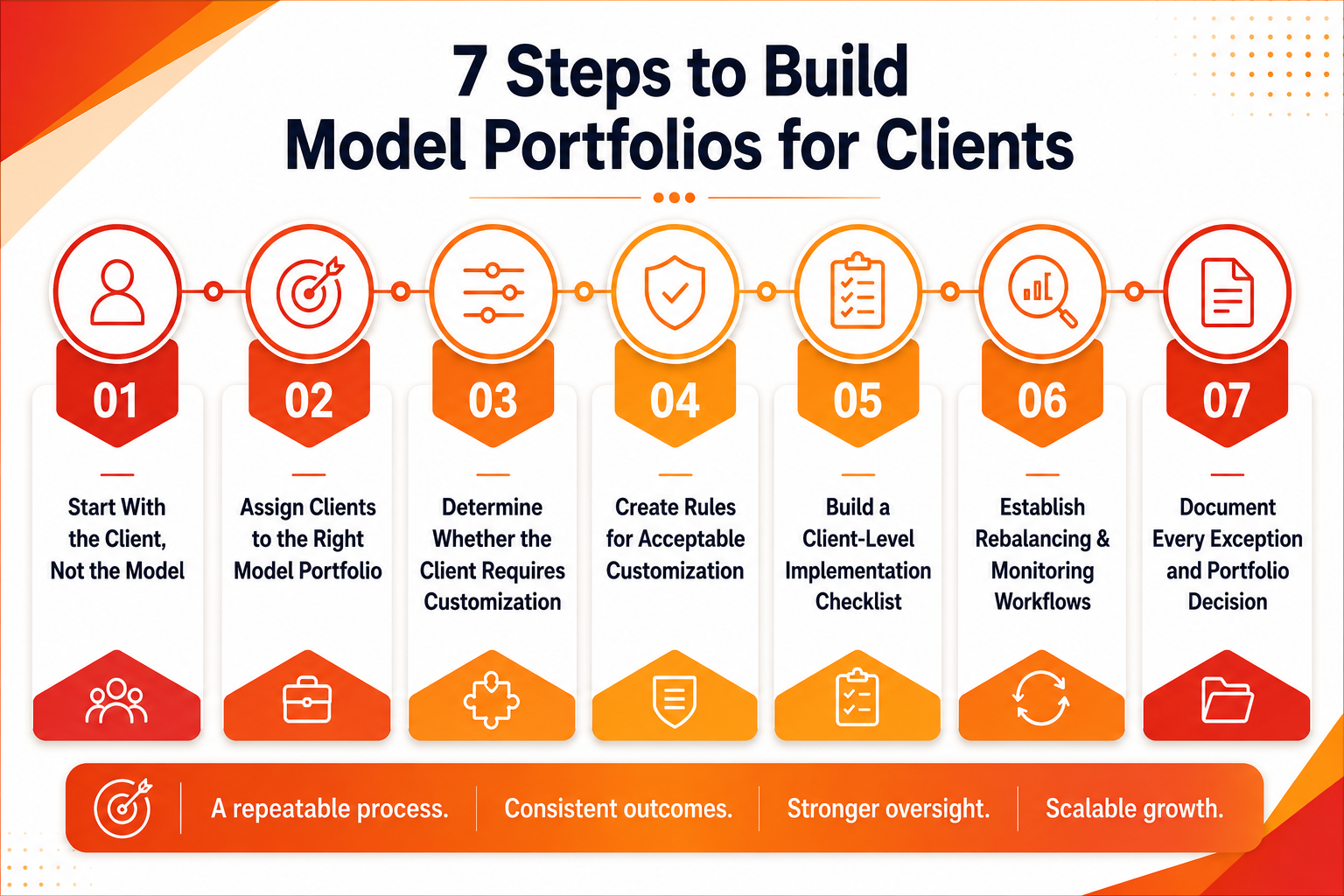
Many firms unintentionally begin the portfolio process in the wrong place. They start with the model. The stronger approach starts with the client.
Building model portfolios for clients requires more than selecting investments and assigning target allocations. Advisors first need to understand the client's investment objectives, risk tolerance, liquidity needs, household circumstances, and long-term financial goals.
Two clients may qualify for the same model portfolio while requiring very different implementation decisions.
A retiree drawing portfolio income may require additional liquidity planning. A business owner with significant outside assets may need a broader household-level risk review. A tax-sensitive investor may require a different transition strategy than a client with no embedded gains.
The model may remain the same. The implementation often does not.
As model portfolios become a larger part of advisory practices, the pressure to standardize naturally increases.
Standardization improves consistency, simplifies portfolio oversight, and helps firms scale investment management across a growing client base. However, advisors must avoid turning efficiency into rigidity. The goal is not to maximize standardization. The goal is to create consistency while maintaining suitability. Clients should fit the model. The model should not force clients into an unsuitable framework.
Firms that rely on overly rigid portfolio processes often experience more exception requests, inconsistent implementation decisions, and greater administrative burden over time. The result is a portfolio process that becomes harder to manage as complexity grows.
If these questions have not been answered, the advisor may be implementing a model before fully understanding the client's complete financial picture. This often leads to avoidable customization, concentration risk, and portfolio management challenges later in the relationship.
Read More: 7 Proven Ways to Improve Investment Process in Wealth Management
Once client objectives have been established, the next step is determining which model portfolio best aligns with the client's needs. This may sound straightforward.
In practice, it is often where inconsistency begins. Many firms have clearly defined model portfolios but lack clearly defined assignment criteria. As a result, similar clients may receive different recommendations depending on which advisor conducts the review.
Building model portfolios for clients requires more than designing the models themselves. Advisors also need a consistent process for determining which clients belong in which portfolios.
At a minimum, assignment decisions should evaluate the client’s risk tolerance, investment objectives, time horizon, liquidity requirements, income needs, household assets, client restrictions, and overall portfolio complexity. Those inputs help ensure the recommendation reflects the client’s full financial picture rather than a single risk score or account-level view.
The goal is not to eliminate advisor judgment. The goal is to create enough structure that different advisors evaluating the same client would reach a similar conclusion. That consistency becomes more important as firms add advisors, manage more client relationships, and rely on model portfolios to support scalable portfolio oversight.
Some clients fit neatly into a standardized portfolio framework. Others require additional review.
Common examples include clients with concentrated stock positions, complex tax situations, unique income requirements, large legacy holdings, or significant household-level concentration risks. These situations do not necessarily require a new model portfolio. However, they often require additional analysis before implementation.
The key is identifying these circumstances before assigning the client to a model, not after.
A documented assignment process helps firms create consistency across advisors, improve training, strengthen portfolio oversight, and reduce recommendation variability. Most importantly, it reduces reliance on individual judgment.
As firms grow, assignment consistency becomes increasingly important. Without documented standards, similar clients may receive different recommendations, customization requests often increase, and portfolio oversight becomes more difficult to maintain.
Strong assignment processes help firms create consistency before complexity develops.
Read Next: How Advisors Can Turn Risk Management Into a Repeatable Model Portfolio Process
One of the biggest misconceptions about model portfolios is that every client should fit neatly into a standardized allocation. In reality, the most effective model portfolio programs recognize that some level of customization is inevitable.
The challenge is not whether customization occurs. The challenge is determining when customization is appropriate and whether it serves a legitimate investment purpose.
Advisors regularly encounter client concerns that may not justify portfolio changes. Short-term market concerns, news-driven investment preferences, temporary emotional reactions, and performance comparisons often require communication rather than portfolio adjustments.
Customization should generally be tied to factors that affect the client's investment objectives, portfolio constraints, or long-term planning needs.
The key distinction is that customization should serve a clear investment purpose rather than simply accommodate preference.
Before approving a customization request, advisors should determine whether the change supports the client's investment objectives, whether it is temporary or permanent, whether it can be monitored consistently, and whether additional oversight or documentation may be required.
If those questions cannot be answered clearly, further review may be warranted before implementation.
The most scalable firms do not eliminate customization. They standardize it.
Rather than evaluating every request from scratch, they establish clear guidelines for what types of customization are permitted, how requests are reviewed, and who has the authority to approve exceptions. This creates consistency without eliminating flexibility.
Without established standards, customization decisions often become subjective. Different advisors may handle similar situations differently, creating inconsistent client experiences and making portfolio oversight more difficult.
A documented framework helps reduce variability while supporting advisor judgment.
Creating categories allows firms to evaluate requests using a repeatable process rather than ad hoc decision-making.
Every customization policy should define the boundaries of advisor discretion before exceptions occur. That includes identifying which types of customization are permitted, who has authority to approve them, how decisions are documented, how frequently exceptions are reviewed, and under what circumstances they should be removed. Establishing these standards upfront helps ensure that similar client situations are handled consistently across the firm while still allowing advisors the flexibility to address legitimate client needs.
Customization is often viewed as a client service issue. In reality, it is also a governance and operational issue.
As firms grow, customization can become one of the highest hidden costs within the investment process. Additional portfolio variations, more exceptions to monitor, and increasing documentation requirements all place greater demands on advisors and investment teams.
A single customization request may seem manageable. Hundreds of customization requests across a growing advisory firm create a very different challenge. Firms that manage customization systematically often build stronger operational infrastructure than firms that rely solely on advisor discretion.
Read More: Why Advisors Are Turning to Quantitative Risk Management in 2025
Many investment processes break down because critical decisions occur informally. An advisor evaluates a client, assigns a model, discusses customization, and moves forward.
The process feels straightforward. However, as firms grow, informal processes often create inconsistency.
The most effective financial advisors rely on repeatable workflows that help ensure key decisions are documented, reviewed, and applied consistently across client accounts.
Using model portfolios at scale requires more than strong portfolio construction. Advisors also need a process that helps ensure investment objectives, portfolio management decisions, customization requests, and implementation requirements are addressed before assets are invested.
Checklists help convert judgment into repeatable workflows. They improve consistency, support documentation, streamline advisor training, and reduce the risk of important considerations being overlooked.
This type of framework helps financial professionals apply model portfolio solutions consistently while maintaining flexibility for individual client circumstances.
Checklists may appear administrative. In reality, they are governance tools.
As advisory firms add clients, advisors, and investment portfolios, consistency becomes increasingly important. Processes that work for a handful of accounts often become difficult to maintain across dozens or hundreds of relationships.
A documented implementation process helps firms streamline portfolio management, improve oversight, and scale their practice without relying on memory or informal decision-making.
Many firms eventually support implementation workflows through a technology platform that helps automate documentation, portfolio monitoring, rebalancing, and reporting.
Technology alone does not solve process problems. However, selecting the right technology becomes much easier when firms first establish a repeatable workflow for how model portfolios are assigned, customized, implemented, and monitored.
The strongest technology platforms reinforce disciplined processes rather than replace them.
Once a client has been assigned to a model and implementation is complete, the focus shifts to ongoing oversight. This is where many portfolio workflows become reactive rather than proactive.
Model portfolio implementation is not a one-time event. It is an ongoing process.
Many firms monitor allocations, performance, and portfolio drift but spend less time evaluating whether the client still fits the original implementation decision.
Over time, financial objectives change. Liquidity needs evolve. Outside assets grow or shrink. Existing customization requests may no longer be necessary. A portfolio can remain aligned with its model while becoming misaligned with the client.
That is why effective monitoring extends beyond investment portfolios and includes regular reviews of the client's broader financial circumstances.
A strong implementation process should establish clear standards for what is reviewed and how often those reviews occur.
The goal is not to create more reviews. It's to ensure reviews focus on the areas most likely to affect portfolio suitability and long-term client outcomes.
Monitoring workflows should also evaluate process integrity.
As model portfolio programs grow, firms should periodically assess whether advisors are applying models consistently, whether customization requests are increasing, whether exceptions are being reviewed, and whether implementation standards are being followed across the organization.
These reviews often reveal operational risks long before they become portfolio risks.
As advisory firms grow, implementation oversight becomes increasingly important. More clients, more advisors, and more customization requests naturally create additional complexity.
Without structured monitoring workflows, firms often experience inconsistent implementation, greater oversight burdens, and increasing dependence on key individuals. Strong monitoring processes help firms maintain consistency, improve portfolio management oversight, and support scalable growth without sacrificing the client experience.
Read Next: How Advisors Can Turn Risk Management Into a Repeatable Model Portfolio Process
Most model portfolio implementation challenges are not caused by poor investment decisions. They are caused by poor documentation.
As advisory firms grow, portfolio management workflows become increasingly difficult to supervise when customization decisions, client restrictions, implementation changes, and portfolio exceptions are tracked inconsistently.
Documentation is what connects every step in the model portfolio process. It creates accountability, consistency, institutional memory, and governance continuity. A documented process helps ensure that portfolio decisions can be understood, reviewed, and explained long after the original advisor made them.
Every implementation decision reflects a judgment call. Documentation preserves the reasoning behind that decision.
Over time, clients change, portfolios evolve, and advisors move into different roles. Without clear documentation, it becomes difficult to understand why a client was assigned to a particular model, why a customization was approved, why a concentrated position was retained, or why a portfolio adjustment was made.
Strong documentation creates continuity. It allows advisors, investment committees, and future team members to review decisions in their proper context rather than relying on memory or assumptions. As firms grow, that consistency becomes essential for maintaining oversight, supporting governance, and preserving decision quality across client relationships.

Effective documentation extends beyond account records and trading activity. Advisors should document the key decisions that shape portfolio implementation, including model assignments, customization approvals, client restrictions, portfolio exceptions, implementation decisions, and ongoing review outcomes. The objective is not creating paperwork. It's preserving decision quality.
When decisions are documented consistently, firms create institutional memory that supports oversight, advisor transitions, succession planning, and long-term governance. As portfolios and teams become more complex, documentation helps ensure important decisions remain understandable long after they were originally made.
Strong documentation reduces dependency on individual advisors.
As firms add advisors, expand investment teams, acquire books of business, or prepare for succession, relying on institutional memory becomes increasingly difficult. Documented investment decisions help ensure portfolio management remains consistent regardless of who reviews, implements, or oversees the account.
Institutional investment processes rely on documented decision-making because people change. Processes remain.
For wealth management firms, documentation supports more consistent portfolio management, stronger investment oversight, and a more scalable approach to implementing model portfolios across client accounts. It also helps preserve continuity during advisor transitions, leadership changes, and periods of firm growth.
Documentation affects far more than compliance records.
It supports advisor training, delegation, client consistency, succession planning, and investment governance. As firms grow, documented decision-making helps ensure portfolio oversight remains consistent across advisors, teams, and client relationships.
Firms that rely heavily on advisor memory often discover that complexity grows faster than their ability to supervise it. Before moving forward, leadership should be able to answer a few simple questions:
Can another advisor understand why a customization exists?
Can leadership identify all active exceptions?
Can investment decisions be reconstructed six months later?
Are review outcomes documented consistently?
If the answer to any of these questions is no, documentation may be creating hidden operational risk.
Read Next: The Strategic Advantage of Outsourced Investment Committees
Most advisory firms do not experience a single catastrophic process failure. Instead, portfolio workflows tend to weaken gradually. Small inconsistencies accumulate. Temporary exceptions become permanent. Documentation becomes uneven. Over time, complexity begins to outpace governance.
Many implementation challenges share a common source. The firm grows, but the investment process does not evolve with it. More clients create more exceptions. More advisors create more variation. More customization creates more oversight requirements. What once worked for a smaller practice becomes increasingly difficult to manage at scale.
The issue is rarely the model portfolio itself. It's that the surrounding workflow was never designed to support the firm's current level of complexity.
None of these issues typically appears overnight. They develop gradually as advisors make reasonable decisions that, over time, create an increasingly difficult process to supervise and scale.
Many implementation challenges are not investment problems. They are process problems.
Decision fatigue, inconsistent training, founder attachment to legacy workflows, and informal decision-making can all weaken an otherwise sound investment process. Strong governance helps firms maintain consistency as teams grow, responsibilities change, and client complexity increases.
The firms that build the most effective model portfolio programs are not necessarily those with the most sophisticated models. They are often the firms with the most disciplined implementation processes.
Read More: Outsourced Portfolio Management: When Control Creates More Risk Than Protection
Building model portfolios for clients is ultimately about creating consistency. Most advisory firms can design a model portfolio. The greater challenge is implementing that model consistently across different clients, advisors, and account types without creating unnecessary complexity.
The most effective firms recognize that portfolio implementation is not simply an investment exercise. It is a framework for improving portfolio oversight, investment governance, operational efficiency, and long-term scalability.
Key Takeaways
Strong model portfolio programs begin with client evaluation, not portfolio selection.
Consistent model assignment criteria help improve suitability, oversight, and advisor alignment.
Customization should be governed through defined policies rather than handled informally.
Rebalancing, monitoring, and documentation workflows help preserve consistency as firms grow.
Scalable implementation processes reduce operational complexity while supporting stronger investment governance.
For growing advisory firms, model portfolios are not simply a portfolio management tool. They are a framework for delivering consistent client experiences, improving investment oversight, and creating a more scalable investment process.
At Helios, we help advisory firms strengthen portfolio implementation through our Advanced Portfolio Design and Automation service. By helping firms create more consistent model assignment, customization, monitoring, and portfolio oversight workflows, we support investment processes that remain scalable as client relationships, advisor teams, and operational complexity grow.
A model portfolio workflow is the process an advisor uses to assign clients to model portfolios, evaluate customization requests, document decisions, monitor exceptions, and maintain portfolio oversight over time. Strong workflows help financial advisors apply investment strategies consistently across client accounts.
Financial advisors typically evaluate investment objectives, risk tolerance, liquidity needs, time horizon, household assets, and portfolio constraints before assigning a client to a model. The goal is to align the portfolio with the client's broader financial circumstances rather than relying solely on a risk questionnaire.
Customization may be appropriate when clients have concentrated stock positions, tax-sensitive holdings, unique liquidity requirements, or client-imposed investment restrictions. Effective personalization should support a specific investment objective rather than simply reflect short-term preferences.
In many cases, yes. Advisors using model portfolios from asset managers or a third-party model portfolio provider may still have customization capabilities available. The key is ensuring that any modifications are documented, monitored, and aligned with the client's needs.
Common risks include inconsistent model assignment, excessive customization, weak documentation, founder dependency, and inadequate monitoring. These issues can make managing portfolios more difficult as firms grow and portfolio complexity increases.
Model portfolio solutions help wealth managers create more consistent investment processes, streamline portfolio management, improve advisor training, and reduce operational bottlenecks. When implemented effectively, they can support solutions at scale without sacrificing client experience.
Implementation workflows help firms maintain consistency as they add clients, advisors, and investment portfolios. Strong workflows improve governance, support delegation, strengthen client relationships and business growth, and reduce dependence on individual decision-makers.
Well-defined workflows help ensure that investment objectives remain aligned with portfolio decisions over time. They also create a more repeatable process for monitoring client needs, reviewing personalization requests, and maintaining investment discipline through changing market conditions.

Learn how advisors use model portfolios to improve consistency, strengthen governance, and scale portfolio management.

Model portfolio management best practices for advisors. Improve investment oversight, portfolio governance, and scalable wealth management.

Explore how advisors outsource investment management, compare asset management platforms, and evaluate portfolio support options.