Model Portfolio Management: Best Practices for Advisors to Improve Investment Oversight
Model portfolio management best practices for advisors. Improve investment oversight, portfolio governance, and scalable wealth management.
.png?width=258&height=145&name=Helios%20Web%20Images%20800x450%20(9).png)
How Advisors Can Use Market Commentary to Strengthen Client Relationships — Not Overwhelm Them
15 min read

Model portfolio construction helps advisors scale portfolio management by establishing a repeatable framework for asset allocation, risk management, rebalancing, and portfolio oversight, while maintaining appropriate customization to client needs.
The adoption of model portfolios continues to accelerate across the wealth management industry. According to Morningstar's 2025 U.S. Model Portfolio Landscape Report, third-party model portfolio assets surpassed $645 billion as of March 2025, a 62% increase since Morningstar's prior survey in June 2023. That growth reflects a broader shift toward scalable portfolio frameworks that improve consistency, efficiency, and governance across client portfolios.
For advisory firms, model portfolios influence far more than investment management. They affect advisor capacity, governance, operational efficiency, compliance oversight, and the client experience. The question is not whether advisors use model portfolios. The question is whether their portfolio framework can scale without creating excessive customization, governance challenges, or operational bottlenecks.
P.S. Model portfolios are only as effective as the process behind them. Many advisory firms turn to Helios’s Advanced Portfolio Design and “Automation” to strengthen portfolio construction, improve model scalability, and create more consistent oversight as client complexity grows.
Model portfolio construction is often discussed as an investment management tool, but for many advisory firms, it is really an operating model. As firms grow, portfolio construction becomes less about selecting investments and more about creating a repeatable framework that can be implemented, monitored, governed, and scaled consistently across client portfolios.
A model portfolio is a standardized investment framework designed for clients with similar investment objectives, risk tolerances, and asset allocation needs. Rather than building every portfolio independently, advisors use model portfolios to establish consistent guidelines for asset allocation, security selection, risk management, rebalancing, and portfolio oversight.
The goal is not to eliminate customization. The goal is to create a repeatable investment process that allows advisors to deliver consistent portfolio management while still accommodating client-specific needs when appropriate.
The primary difference between traditional portfolio management and model portfolio construction is where investment decisions are made.
In a traditional approach, advisors often manage portfolios account by account, making allocation, security selection, and rebalancing decisions individually. A model-based approach centralizes those decisions into a defined framework that can be implemented consistently across multiple client portfolios.
For many firms, the challenge is not portfolio quality. It is portfolio scalability. A founder who personally oversees every allocation decision eventually becomes a bottleneck. Team practices often struggle with consistency across advisors. Growing RIAs frequently discover that managing portfolios manually consumes time that could otherwise be spent on financial planning, client relationships, or business development.
The adoption of model portfolios continues to accelerate because advisory firms face increasing pressure to improve consistency, governance, and operational efficiency as they grow.
A well-designed model portfolio framework helps create more consistent client outcomes, strengthens investment oversight, and reduces the operational burden associated with managing portfolios individually. It also allows advisors to spend less time maintaining portfolios and more time focusing on planning, client communication, and practice growth.
As firms add clients, advisors, and assets, portfolio construction increasingly becomes a business challenge rather than simply an investment challenge. For many RIAs, model portfolios have evolved from an investment management tool into a core component of their scalability strategy.
Read Next: The Strategic Advantage of Outsourced Investment Committees
Many advisory firms begin with highly customized portfolio management processes. The founder builds portfolios personally, investment decisions are made account by account, and portfolio reviews rely heavily on individual oversight. These approaches can work well during the early stages of growth, but they often become harder to sustain as firms add clients, advisors, and assets.
The challenge is rarely investment expertise. The challenge is creating an investment process that can scale without becoming dependent on a small number of people.
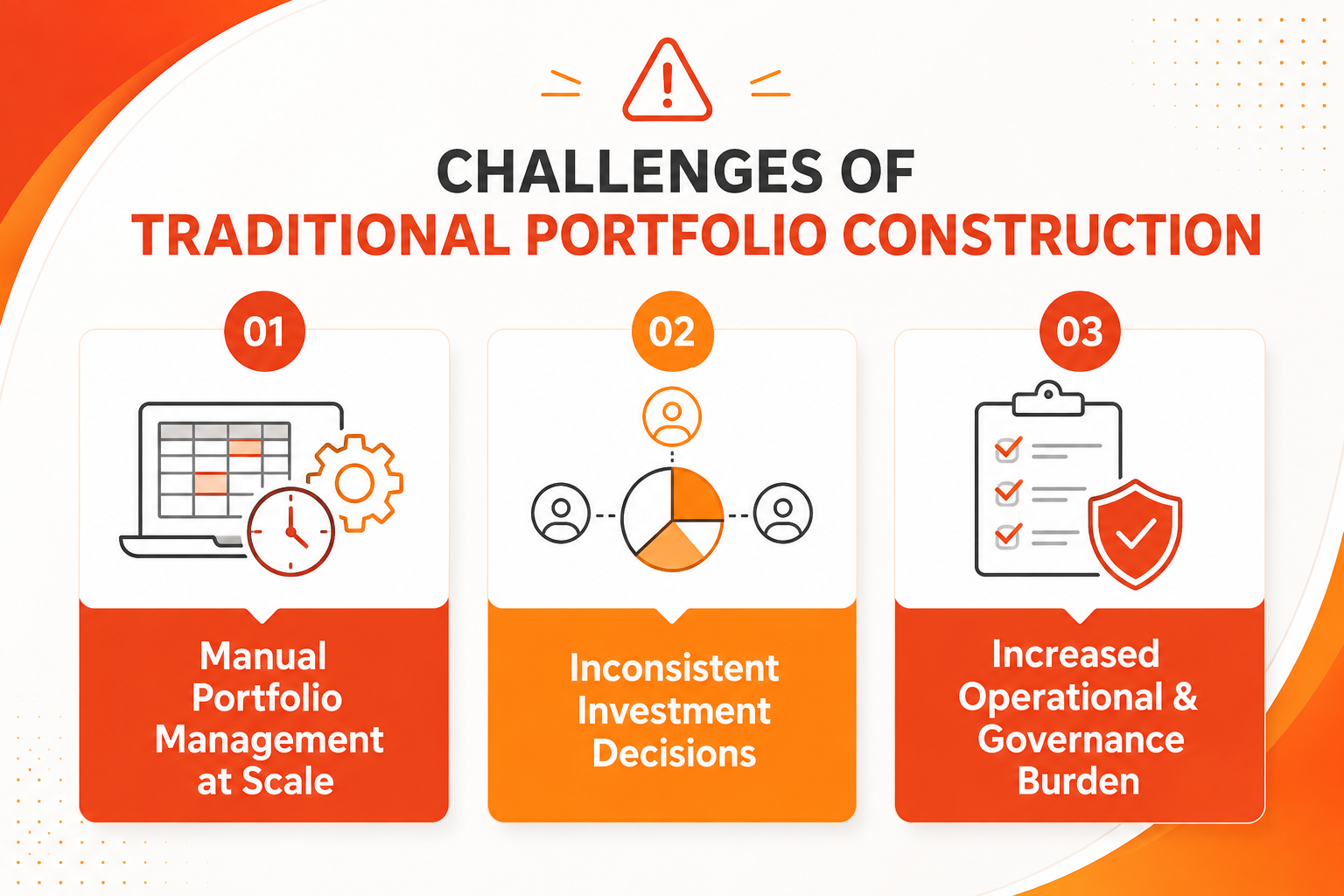
As firms grow, portfolio construction begins competing with other responsibilities, including client service, business development, compliance oversight, financial planning, and team management.
What once felt like a personalized approach can gradually become an operational bottleneck. Advisors find themselves spending more time maintaining portfolios and less time focusing on client relationships, strategic planning, and firm growth.
For many firms, the question is not whether they can manage portfolios manually. The question is whether they should.
Managing portfolios individually can also make consistency more difficult to maintain. Two households with similar objectives may receive different allocations, portfolio adjustments, or rebalancing decisions depending on who reviewed the account and when the review occurred.
Over time, those inconsistencies can create governance challenges, documentation gaps, client communication issues, and increased supervision requirements. This becomes particularly important for RIAs, OSJs, aggregators, and multi-advisor firms where investment oversight extends across multiple stakeholders.
A scalable investment process should produce consistent outcomes, not because every client receives the same portfolio, but because investment decisions are guided by the same framework.
Read More: How Advisors Can Turn Risk Management Into a Repeatable Model Portfolio Process
Every portfolio decision creates downstream responsibilities. Research must be documented, allocation changes must be reviewed, portfolios must be monitored, and client communications must be supported.
As customization increases, those responsibilities multiply.
Many firms eventually discover they are no longer managing a handful of portfolios. They are managing hundreds of unique exceptions. At that point, portfolio management becomes as much a governance challenge as an investment challenge.
A mature investment process requires more than portfolio expertise. It requires systems that support oversight, documentation, accountability, and consistency.
One of the most overlooked consequences of inefficient portfolio construction is its impact on scalability. When investment management depends heavily on a founder, senior advisor, or chief investment officer, growth often becomes constrained by individual capacity.
These warning signs often appear long before firms recognize them as portfolio construction issues. In reality, they are business infrastructure issues.
The firms that scale most effectively are typically those that view model portfolio construction as part of a broader governance and operating framework rather than simply an investment management tool.
Read More: 10 Risk Management Strategies for Advisors — Approaches to Managing Financial Risk Across Client Portfolios
A model portfolio framework is only as strong as the process behind it. Many firms focus heavily on investment selection while overlooking the governance, oversight, and operational structures that determine whether a portfolio construction process can be implemented consistently across hundreds or thousands of client accounts.
Effective model portfolio construction requires more than selecting investments or setting target allocations. It requires a documented framework that defines how decisions are made, reviewed, monitored, and updated over time. The strongest firms treat portfolio construction as an institutional process rather than an individual advisor function.
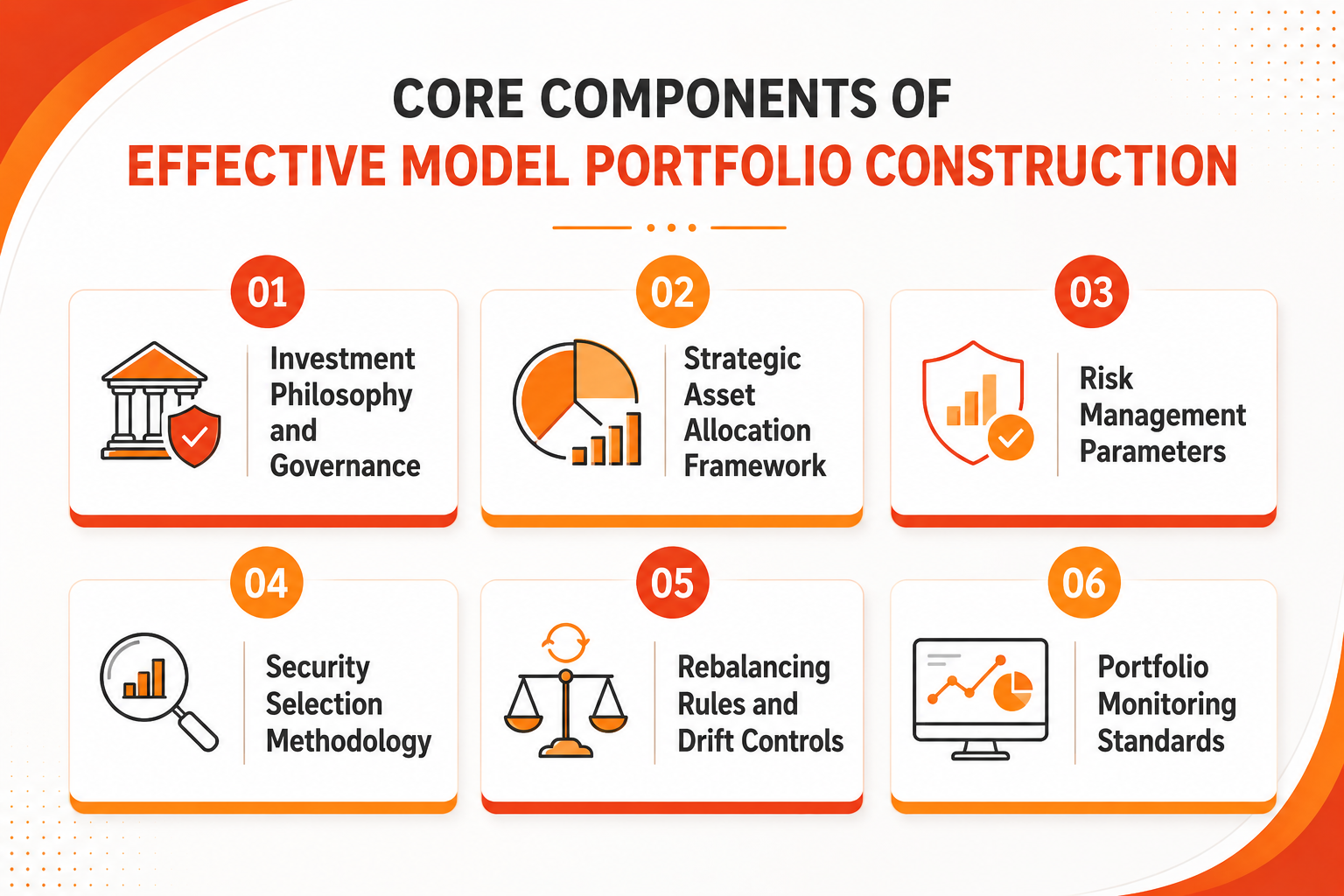
Every model portfolio should begin with a clearly defined investment philosophy. This philosophy establishes how the firm approaches asset allocation, diversification, risk management, security selection, and portfolio customization. More importantly, it creates consistency in decision-making and provides a framework for evaluating future portfolio changes.
Governance transforms that philosophy into an operating framework. It defines who can approve model changes, how often portfolios are reviewed, what documentation standards must be maintained, and how exceptions are handled. As firms grow, governance becomes increasingly important because portfolio construction is no longer managed by a single advisor. It is being implemented across multiple advisors, teams, and client relationships. Without clear governance standards, consistency becomes harder to maintain, and portfolio oversight becomes increasingly dependent on specific individuals.
Asset allocation remains the foundation of model portfolio construction. While investment discussions often focus on security selection, most portfolio decisions begin with determining the appropriate mix of equity, fixed income, cash, and other exposures. A well-defined allocation framework helps ensure portfolios are aligned with their intended objective before individual investment decisions are made.
For advisory firms, strategic asset allocation also serves an important governance function. It creates consistency across client portfolios and establishes clear parameters for future portfolio decisions. When allocation targets are documented and reviewed systematically, advisors can evaluate portfolio changes against a defined framework rather than making allocation decisions independently across hundreds of client accounts.
Model portfolios are designed to create repeatable investment outcomes, but repeatability requires clearly defined risk controls. Advisors should establish standards for monitoring concentration risk, diversification, liquidity, portfolio drift, and other exposures that could cause a portfolio to move away from its intended objective.
Many firms devote significant attention to performance discussions while underinvesting in risk governance. That imbalance often becomes more apparent as customization increases and client portfolios become more complex. Strong risk management standards help advisors identify when a portfolio has deviated from its intended role and determine whether corrective action, additional review, or a documented exception is appropriate.
A model portfolio should also establish a consistent process for selecting, evaluating, and replacing investments over time. Whether a firm uses ETFs, mutual funds, individual securities, or third-party model providers, the selection process should be documented and repeatable.
The goal is not simply choosing investments. The goal is to create a framework that supports consistency across advisors, continuity across market cycles, and long-term portfolio oversight. When security selection depends primarily on individual judgment, scalability becomes more difficult, and institutional knowledge becomes concentrated in a small number of people.
Rebalancing is one of the most important disciplines within a model portfolio framework. Without clearly defined procedures, portfolios can drift away from their intended allocations and gradually take on risk characteristics that differ from their original design.
A scalable framework should establish how rebalancing decisions are triggered, how exceptions are handled, and how allocation changes are implemented across client accounts. These standards help reduce ad hoc decision-making while ensuring portfolios remain aligned with their intended objectives. They also create a more consistent client experience by applying the same decision-making framework across similar portfolios.
Portfolio construction does not end once a model is implemented. Ongoing monitoring is necessary to ensure portfolios remain aligned with their objectives, risk parameters, and intended client use cases. As market conditions change and client circumstances evolve, advisors need a process for identifying issues before they become larger portfolio or governance concerns.
For growing firms, monitoring becomes a critical oversight function. A documented review process helps identify portfolio drift, changing risk exposures, implementation issues, and client-specific exceptions in a timely manner. More importantly, it provides confidence that the investment process is being applied consistently across the organization rather than varying from advisor to advisor.
Read More: Why Advisors Are Turning to Quantitative Risk Management in 2025
Model portfolios can improve consistency and scalability, but only when they are built through a structured process. Firms that skip foundational decisions often find themselves revisiting portfolio construction repeatedly as assets grow, client needs evolve, and customization requests increase.
The framework below provides a practical approach for building model portfolios that can scale without sacrificing oversight, governance, or flexibility.
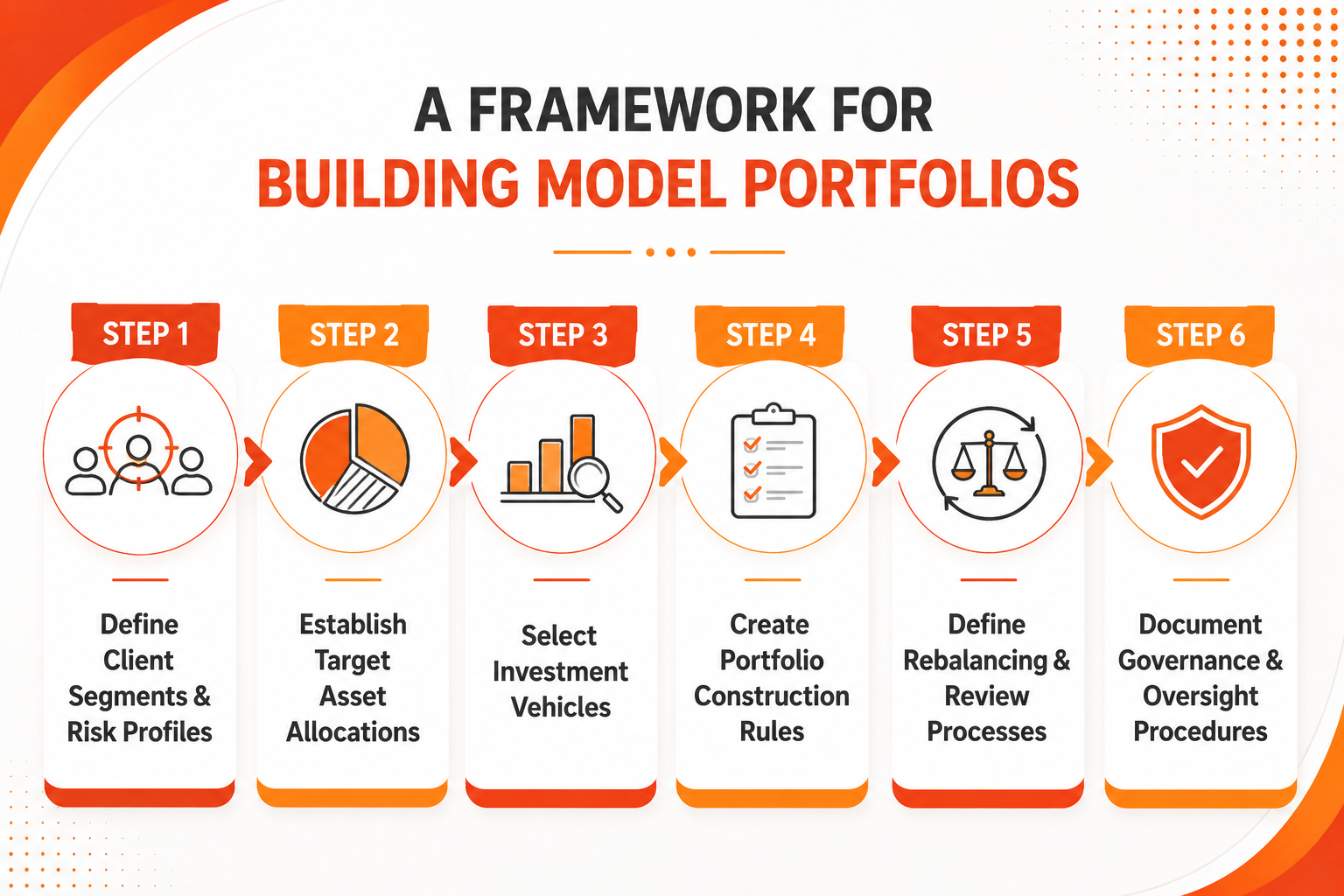
Effective model portfolio construction begins with client segmentation. Before designing portfolios, advisors should determine which client groups the models are intended to serve based on factors such as risk tolerance, investment objectives, liquidity needs, and overall portfolio complexity.
Many firms create unnecessary customization because segmentation is not clearly defined. As a result, new portfolios are created for situations that could have been addressed within an existing framework. Over time, that approach can lead to model sprawl, increased oversight requirements, and operational complexity.
The objective is not to eliminate customization. It is to ensure customization remains intentional, governable, and scalable.
Once client segments are defined, the next step is establishing strategic asset allocation targets. These targets provide the foundation for all future portfolio decisions and help ensure portfolios remain aligned with their intended objectives.
The most effective allocation frameworks are driven by investment policy rather than short-term market views. When allocation decisions become overly reactive, portfolio management often becomes more complex, more time-intensive, and more dependent on a small group of decision-makers.
After establishing allocation targets, advisors must determine how those allocations will be implemented. Whether the firm uses ETFs, mutual funds, individual securities, third-party models, or CIO-managed portfolios, the selection process should be consistent and documented.
The goal is not simply identifying investments. The goal is to build a portfolio structure that can be implemented efficiently, monitored consistently, and maintained as assets and client relationships grow.
Portfolio construction rules create consistency across advisors, portfolios, and client accounts. These rules establish the parameters that guide allocation ranges, diversification standards, risk controls, and customization decisions.
Without documented rules, portfolio management often becomes dependent on individual judgment. While that may work in smaller firms, it becomes increasingly difficult to supervise as the organization grows.
Read More: The New Era of Portfolio Design: Why Mathematical Diversity Outperforms Traditional Diversification
Rebalancing policies should be established before portfolios are implemented, not after. A defined review process helps ensure portfolios remain aligned with their intended allocations while creating consistency in how portfolio changes are evaluated and applied.
As firms grow, rebalancing often becomes one of the largest operational burdens within the investment process. Documented procedures help reduce unnecessary complexity while improving consistency across client portfolios.
The final step is documenting how the portfolio framework will be governed over time. This includes defining review schedules, approval procedures, exception handling standards, and investment oversight responsibilities.
This is the point where portfolio construction evolves from an advisor process into a firm process. Strong governance supports continuity, scalability, succession planning, and consistent implementation across the organization.
Firms that neglect governance often discover that growth creates complexity faster than their operational infrastructure can support.
Read More: Outsourced Portfolio Management: When Control Creates More Risk Than Protection
The debate is no longer whether model portfolios work. The more relevant question is whether legacy portfolio management approaches can continue supporting the operational, governance, and client-service demands facing modern advisory firms.
Many advisors built successful practices through highly personalized portfolio management. Portfolios were built individually, allocation decisions were made account by account, and investment oversight relied heavily on the judgment of a small number of people. While that approach can work effectively in the early stages of growth, it often becomes more difficult to sustain as firms add clients, advisors, and assets.
The primary advantage of model portfolio construction is not automation. It is scalability. Rather than managing hundreds of unique portfolios independently, advisors can oversee a structured framework designed to deliver consistent implementation, governance, and oversight across client portfolios.
Scalability, however, is only part of the story. Model portfolios also create greater consistency across the organization. Clients with similar objectives can be managed within the same investment framework, reducing the variability that often emerges when portfolio decisions are made independently by multiple advisors. Consistency improves portfolio oversight, strengthens governance, and creates a more repeatable investment process as firms grow.
Model portfolios can also improve risk oversight. Rather than monitoring every portfolio independently, firms can establish risk controls at the model level and evaluate implementation across client accounts. This creates a more structured approach to managing allocation drift, concentration risk, and other portfolio exposures while reducing the operational burden associated with account-by-account oversight.
Perhaps most importantly, model portfolios often improve the client experience. Some advisors assume standardization leads to less personalization. In practice, many firms discover the opposite. When advisors spend less time managing portfolios manually, they gain more capacity to focus on financial planning, client communication, behavioral coaching, and other activities that clients value most.
The objective is not to create a one-size-fits-all investment process. The objective is to create a scalable framework that allows advisors to deliver personalized advice more consistently, efficiently, and sustainably.
Read More: Model Fatigue is Real: Why Scalable Portfolio Customization is the Future
Model portfolios can improve consistency, governance, and scalability, but only when they are supported by a disciplined process. Most implementation failures are not investment problems. They are governance, operational, and oversight problems that become more apparent as firms grow.
One of the most common mistakes advisors make is allowing customization to expand beyond their ability to govern it effectively. What begins as a handful of client-specific exceptions can gradually evolve into dozens of portfolio variations, each requiring its own monitoring, documentation, and oversight.
The objective is not to eliminate customization. The objective is to ensure customization remains intentional and scalable. When customization becomes the default rather than the exception, firms often experience increased operational complexity, inconsistent implementation, and greater dependence on a small number of decision-makers.
Many firms invest heavily in portfolio design while underinvesting in governance. Approval procedures, review schedules, documentation standards, and oversight responsibilities are often left informal until growth exposes weaknesses in the process.
Portfolio construction becomes increasingly difficult to scale when investment decisions rely primarily on individual judgment rather than documented procedures. Strong governance creates consistency across advisors, portfolios, and client relationships while reducing dependence on specific individuals.
Rebalancing is one of the most important disciplines within a model portfolio framework, yet many firms approach it inconsistently. Different advisors may apply different drift thresholds, review schedules, or exception standards, creating uneven portfolio management across similar client accounts.
A documented rebalancing process helps maintain consistency, improve oversight, and ensure portfolios remain aligned with their intended objectives over time.
Documentation often receives less attention than portfolio construction itself, but it becomes increasingly important as firms grow. Investment decisions should be supported by clear records that explain what changed, why it changed, who approved the change, and how the decision aligns with the firm's investment process.
Weak documentation can create supervision challenges, increase operational risk, and make portfolio management more dependent on institutional memory rather than documented procedures.
Many of these mistakes appear operational on the surface, but they ultimately stem from the same issue: a portfolio process that has not evolved alongside the growth of the business. The firms that scale most effectively are often those that treat model portfolio construction as a governance framework rather than simply an investment framework.
Read More: 7 Proven Ways to Improve Investment Process in Wealth Management
As model portfolios become a larger part of advisory firm operations, technology plays an increasingly important role in supporting consistency, oversight, and scalability. The objective is not to replace advisor judgment. It is creating a more repeatable investment process that can be implemented and monitored across a growing number of client portfolios.
Quantitative research and portfolio analytics help advisors evaluate asset allocation decisions, monitor risk exposures, assess portfolio drift, and identify potential issues before they become larger portfolio management challenges. Rather than relying exclusively on subjective judgment, firms can incorporate more structured decision-making frameworks into the portfolio construction process.
Technology also helps reduce many of the operational burdens associated with managing portfolios at scale. Rebalancing workflows, portfolio monitoring, documentation processes, and reporting systems can all become more consistent when supported by the appropriate tools and infrastructure. This allows advisors to spend less time maintaining portfolios and more time focusing on client relationships, financial planning, and strategic growth initiatives.
Ultimately, technology is most valuable when it strengthens governance. The goal is not to automate investment management. The goal is to create an investment process that remains consistent, transparent, and scalable as the firm grows.
Model portfolio construction is ultimately about creating a repeatable investment process that supports both client outcomes and firm growth. The most effective frameworks do more than establish asset allocation targets. They create the structure needed to support governance, oversight, consistency, and scalability across the organization.
As advisory firms grow, portfolio construction becomes increasingly connected to advisor capacity, operational efficiency, succession planning, and enterprise value. A process that depends heavily on individual judgment may function effectively today, but it can create future constraints on growth, continuity, and oversight.
The firms that scale most effectively are often those that treat model portfolio construction as a business infrastructure decision rather than simply an investment management decision. By standardizing decision-making, strengthening governance, maintaining consistent risk oversight, and creating repeatable processes, advisors can build portfolio frameworks that remain effective as client relationships, assets, and organizational complexity increase.
Ultimately, the goal is not to eliminate customization. The goal is to create a scalable framework that allows advisors to deliver personalized advice consistently, efficiently, and sustainably.
Model portfolio construction is ultimately about creating a more scalable investment process. The most effective advisory firms recognize that portfolio construction is not simply an asset allocation exercise. It is a framework for improving consistency, strengthening governance, supporting advisor capacity, and delivering a more repeatable client experience as the firm grows.
Key Takeaways
Model portfolios help advisors scale portfolio management without sacrificing investment discipline.
Governance is just as important as asset allocation in a mature portfolio construction framework.
Excessive customization often creates operational complexity that limits scalability.
Consistent processes improve oversight, documentation, and decision-making across advisors and client portfolios.
Portfolio construction should support firm growth, continuity, and enterprise value, not just investment implementation.
For growing advisory firms, model portfolio construction is less about selecting investments and more about building the infrastructure needed to support long-term scalability, consistency, and investment oversight.
At Helios, we help advisory firms strengthen model portfolio design, portfolio monitoring, and scalable implementation through our Advanced Portfolio Design and “Automation” service, giving advisors a more disciplined framework for managing customization, rebalancing, and portfolio oversight.
Model portfolio construction is the process of creating a standardized investment portfolio framework that can be implemented across multiple client portfolios with similar investment objectives, risk tolerances, and asset allocation requirements. Advisors use model portfolios to improve consistency, scalability, and investment oversight.
Financial advisors use model portfolios to create a more repeatable investment process across client portfolios. Model portfolios can help improve consistency, strengthen governance, reduce operational complexity, and allow advisors to spend more time on client relationships, financial planning, and practice growth.
Custom model portfolios are designed to incorporate client-specific requirements that fall outside a firm's core portfolio framework. These may include tax considerations, concentrated positions, withdrawal needs, or investment restrictions. The challenge is balancing customization with governance and operational scalability.
Yes. Many wealth management firms use model portfolio solutions as the foundation for managing high-net-worth relationships. While additional customization may be required, a model-based framework can help maintain consistency while supporting more complex planning and investment needs.
Model portfolios do not guarantee better portfolio performance. Their primary purpose is to create a more consistent and disciplined investment process. Effective portfolio construction can help ensure portfolios remain aligned with investment objectives, risk tolerances, and long-term asset allocation targets.
Model portfolios can be implemented using ETFs, mutual funds, individual securities, collective investment trusts, and other approved investment vehicles. The specific investments selected should align with the firm's investment philosophy, portfolio objectives, and implementation requirements.
The answer depends on the firm's resources, investment expertise, governance structure, and growth objectives. Some advisors build proprietary models internally, while others work with asset managers, third-party model providers, or outsourced investment partners. The most important consideration is whether the chosen approach can support consistent implementation, oversight, and scalability over time.

Model portfolio management best practices for advisors. Improve investment oversight, portfolio governance, and scalable wealth management.

Learn how advisors build model portfolios for clients, manage customization, and create scalable portfolio processes.

Explore how advisors outsource investment management, compare asset management platforms, and evaluate portfolio support options.