Why Institutional Investment Management Matters for Succession
OCIO investment management helps multi-partner firms optimize succession, governance, and capital. Discover how institutional strategies and hiring...
.png?width=258&height=145&name=Helios%20Web%20Images%20800x450%20(9).png)
How Advisors Can Use Market Commentary to Strengthen Client Relationships — Not Overwhelm Them
11 min read

Every firm owner eventually faces a crossroads: continue building investment operations in-house and risk hitting a ceiling, or redesign the foundation to unlock scale, resilience, and higher valuation. Based on Deloitte’s 2026 investment management outlook, many firms are facing sustained pressure on profit growth as operating costs rise and margins tighten, while firms that outsource are achieving measurable gains in operational efficiency and enterprise value.
In 2026, the gap between firms that institutionalize their investment management process and those that rely on founder bandwidth is widening fast. Outsourced investment management has moved beyond a capacity solution and now serves as a structural lever for building enterprise value, especially for many advisory firms where leadership time is the primary bottleneck.
This guide covers:
P.S. Helios provides a fully integrated, quantitative investment management ecosystem designed to help firm owners institutionalize their investment process, reduce operational risk, and unlock new levels of enterprise value. Talk to our strategy team to evaluate how outsourcing can transform your firm’s growth trajectory through outsourced CIO solutions.
|
Section |
Actionable Takeaway |
|---|---|
|
Governance & Fiduciary Discipline |
Formalize decision rights, oversight cadence, and documentation with a defined OCIO process to reduce key-person risk. |
|
Operational Efficiency & Scalability |
Use portfolio oversight automation and integration with existing workflows to increase team capacity and scale profitably as outsourcing allows the firm to redeploy time and attention where it matters most. |
|
Enterprise Value Drivers |
Outsourcing supports recurring revenue, differentiation, and risk-adjusted profitability, all of which drive valuation. |
|
Cost & ROI |
Compare the total cost of ownership, including internal staff, tech, and compliance, against transparent OCIO fee models. |
|
OCIO vs. In-House Comparison |
Evaluate control, cost, research depth, scalability, risk, and client experience using a direct comparison table. |
|
Readiness & Fit |
Assess AUM, complexity, and growth goals to determine if your firm is a good candidate for outsourcing. |
|
Implementation & Integration |
Follow a structured transition plan, including risk mitigation and client communication, for a smooth handoff. |
|
Differentiation & Growth |
Leverage white-labeled solutions and institutional-grade processes to attract HNW clients and create new revenue streams. |
Growth-focused firms eventually reach a stage where the demands of investment oversight, research, and documentation begin to outpace the capacity of their leadership. As assets under management climb, so does the complexity of compliance, reporting, and client communication.
This accumulation of responsibility can quietly slow momentum, introduce operational risk, and limit the firm’s ability to pursue new opportunities. Outsourced investment management provides a structured solution, enabling firms to formalize their processes, distribute workload, and build a platform for sustainable expansion.
Firms operating in asset management environments often encounter this inflection point earlier, as portfolio complexity, reporting expectations, and governance requirements increase alongside client demand.
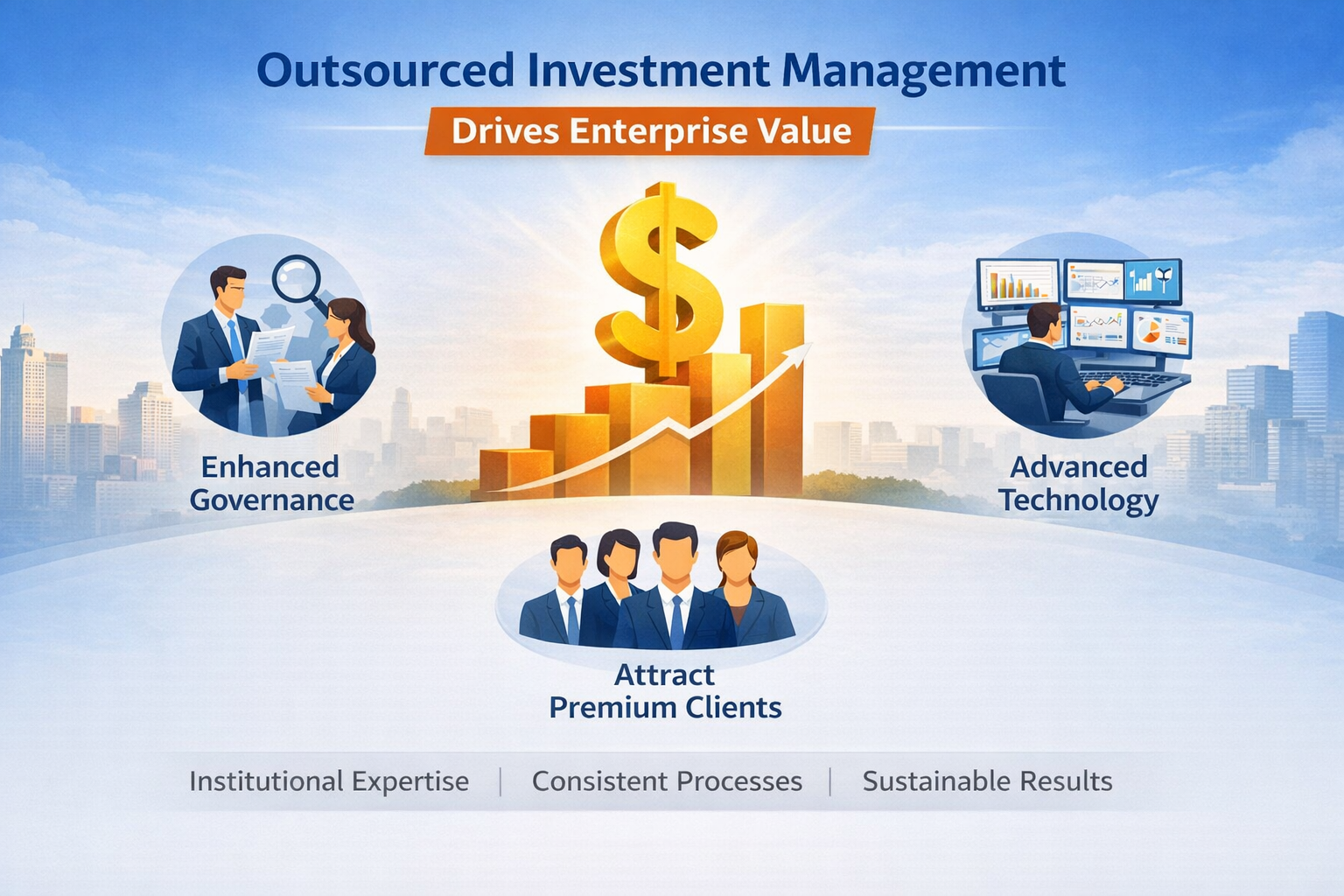
Firm value is shaped by more than just investment returns. The ability to scale operations, maintain rigorous governance, and deliver a consistent client experience all contribute to a higher enterprise valuation.
Outsourced investment management gives firm owners access to institutional-grade processes and technology that are often out of reach for in-house teams. By shifting to a structured, quantitative OCIO partnership, firms can reduce operational bottlenecks, improve documentation, and create a foundation for sustainable growth.
This approach supports current business needs and also positions the firm to attract premium clients, increase recurring revenue, and command a higher multiple in future transactions—because the investment enterprise becomes less dependent on founder bandwidth and more dependent on repeatable systems.
Effective governance underpins a firm’s credibility and long-term value. As firms grow, investment decisions become more complex and oversight requirements increase. Outsourcing investment management introduces a structured, committee-driven process that replaces informal routines with defined accountability.
Instead of relying on ad hoc judgment, portfolio changes, asset allocation adjustments, and risk responses follow a documented process supported by clear rationale and decision ownership. This structure creates a transparent audit trail that withstands both client and regulatory scrutiny.
A disciplined oversight framework ensures that model updates, committee decisions, and portfolio adjustments are consistently recorded and reviewed. These processes help close governance gaps and strengthen audit readiness as firms expand.
Regular investment committee meetings, structured documentation, and outcome monitoring reinforce fiduciary discipline. In many firms, the investment manager works within this governance structure to ensure portfolio decisions align with documented objectives and oversight procedures.
A well-designed governance model also supports the consistent delivery of investment management services, ensuring recommendations, approvals, and portfolio changes follow a clear, repeatable process rather than informal discussions.
Strong governance further reduces conflict-of-interest risk by clearly defining roles, decision rights, and documentation standards, ensuring oversight remains consistent regardless of who participates in the decision-making process.
Firms that bring in a third-party partner strengthen their investment expertise and extend their investment team without increasing internal headcount.
In this model, the OCIO often serves as a strategic outsourcing partner, supporting the firm’s internal teams with research infrastructure, governance processes, and portfolio oversight capabilities.
These structures allow firms to implement diversified investment strategies more consistently while maintaining oversight and documentation standards.
For leadership teams focused on practice management, this shift is often the difference between “we’re holding it together” and “we’re building a firm that can scale.”
Read Next:
Outsourcing investment management influences the most important levers of firm valuation. When operations are streamlined and supported by a defined process, recurring revenue becomes more stable and predictable.
Institutional-grade reporting and oversight help firms stand out in a crowded market, making them more appealing to high-net-worth clients and potential acquirers. As operational costs are brought under control and compliance risk is reduced, profitability improves on a risk-adjusted basis.
This is why wealth management leadership teams increasingly treat outsourcing as an enterprise decision, and not just a staffing decision, as it changes how buyers underwrite durability, risk, and scalability.
Understanding the true cost of investment management requires a detailed look at every component that affects the firm’s bottom line. For decision-makers, the focus should be on how each cost element supports margin expansion, operational flexibility, and long-term value creation.
Additionally, in many firms, outsourcing consolidates multiple operational management services, including research oversight, portfolio monitoring, reporting, and governance, into a more streamlined structure.
Instead of simply comparing headline fees, evaluate the full financial impact of both in-house and outsourced models, including hidden costs and the opportunity to reinvest in growth initiatives. This is central to the strategy decision to outsource.
|
Cost Area |
In-House Model |
Outsourced OCIO Model |
Verification/Next Step |
|---|---|---|---|
|
Staff & Payroll |
Salaries, benefits, ongoing training, and turnover risk for investment staff. |
Flat fee per advisor or basis points on AUM; no internal hiring required. |
Compare the total annual cost for the current team vs. the OCIO fee. |
|
Technology & Research |
Licensing, data feeds, analytics tools, and ongoing upgrades. |
Included in OCIO service; access to institutional-grade research and tools. |
Audit current tech spend and compare to OCIO inclusions. |
|
Compliance & Oversight |
Internal compliance staff, documentation, and audit prep. |
Built-in compliance documentation and audit-ready systems. |
Review audit history and regulatory findings. |
|
Opportunity Cost |
Time spent on investment ops vs. client growth and business development. |
Advisors focus on client relationships and growth activities. |
Track advisor time allocation pre- and post-outsourcing. |
|
Scalability |
Cost and complexity increase with AUM and client base. |
OCIO model scales efficiently with firm growth. |
Project cost at the next AUM milestone for both models. |
|
ROI |
Variable, dependent on team performance and retention. |
Predictable, with performance reporting and accountability. |
Analyze historical ROI and set benchmarks for OCIO. |
Read Next:
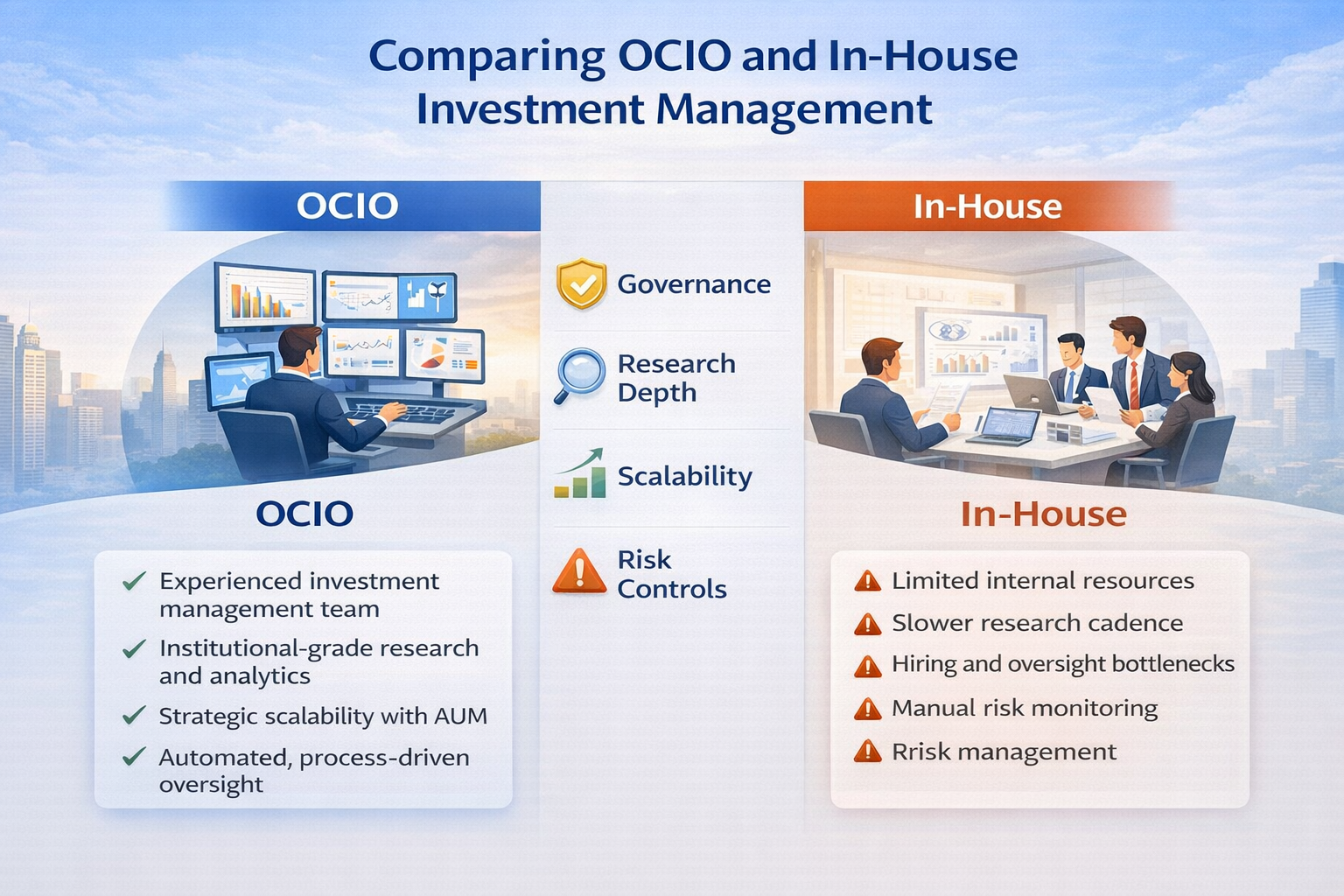
Evaluating whether to retain investment management in-house or partner with an OCIO is a pivotal decision for firm owners. Each model comes with trade-offs across control, cost, research depth, scalability, investment risk management, and client experience.
However, in practice, the benefits of an OCIO are easiest to evaluate when you compare governance, research depth, scalability, and risk controls side-by-side against an in-house model.
| Dimension | OCIO/Outsourced CIO Model | In-House Portfolio Management Model | What to Verify/Consider |
|---|---|---|---|
| Control | Defined governance, decision rights, and oversight cadence; clear documentation. | Founder or small team retains control; risk of inconsistent process. | Review governance logs and decision records. |
| Cost | Transparent fee structure; eliminates internal hiring, tech, and compliance overhead. | High fixed costs for staff, tech, and compliance; variable with growth. | Calculate the total cost of ownership at current/future AUM. |
| Research Depth | Access to institutional-grade research, analytics, and model portfolios. | Limited by internal expertise and resources. | Compare research output and due diligence cadence. |
| Scalability | Scales efficiently with AUM and client base; supports rapid growth and integration. | Scaling requires hiring, training, and an increased oversight burden. | Project resource needs at the next growth milestone. |
| Risk Management | Quantitative, process-driven risk monitoring and oversight automation. | Manual monitoring; higher key-person and operational risk. | Audit risk review cadence and incident history. |
| Client Experience | White-labeled, branded reporting and communication; supports HNW client acquisition. | Custom, often inconsistent client materials; limited scalability. | Survey client satisfaction and retention rates. |
For OCIO firms, the differentiator is often the ability to deliver a repeatable, auditable operating model—not simply “more resources.”
Read Next: What It Takes to Run Investments In-House vs Outsourced CIO Cost
Deciding to outsource investment management requires a comprehensive evaluation of your firm’s current structure, growth ambitions, and governance needs. This decision is not simply about shifting workload; it is about aligning your operating model with your long-term vision for scale, efficiency, and risk management.
A robust framework helps firm owners assess readiness, clarify governance expectations, and identify the right partner fit, so the decision to outsource supports both immediate operations and future valuation.
Determining if your firm is a good candidate for outsourcing starts with an honest assessment of current capacity, growth goals, and risk exposure. Firms with $100M+ in AUM, complex investment or client needs, or rapid growth ambitions often benefit most from outsourcing. Evaluate whether your organization's investment process is scalable, compliant, and defensible under audit. If internal workload is inconsistent or key-person risk is rising, outsourcing may be the next logical step.
Maintaining appropriate oversight post-outsourcing requires a clear governance process. Define who retains final decision rights, how model changes are approved, and how documentation is maintained.
Compliance documentation support and oversight automation ensure that every action is logged, reviewable, and aligned with fiduciary responsibilities. Regular investment committee meetings and audit-ready records are essential for sustaining control and accountability.
Selecting the right OCIO partner involves more than comparing fees. Assess alignment with your investment philosophy, technology integration capabilities, and flexibility to tailor solutions to your firm’s needs.
Look for partners who offer white-labeled frameworks, robust risk management, and transparent reporting. Red flags include a lack of documentation, inflexible service models, or misalignment with your management strategy.
Read Next:
A successful transition to outsourced investment management depends on careful planning, clear communication, and disciplined execution. Firms that approach this process methodically are able to minimize disruption, maintain client confidence, and realize the full benefits of their new operating model.
Each step should be designed to ensure operational continuity, regulatory compliance, and a seamless client experience.
A successful transition includes:
Outsourcing investment management is a strategic lever for firms that want to stand out in a competitive market and accelerate sustainable growth. By adopting institutional-grade processes, firms can deliver a client experience that is both consistent and compelling, which is especially important for attracting and retaining high-net-worth clients.
The ability to scale operations, maintain rigorous oversight, and provide branded, data-driven reporting positions the firm as a leader in its segment.
A transparent, repeatable investment process signals credibility to sophisticated clients and referral partners. Firms that use Helios’ quantitative investment models and portfolio oversight automation can demonstrate a disciplined approach to risk management, portfolio construction, and ongoing monitoring.
This level of process maturity is often cited by Helios clients as a key factor in winning new business and building trust with demanding clients.
Helios’ white-labeled framework enables firms to deliver branded, data-backed reports and educational content at scale. This capability supports consistent client engagement, reinforces the firm’s brand, and allows for rapid growth without compromising quality or compliance.
By integrating these solutions into their operating model, firms can efficiently serve a broader range of clients while maintaining a high standard of service.
Outsourcing can also open new revenue opportunities. By bringing external management fees in-house and supporting the acquisition or integration of other practices, firms can create additional recurring revenue streams. This is one reason private equity buyers often care deeply about whether the investment engine is founder-dependent or truly institutional.
Outsourced investment management provides a foundation for sustainable growth, robust governance, and increased enterprise value. When firms institutionalize their investment process, reduce operational risk, and create new revenue streams, they gain the capacity to scale and adapt in a changing market.
This approach allows firm owners to dedicate more time to client relationships and long-term strategy, supporting both immediate business and financial goals and a lasting legacy.
A firm’s ability to scale, adapt, and lead is determined by the strength of its investment infrastructure. When investment management is supported by institutional-grade processes, rigorous documentation, and a scalable operating model, the firm is positioned for sustainable growth and higher valuation.
Helios delivers quantitative investment models, compliance documentation support, and a white-labeled framework that enables firm owners to institutionalize their investment process and maximize enterprise value. Talk to our strategy team to explore how outsourcing can become your next growth lever.
Outsourcing investment management provides firm owners with access to institutional-grade research, risk management, and operational efficiency. It reduces key-person risk, streamlines compliance, and enables scalable growth, all of which contribute to higher enterprise value, especially for firms that outsource to institutionalize their process.
An OCIO model formalizes governance, automates oversight, and provides access to advanced research and technology. In-house models rely on internal staff and can be limited by bandwidth, expertise, and scalability, increasing operational risk as the firm grows. This is why some leaders hire an OCIO when growth makes internal oversight difficult to sustain
Key criteria include alignment with your investment philosophy, robust risk management, transparent reporting, technology integration, and the ability to tailor solutions to your firm’s needs. Documentation, flexibility, and a proven track record are essential, especially for advisors outsourcing decisions where client experience must remain consistent.
Outsourcing with a partner like Helios provides built-in compliance documentation, automated oversight, and audit-ready systems. This reduces administrative burden, mitigates regulatory risk, and ensures every investment action is defensible and reviewable.
Firms with growing AUM, complex client needs, or inconsistent internal workload are strong candidates. If key-person risk is rising or the current process is not scalable or audit-ready, outsourcing can provide immediate and long-term value, particularly for financial advisor teams expanding quickly.
The process includes auditing current operations, planning data migration and integration, assigning roles, communicating with clients, testing systems, and documenting every step for compliance. Regular reviews and performance monitoring ensure a smooth transition.

OCIO investment management helps multi-partner firms optimize succession, governance, and capital. Discover how institutional strategies and hiring...

Many founder-led RIAs wait too long to partner with an outsourced chief investment officer (OCIO). Uncover the root causes, risks, and how to make a...

Compare OCIO models that outsource investment management and show how an outsourced chief investment officer supports governance model decisions,...