Investment Process Documentation: The Missing Link Between Performance and Governance
Discover why investment process documentation helps RIAs strengthen governance, improve oversight, reduce risk, and scale more effectively.
.png?width=258&height=145&name=Helios%20Web%20Images%20800x450%20(9).png)
How Advisors Can Use Market Commentary to Strengthen Client Relationships — Not Overwhelm Them
16 min read

Risk-adjusted return investing helps advisors evaluate investment performance relative to the amount of risk required to generate those returns. Rather than focusing solely on absolute return, advisors use measures such as the Sharpe Ratio, Sortino Ratio, Treynor Ratio, beta, and alpha to determine whether an investment portfolio is delivering sufficient return for the risk taken.
That distinction matters because a fund's reported return is not always the return investors actually experience. Morningstar's 2025 Mind the Gap study found that the average dollar invested in U.S. mutual funds and ETFs earned 7.0% annually over the decade ending December 31, 2024, compared with an 8.2% annual total return for those same funds. Performance alone rarely tells the full story. Advisors must also evaluate volatility, downside risk, market exposure, investor behavior, and portfolio efficiency when assessing investment results.
For advisory firms, risk-adjusted returns influence far more than portfolio analysis. They shape manager selection, model portfolio oversight, investment committee decisions, due diligence standards, and investment governance. The question is not whether advisors should evaluate returns. The question is whether they have a consistent framework for evaluating return and risk across portfolios, advisors, and investment committees.
P.S. Many advisory firms turn to Helios's Outsourced CIO Services to create a more disciplined framework for evaluating risk, return, and portfolio performance across client accounts.
Risk-adjusted investing is the practice of evaluating returns in the context of the risk required to achieve them. For advisors, this approach provides a more complete framework for assessing portfolio performance, comparing investment strategies, and supporting investment decisions. Rather than asking whether a portfolio generated strong returns, risk-adjusted investing asks whether those returns justified the level of risk taken to achieve them.
A risk-adjusted return measures how much return an investment generates relative to the amount of risk required to achieve that result.
Most investors naturally focus on performance. However, two investments can generate identical returns while exposing clients to dramatically different levels of risk. Risk-adjusted investing helps advisors evaluate performance relative to the risk involved rather than focusing solely on the final return.
For example, two portfolios may each generate a 10% average return over a given period. If one portfolio experienced significantly higher volatility, larger drawdowns, and greater downside risk, the second portfolio likely produced a superior risk-adjusted return despite delivering the same absolute performance.
This distinction becomes increasingly important as advisory firms grow.
A portfolio that generates attractive returns but introduces excessive volatility creates additional client communication challenges, increases behavioral risk, complicates investment oversight, and places greater demands on investment committees and portfolio review processes.
Risk-adjusted return metrics create a common language for investment decision-making. Without standardized risk metrics, advisors often rely on subjective judgments when evaluating managers, mutual funds, ETFs, model portfolios, and investment strategies. A structured framework helps firms:
Compare investment options consistently
Evaluate active managers more objectively
Improve portfolio governance
Strengthen investment committee reviews
Create repeatable due diligence standards
Improve advisor scalability
As firms add advisors, portfolios, and client relationships, consistency becomes increasingly valuable. Standardized risk-adjusted metrics help ensure that investment decisions remain repeatable, defensible, and aligned with the firm's broader investment process.
Read Next: Why Advisors Are Turning to Quantitative Risk Management in 2025
Risk-adjusted return measures are frequently used throughout the advisory firm's investment process.
Whether evaluating managers, reviewing model portfolios, or supporting investment committee decisions, risk-adjusted metrics help advisors create a more disciplined framework for assessing portfolio performance and risk.
The Sharpe Ratio is one of the most widely used risk-adjusted return measures in investment management. Advisors use it to evaluate whether an investment portfolio is generating sufficient return relative to the volatility required to achieve those results. While returns often receive the most attention, the Sharpe Ratio helps put those returns into context by measuring performance relative to risk.
Developed by Nobel Prize-winning economist William Sharpe, the Sharpe Ratio measures excess return relative to total portfolio volatility.
The calculation subtracts the risk-free rate from the portfolio return and divides the result by the portfolio's standard deviation. The resulting figure indicates how much return an investment generated for each unit of total risk assumed.
In general, a higher Sharpe Ratio suggests stronger risk-adjusted performance because the portfolio is generating greater returns relative to its overall volatility. This makes the metric particularly useful when evaluating two investments with similar returns but different risk profiles.
The best way to understand the Sharpe Ratio is to see it in practice. Assume two portfolios each generated a 10% annual return while the risk-free rate was 4%.
For Portfolio A, the excess return is 6% (10% minus 4%). Dividing that figure by a 12% standard deviation produces a Sharpe Ratio of 0.50.
For Portfolio B, the same 6% excess return is divided by an 8% standard deviation, resulting in a Sharpe Ratio of 0.75. Although both portfolios generated identical returns, Portfolio B achieved those returns with a lower degree of risk. As a result, it produced a higher Sharpe Ratio and a better risk-adjusted outcome.
For advisors evaluating managers, ETFs, mutual funds, or model portfolios, this distinction can be meaningful. Two investments may appear equally attractive based on performance alone, but a risk-adjusted analysis often reveals important differences in portfolio efficiency.
The Sharpe Ratio remains a foundational metric because it creates a common framework for evaluating investment portfolios across different managers and strategies.
Advisors frequently use the metric when conducting due diligence, reviewing model portfolios, evaluating manager performance, and supporting investment committee discussions. Because it evaluates return and standard deviation together, it provides a more complete assessment of portfolio efficiency than performance alone.
As advisory firms grow, standardized evaluation frameworks become increasingly important. Consistent risk-adjusted return measures help reduce subjectivity, improve investment governance, and create a more repeatable process for portfolio oversight.
No single metric can capture every dimension of portfolio risk.
The primary limitation of the Sharpe Ratio is that standard deviation treats all volatility equally. Positive volatility and negative volatility both influence the calculation.
From an investor's perspective, however, these outcomes are rarely viewed the same way. Most clients are not concerned when returns exceed expectations. They are concerned when portfolios experience losses.
As a result, the Sharpe Ratio may not fully capture how investors experience risk. This limitation is one reason advisors often supplement Sharpe analysis with additional risk-adjusted return measures that focus specifically on downside risk.
While the Sharpe Ratio remains one of the most widely used risk-adjusted return metrics, many advisors want a measure that focuses more directly on downside risk. The Sortino Ratio was developed to address that need by evaluating returns relative to negative volatility rather than overall volatility.
The Sortino Ratio builds upon the concept of risk-adjusted returns by isolating downside deviation.
Unlike the Sharpe Ratio, which uses total standard deviation, the Sortino Ratio focuses exclusively on negative volatility. This allows advisors to evaluate how efficiently a portfolio generates returns relative to downside risk.
For many firms, this provides a more practical measure of portfolio risk because it aligns more closely with how investors experience market declines.
Consider two portfolios that each generated a 10% annual return and use a 4% target return.
Both portfolios generated the same return. However, Portfolio B experienced significantly less downside volatility.
As a result, Portfolio B produced a substantially higher Sortino Ratio, indicating that it generated stronger returns relative to the downside risk assumed.
This distinction can be particularly important when evaluating retirement income portfolios, downside protection strategies, or risk-managed investment portfolios where limiting losses is a primary objective.
For many investors, downside risk has a greater impact on the client experience than total volatility.
Portfolio drawdowns, sequence-of-return risk, withdrawal sustainability, and behavioral responses to market declines often have a more direct effect on client outcomes than short-term fluctuations alone.
Because the Sortino Ratio focuses specifically on negative outcomes, it often provides additional insight into how a portfolio may behave during challenging market environments.
Many advisory firms use both Sharpe and Sortino analysis because each metric highlights a different aspect of portfolio risk.
Read More: How Advisors Can Turn Risk Management Into a Repeatable Model Portfolio Process
Both the Sharpe Ratio and Sortino Ratio are designed to evaluate risk-adjusted returns, but they measure different forms of risk. Understanding those differences can help advisors select the right metric for the right situation.
The Sharpe Ratio evaluates return relative to total volatility, while the Sortino Ratio evaluates return relative to downside volatility only.
At first glance, the distinction may seem minor. In practice, it can lead advisors to very different conclusions about the same investment portfolio.
Consider two portfolios with similar returns and comparable levels of overall volatility.
A Sharpe Ratio analysis may suggest that both portfolios are equally attractive because their return calculation and standard deviation profiles are similar.
However, if one portfolio experienced significantly fewer negative periods, the Sortino Ratio could produce a very different conclusion. In that scenario, the portfolio with less downside deviation may provide a better risk-adjusted experience despite appearing similar under a traditional volatility-based analysis.
For advisors, understanding the type of risk behind investment performance is often just as important as understanding the performance itself.
Neither the Sharpe Ratio nor the Sortino Ratio should be viewed in isolation.
Many firms supplement these calculations with additional risk-adjusted return measures such as alpha, Jensen's alpha, beta, R-squared, standard deviation, and maximum drawdown. Each metric evaluates a different aspect of portfolio behavior and helps create a more complete picture of risk and return.
For example, a portfolio may generate a high Sharpe Ratio but produce little alpha relative to its benchmark. Another strategy may demonstrate attractive risk-adjusted performance while maintaining a level of market risk that exceeds the client's objectives.
Viewed together, these metrics provide greater context than any individual calculation alone and support more informed investment decisions.
There is no universally superior measure of risk-adjusted performance.
The Sharpe Ratio is often most useful when evaluating broad portfolio efficiency and return per unit of total risk. The Sortino Ratio becomes increasingly valuable when downside protection, withdrawal sustainability, and loss mitigation are primary concerns.
The strongest investment governance frameworks rarely rely on a single metric. Instead, they combine Sharpe Ratio, Sortino Ratio, alpha, beta, R-squared, and other risk-adjusted return measures to evaluate portfolio performance from multiple perspectives.
Ultimately, choosing the right metric depends on the portfolio objective, client goals, and type of risk being evaluated. Advisors who incorporate multiple risk-adjusted measures into their investment process are often better positioned to strengthen portfolio oversight, improve governance, and make more consistent investment decisions.
Read More: 7 Best Downside Protection Strategies for Advisors — Managing Portfolio and Investment Risk
While the Sharpe Ratio and Sortino Ratio are among the most widely used risk-adjusted return measures, they do not capture every dimension of portfolio risk. Advisors often incorporate additional metrics to evaluate manager skill, benchmark-relative performance, downside exposure, and portfolio resilience.
Taken together, these measures provide a more complete framework for evaluating investment portfolios and supporting investment committee decisions.
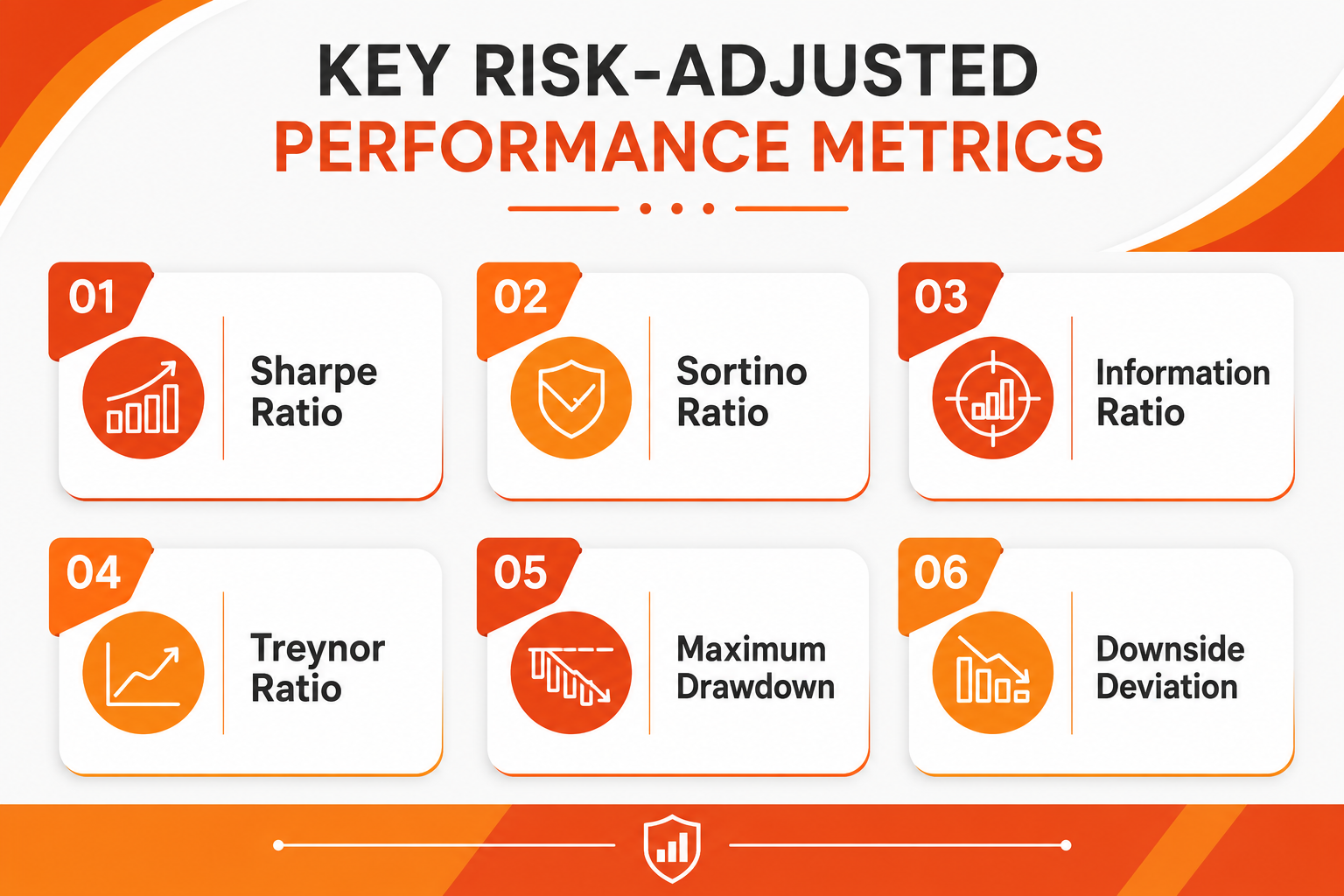
The Information Ratio evaluates a manager's ability to generate excess returns relative to a benchmark.
Unlike the Sharpe Ratio, which compares returns against a risk-free rate, the Information Ratio focuses on benchmark-relative performance. Specifically, it measures whether a manager is generating enough excess return to justify deviating from the benchmark.
For advisors conducting manager due diligence, this can be an important distinction.
A manager may outperform the benchmark in a given period, but if that outperformance comes with significant tracking error, the results may be less impressive than they initially appear. The Information Ratio helps quantify whether active management decisions are adding value consistently rather than simply increasing portfolio risk.
As a result, the metric is commonly used during manager selection, institutional portfolio reviews, investment committee evaluations, and Outsourced CIO oversight processes.
The Treynor Ratio is similar to the Sharpe Ratio but evaluates returns relative to market risk rather than total portfolio volatility.
Instead of using standard deviation, the Treynor Ratio uses beta, which measures a portfolio's sensitivity to broader market movements.
Because beta focuses on systematic risk, the Treynor Ratio can be particularly useful when evaluating diversified portfolios where company-specific risk has largely been diversified away.
For example, two equity managers may generate similar returns, but one manager may be taking substantially more market risk to achieve those results. The Treynor Ratio helps advisors determine which manager is generating more return per unit of market exposure.
This makes the metric particularly relevant when comparing diversified equity strategies, evaluating benchmark-relative performance, and assessing portfolios against broad market indexes such as the S&P 500.
While maximum drawdown is not technically a ratio, it remains one of the most practical measures of portfolio risk.
Maximum drawdown measures the largest peak-to-trough decline experienced by a portfolio during a specific period. Unlike many risk metrics that focus on statistical concepts, drawdowns represent losses that clients can clearly see and experience.
For many advisory firms, maximum drawdown is one of the most important metrics in portfolio reviews because it connects directly to investor behavior.
A portfolio may demonstrate strong long-term returns and attractive risk-adjusted performance, but significant drawdowns can still create client communication challenges, increase behavioral risk, and place additional pressure on advisors during market downturns.
For this reason, many firms evaluate maximum drawdown alongside Sharpe Ratio, Sortino Ratio, and other risk-adjusted return measures rather than reviewing any metric in isolation.
Downside deviation measures the variability of negative returns and serves as the foundation of the Sortino Ratio.
Where standard deviation measures both positive and negative volatility, downside deviation focuses exclusively on returns that fall below a specified target or minimum acceptable return.
This distinction makes downside deviation particularly useful when evaluating how portfolios behave during periods of market stress.
For advisors focused on retirement income planning, downside protection, or risk-managed portfolios, downside deviation often provides more actionable insight than standard deviation alone because it concentrates on the outcomes most likely to affect client behavior and long-term financial plans.
One of the most common mistakes advisors make is relying too heavily on a single performance metric.
Every risk-adjusted measure evaluates a different aspect of portfolio behavior. The Sharpe Ratio focuses on return relative to total volatility. The Sortino Ratio isolates downside risk. The Information Ratio evaluates benchmark-relative skill. The Treynor Ratio measures return relative to market exposure. Maximum drawdown highlights real-world losses experienced by investors.
Viewed together, these metrics provide a more complete picture of portfolio performance than any individual calculation alone.
For advisory firms, this broader perspective can strengthen manager due diligence, improve investment governance, support investment committee reviews, and create a more repeatable framework for portfolio oversight.
Read Next: 7 Proven Ways to Improve Investment Process in Wealth Management
Understanding risk-adjusted metrics is only the first step. Their real value comes from how they influence portfolio construction, manager selection, investment committee decisions, and ongoing portfolio oversight.
Risk-adjusted investing becomes most valuable when it influences portfolio decisions rather than serving as a reporting exercise.
Many advisory firms focus heavily on asset allocation and security selection but spend less time evaluating whether the level of risk taken is being rewarded appropriately. Risk-adjusted return measures help bridge that gap by providing a framework for evaluating portfolio efficiency alongside portfolio performance.
For example, two model portfolios may target similar long-term returns. However, one may require substantially higher volatility, greater downside risk, and larger drawdowns to achieve those results. A risk-adjusted review helps advisors determine whether the additional risk is justified.
This distinction extends beyond investment outcomes. Portfolio construction decisions affect client experience, behavioral discipline during market volatility, portfolio oversight requirements, and the firm's ability to scale investment management across multiple advisors.
As firms grow, risk-adjusted analysis helps ensure portfolio decisions remain consistent across advisors, models, and client relationships.
Manager evaluation remains one of the most common applications of risk-adjusted return analysis.
Whether advisors are reviewing mutual funds, ETFs, separately managed accounts, model providers, or third-party strategists, performance alone rarely tells the full story. A manager who generated higher returns may appear superior until advisors evaluate the risk required to achieve those results.
Risk-adjusted analysis provides additional context by incorporating factors such as volatility, beta, downside deviation, maximum drawdown, alpha generation, and benchmark-relative performance. This helps advisors distinguish between genuine skill and returns driven primarily by higher risk exposure.
Objective risk-adjusted metrics also help support manager decisions with documented evidence rather than recent performance alone. This creates a more disciplined framework for due diligence and investment oversight.
Investment committees function most effectively when decisions are guided by objective standards.
Without a consistent framework, portfolio reviews can become influenced by recent performance, market forecasts, manager reputation, or individual preferences. Risk-adjusted return measures create a common language for evaluating investment decisions.
Rather than focusing solely on returns, committees can evaluate whether a portfolio generated sufficient return for the risk taken, whether the strategy remains aligned with its intended role, and whether its risk profile has changed over time.
As firms grow beyond founder-led decision-making, standardized review criteria help create continuity across advisors, committees, and investment processes.
Model portfolio oversight often becomes more challenging as customization increases.
Additional portfolio variations can expand research demands, complicate review cycles, and make documentation more difficult to maintain. Over time, these challenges can create inconsistencies in how portfolios are monitored and evaluated.
Risk-adjusted return measures help establish standardized review criteria across the investment platform. Firms may evaluate return efficiency using the Sharpe Ratio, downside protection through the Sortino Ratio, market exposure through beta, active management value through alpha, benchmark-relative performance through the Information Ratio, and loss experience through maximum drawdown.
No single metric tells the entire story. Effective portfolio oversight combines multiple measures to evaluate performance from different perspectives. When applied consistently, risk-adjusted review processes help reduce subjectivity, improve governance, and create a more scalable approach to portfolio management.
Risk-adjusted return measures provide valuable insight into portfolio performance, but their effectiveness depends on how they are applied. Advisors can strengthen investment analysis by avoiding common pitfalls that may lead to incomplete conclusions or misaligned recommendations. The following mistakes often limit the value of risk-adjusted performance evaluation and can affect portfolio decision-making.
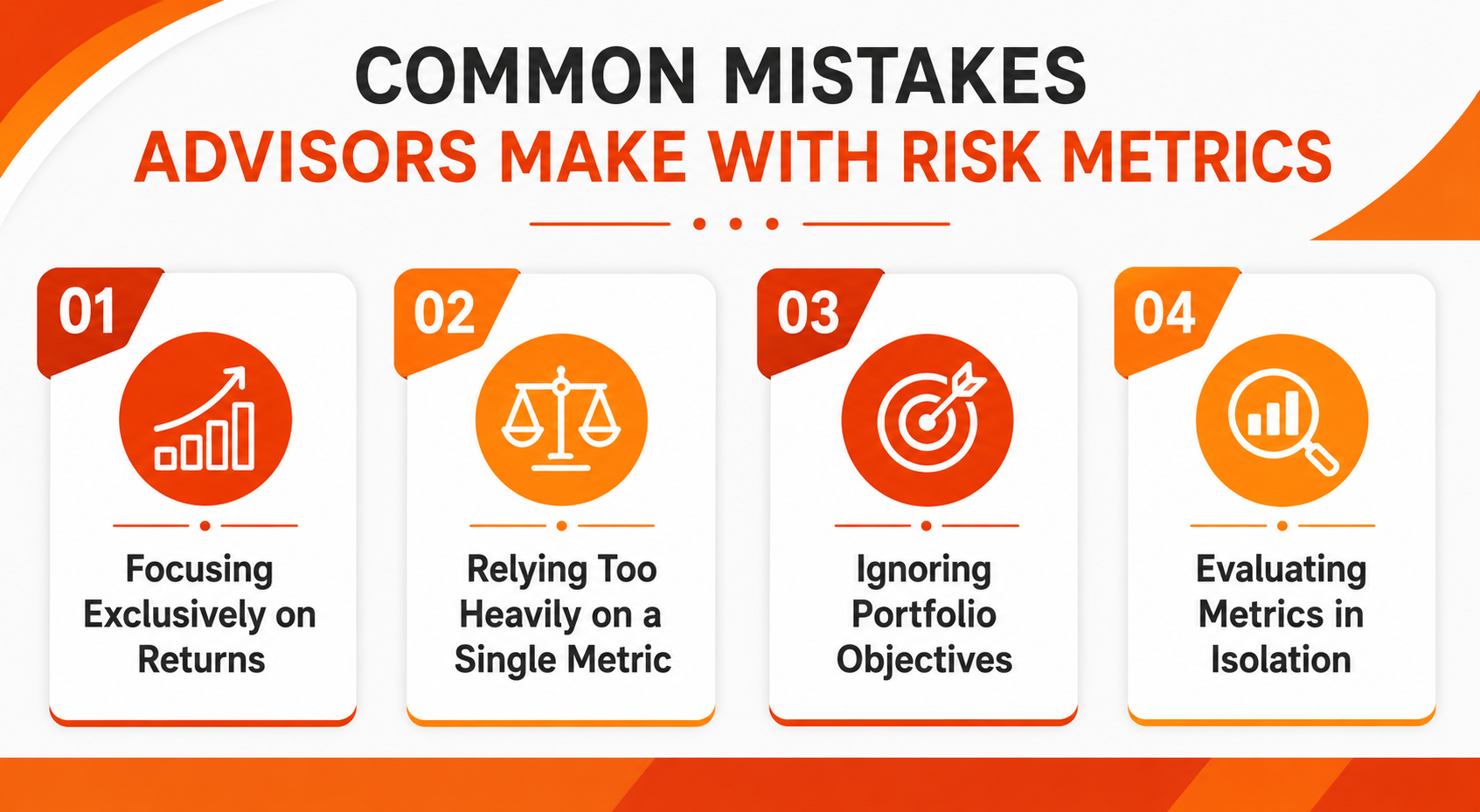
Understanding risk-adjusted return metrics is important, but their value depends on how consistently they are incorporated into the investment process. The strongest advisory firms use risk-adjusted analysis as part of a repeatable framework for portfolio oversight, manager evaluation, and investment governance.
Effective investment review processes define evaluation criteria before performance is reviewed.
This includes selecting the metrics that will be monitored, establishing appropriate benchmarks, determining review frequency, and creating documentation standards for investment decisions.
Without consistent standards, portfolio reviews can become influenced by individual preferences rather than a structured process. As firms grow, this can make investment oversight more difficult and create unnecessary governance challenges.
Risk-adjusted metrics are most valuable when they are monitored consistently over time.
Changes in Sharpe Ratio, beta, downside deviation, alpha generation, or benchmark-relative performance can provide early insight into changing portfolio characteristics. These indicators help advisors identify potential concerns before they become larger portfolio management issues.
Rather than reacting solely to performance results, firms can use quantitative oversight to support more proactive investment reviews and manager evaluations.
Read Next: The Strategic Advantage of Outsourced Investment Committees
Documentation is one of the most overlooked components of investment governance.
Risk-adjusted performance reviews should clearly record the metrics evaluated, benchmarks used, conclusions reached, and any recommended actions or follow-up items.
Strong documentation improves consistency across advisors, supports investment committee discussions, and creates continuity as firms grow.
Perhaps most importantly, documented decision-making helps ensure that investment processes remain durable over time, regardless of personnel changes, organizational growth, or evolving market conditions.
Risk-adjusted portfolio management becomes more challenging as advisory firms grow, add investment models, expand client customization, and formalize investment oversight. Helios helps firms build more consistent investment processes through research, model management, and governance support designed specifically for advisor-led practices.
1. Quantitative Investment Models
Helios' Quantitative Investment Models help advisory firms evaluate portfolio construction through a disciplined, repeatable framework. Rather than relying solely on subjective market opinions, quantitative models can help advisors monitor risk-adjusted performance, evaluate diversification, and maintain greater consistency across client portfolios.
2. ETF, Mutual Fund, and Stock Research
Risk-adjusted return analysis is most effective when supported by structured research. Helios' ETF, Mutual Fund, and Stock Research helps advisors evaluate managers, strategies, and investment vehicles through a due diligence process that considers both return potential and risk characteristics.
3. Outsourced CIO Services
As firms grow, investment governance often becomes more complex across portfolios, advisors, committees, and client-specific exceptions.
Helios' Outsourced CIO Services help advisory firms strengthen investment oversight, portfolio governance, committee support, documentation processes, and research workflows. The objective is to create a scalable investment process that remains consistent as the firm expands.
Whether the goal is improving portfolio construction, strengthening manager due diligence, or creating more consistent investment oversight, risk-adjusted analysis provides a framework for making better decisions. The challenge for many firms is not understanding the metrics themselves. It is incorporating those metrics into a repeatable investment process that can scale over time.
Risk-adjusted return investing is ultimately about improving decision quality.
The most effective advisory firms evaluate more than performance alone. They evaluate how returns were generated, how much risk was required, and whether that risk aligns with portfolio objectives, client expectations, and investment governance standards.
Key Takeaways
Risk-adjusted return measures provide more meaningful insights than absolute returns alone.
Sharpe Ratio, Sortino Ratio, Treynor Ratio, beta, and alpha each evaluate different aspects of portfolio risk.
Consistent risk-adjusted evaluation supports stronger investment governance and portfolio oversight.
Documented review processes help improve scalability, continuity, and decision-making consistency.
Risk-adjusted analysis helps advisors make more disciplined investment decisions across portfolios and teams.
For growing advisory firms, risk-adjusted investing is not simply a portfolio management exercise. It is a framework for improving portfolio oversight, manager evaluation, investment governance, and long-term consistency.
At Helios, we help advisory firms apply these principles through our Quantitative Investment Models, designed to support disciplined portfolio construction, risk management, and investment decision-making across changing market environments.
A risk-adjusted return measures investment performance relative to the amount of risk required to generate that return. Rather than focusing solely on high returns, advisors use risk-adjusted return measures to evaluate whether an investment portfolio produced sufficient returns for the level of risk assumed.
The Sharpe Ratio uses standard deviation to measure total portfolio volatility, while the Sortino Ratio focuses only on downside deviation. Because it isolates downside risk, the Sortino Ratio is often used to evaluate how portfolios perform during volatile periods and market declines.
Beta measures a portfolio's sensitivity to market movements relative to a benchmark such as the S&P 500. Advisors use beta to evaluate systematic risk, market exposure, and how an investment portfolio may behave as market conditions change.
The Treynor Ratio measures excess return relative to beta and evaluates return per unit of systematic risk. Unlike the Sharpe Ratio, which uses standard deviation, the Treynor Ratio focuses specifically on market risk and is commonly used to evaluate diversified portfolios.
There are several ways to calculate risk-adjusted returns. Common approaches include the Sharpe Ratio, Sortino Ratio, Treynor Ratio, Information Ratio, alpha, beta, and R-squared. Each metric evaluates a different aspect of portfolio risk and performance.
There is no single best metric for evaluating risk-adjusted performance. The appropriate measure depends on the portfolio objective, risk profile, and type of risk being evaluated. Many advisors use multiple risk-adjusted return measures together when evaluating managers, portfolios, and investment strategies.

Discover why investment process documentation helps RIAs strengthen governance, improve oversight, reduce risk, and scale more effectively.

Explore downside protection strategies advisors can use to manage risk, safeguard investments, and help reduce potential losses in volatile markets.

Learn how advisors can design, monitor, and scale risk-managed model portfolios, align client goals, and decide when to partner with an OCIO.