Investment Process Documentation: The Missing Link Between Performance and Governance
Discover why investment process documentation helps RIAs strengthen governance, improve oversight, reduce risk, and scale more effectively.
.png?width=258&height=145&name=Helios%20Web%20Images%20800x450%20(9).png)
How Advisors Can Use Market Commentary to Strengthen Client Relationships — Not Overwhelm Them
9 min read

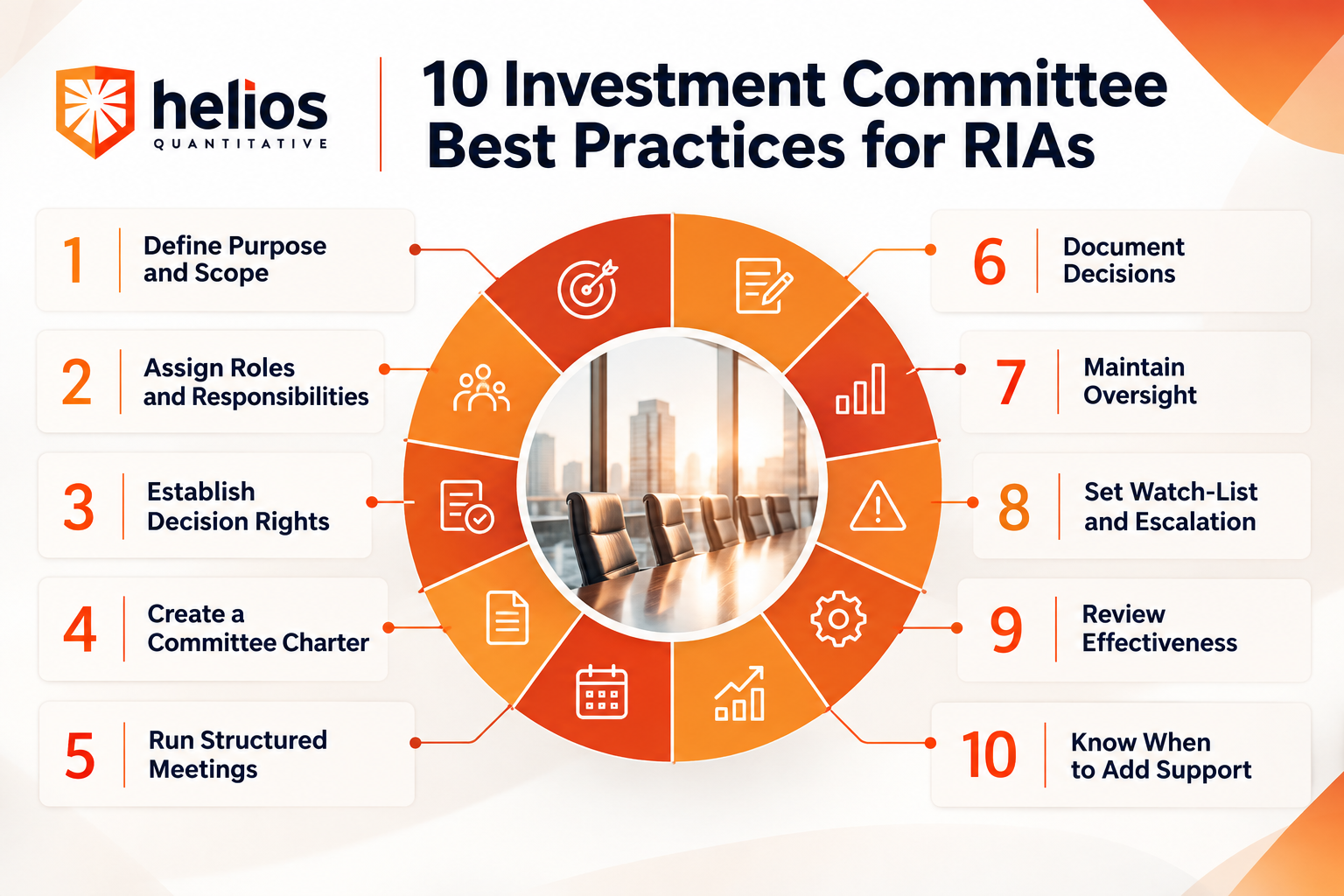
Investment committee best practices for RIAs start with a defined mandate, clear roles, documented decision rights, structured meetings, and a repeatable process for reviewing investment decisions. Each committee member should know what falls within the committee's authority, which decisions require approval, and who is responsible for implementation and ongoing oversight.
That discipline becomes more important as investment management shifts toward firm-level processes. Raymond James’ 2025 RIA Benchmarking Survey found that 64% of participating RIA firms use firm-driven model portfolios, while 55% planned to add or expand their exposure to alternative investments. As firms manage more strategies, models, managers, and investment options across client portfolios, informal decision-making becomes harder to maintain consistently.
A well-structured investment committee gives the RIA a practical framework for assigning responsibility, reviewing investment proposals, documenting material decisions, and determining when an issue requires further attention. It also creates continuity as the firm adds advisors or investment personnel, reducing the amount of investment governance that depends on one person's memory or availability.
The committee’s mandate should define what it oversees, what it can delegate, and which situations require formal review or escalation. A useful way to define that boundary is to separate governance decisions from day-to-day implementation:
The exact split will differ by firm. A smaller RIA may keep more authority with one chief investment officer, while a larger practice may distribute research, recommendation, approval, and implementation across several people. Everyone involved should know which decisions belong to the committee, which can be handled within approved guidelines, and which require formal review.
Read Next: 7 Proven Ways to Improve Investment Process in Wealth Management
Once the committee’s scope is defined, assign an owner to each stage of the investment process: research, recommendation, approval, implementation, and follow-up.
Research: Gather and evaluate the information needed to support an investment decision.
Recommendation: Present a documented proposal, including the rationale, risks, and expected role in the portfolio.
Approval: Decide whether the proposal fits the firm’s investment policies and warrants implementation.
Implementation and oversight: Carry out the approved decision, monitor the outcome, and bring material changes back to the committee when needed.
The same person may hold more than one responsibility, especially at a smaller RIA, but ownership should still be explicit. If several committee members assume someone else is monitoring a manager, documenting an exception, or following up on an approved change, gaps can persist unnoticed.
For firms that need more research capacity behind committee recommendations, Helios’ ETF, Mutual Fund, and Stock Research can provide an additional quantitative research layer for evaluating investment options and portfolio fit.
The committee should define who can recommend, approve, and implement each type of decision, along with which actions can proceed within pre-approved limits. A simple decision-rights matrix can make that practical:
A documented decision-rights matrix can reduce delays and duplicate work by making authority visible before an issue reaches the committee. Approval rules should also reflect the significance of the decision. Routine changes within an established framework may be delegated, while changes that affect investment policy, manager selection, portfolio construction, or fiduciary oversight may warrant formal committee approval.
A strong process leaves little room for ambiguity around who can recommend, who can decide, and who is accountable for what happens next.
Read More: OCIO Model: Outsource Investment Governance
The RIA should capture its roles, decision rights, and operating procedures in an investment committee charter. A useful charter should answer five questions:
What is the committee responsible for? Define its purpose, scope, and relationship to the firm’s broader investment policies and investment process.
Who serves on the committee? Identify members, leadership roles, voting authority, and any expectations around investment experience or expertise.
How are decisions made? Establish quorum, voting procedures, approval thresholds, and how conflicts of interest are handled.
How is committee activity documented? Specify expectations for agendas, meeting minutes, decision records, supporting research, and assigned follow-up.
When is the charter reviewed? Revisit it when committee membership, investment responsibilities, firm structure, or decision authority changes materially.
The charter should also remain distinct from the investment policy statement (IPS). An IPS typically sets investment objectives, constraints, and portfolio guidelines, while the committee charter defines how the committee operates and where decision authority sits. Helios’ Compliance Documentation can support the investment records surrounding that process, including portfolio rationale, research documentation, and committee materials.
An investment committee meeting should make it clear what needs to be reviewed, what requires a decision, and what happens next. A consistent meeting structure helps prevent important issues from getting buried in broad portfolio updates. A practical rhythm is:
A disciplined committee meeting should leave participants with a clear record of what was discussed, what was decided, who owns the next step, and when the issue will be reviewed again.
Read Next: The Strategic Advantage of Outsourced Investment Committees
Months after an investment decision is made, the most useful question is often simple:
Why did the committee approve it in the first place?
Meeting minutes that record only the outcome rarely provide enough context.
For material decisions, the record should preserve the reasoning behind the action. That may include the investment thesis, portfolio role, risks discussed, alternatives considered, conditions attached to approval, and any follow-up the committee expected. If a manager is later questioned or a model change produces an unexpected result, the committee can compare current evidence with the assumptions that supported the original decision.
A durable decision record reduces reliance on individual memory. As committee membership changes or responsibilities shift, the firm retains a usable history of how material decisions were reached. Helios’ Compliance Documentation can support firms that want a more consistent framework for capturing investment rationale and committee materials.
Read More: Why Investment Process Documentation Matters for Growing RIAs
Ongoing oversight works best when the committee separates routine monitoring from event-driven review. That keeps short-term market noise from dominating meetings while still creating a path for issues that deserve closer attention.
Routine Review should test managers, models, and investment strategies against the expectations established at approval. Performance, risk, portfolio exposures, and benchmark relationships can indicate whether the investment is still serving its intended role.
Event-Driven Review begins when something material changes. Examples include a portfolio manager departure, a change in investment process, unusual risk behavior, ownership changes, liquidity concerns, or a meaningful shift in portfolio construction.
Thesis Review asks whether the original reason for approval still holds. If the evidence has changed enough to weaken that case, the issue should move from normal monitoring to a deeper committee discussion.
Separating these review types helps the committee distinguish normal variation from developments that may warrant action without treating every period of underperformance as a governance event.
Read More: Model Portfolio Management for Advisors: Best Practices
A committee needs a defined response when an investment concern falls somewhere between routine monitoring and immediate replacement. Watch-list and escalation procedures create that middle ground.
A watch-list designation should lead to a defined next step, such as additional research, more frequent review, specific conditions, or a formal retain-or-replace decision. A documented escalation path helps the committee respond proportionately to material concerns without overreacting to short-term noise or leaving unresolved issues open indefinitely.
An investment committee should evolve with the firm. Growth can change the number of decisions coming to the committee, the people involved, and the amount of research and follow-up required. A structure that worked well for a smaller practice may become less effective once the investment program becomes more complex.
Changes in committee membership, leadership, or investment responsibilities should trigger a review of how authority is assigned. If new advisors, portfolio managers, or research personnel join the process, the firm may need to update voting rights, approval authority, or ownership of specific tasks.
An expanded lineup of model portfolios, investment managers, or alternative strategies can increase the committee’s workload and change which decisions warrant full committee attention.
Some of the clearest warning signs are operational:
agenda items repeatedly carry over from one meeting to the next
too many decisions depend on one CIO, founder, or senior advisor
follow-up items remain unresolved
committee meetings spend more time reviewing routine information than making decisions
documentation becomes inconsistent as activity increases
These patterns often point to an operating-capacity issue. The committee may need better delegation, clearer thresholds, or additional support around research and administration.
Adding committee members or approval layers can create more friction when responsibilities are already unclear. The structure should remain proportionate to the firm’s needs.
A periodic review should ask whether the committee still has the right membership, authority, meeting cadence, and support to handle the RIA’s current investment program. If the answer is no, the firm can revise responsibilities before delays, bottlenecks, or continuity risks become part of the normal operating process.
Read Next: Why Institutional Investment Management Matters for Succession
As committee workload grows, available capacity can become a practical constraint on research, preparation, monitoring, and follow-up. Research takes longer, meeting materials require more preparation, portfolio reviews become more specialized, and senior investment personnel spend increasing amounts of time coordinating work that supports the committee.
Warning signs include delayed manager reviews, uneven monitoring across strategies, inconsistent documentation, or too many decisions depending on one CIO or portfolio lead. These are indications that the work supporting committee decisions may need additional capacity.
The RIA can retain authority over investment philosophy, policy, approvals, and client-facing decisions while adding outside capacity for research, portfolio analysis, monitoring, documentation, or other investment-management functions.
Helios’ Outsourced CIO Services can add research, portfolio analysis, monitoring, and investment-process capacity around the committee while the RIA retains control over its investment philosophy, governance, and client relationships.
Investment committee governance should evolve alongside the firm’s investment program. A periodic review can help confirm that the structure still reflects how decisions are actually made and supervised.
Authority: Do approval rights and escalation thresholds still fit the firm’s structure?
Membership: Does the committee still include the right people for the decisions it oversees?
Documentation: Can past decisions and their rationale still be understood clearly?
Oversight: Are managers, models, and portfolio risks being reviewed consistently?
Continuity: Would the process remain workable if responsibilities shifted to other investment personnel?
Governance should stay aligned with how the firm actually operates as responsibilities and investment complexity increase. When that alignment begins to weaken, the committee has a clear reason to revisit its structure, decision rights, and supporting processes.
The strongest investment committees use a defined mandate, clear roles, documented decision rights, structured meetings, and a repeatable review process. For registered investment advisors, those practices help create consistency around investment selection, portfolio oversight, risk management, and accountability as more financial professionals become involved in making investment decisions.
Committee members should have enough investment experience to evaluate the issues the firm regularly faces and, where useful, represent different areas of responsibility. A well-rounded committee may include a chief investment officer, portfolio or research personnel, senior advisors, and other professionals involved in governance or implementation.
There is no universal committee size or requirement to use an odd number of members. The structure should support efficient decision-making, appropriate checks and balances, and enough diversity of thought to challenge assumptions without making the group unnecessarily difficult to manage.
An investment committee charter defines how the committee itself operates, including membership, authority, voting procedures, responsibilities, meeting expectations, and escalation rules.
An investment policy statement (IPS) generally addresses investment objectives, risk tolerance, constraints, asset allocation guidelines, and other portfolio policies. When creating an IPS, the RIA should align it with the broader governance framework without duplicating the committee charter.
Investment performance should be reviewed in context. The committee should consider the relevant benchmark, expected portfolio role, risk taken, market conditions, and whether the manager or strategy continues to follow the investment approach that was originally approved.
That review may also include due diligence on investment managers, changes in exposures, risk characteristics, and whether an investment alternative still fits the portfolio's objectives and risk tolerance. This context helps the committee distinguish normal variation from a change that warrants deeper review.
An RIA investment committee should understand how its decisions fit within the firm’s fiduciary responsibilities, including serving clients’ best interests, addressing conflicts appropriately, and applying a consistent process to investment advice and portfolio decisions.
Responsibility for investment decisions should also be clearly assigned so the firm can identify who recommended, approved, implemented, and monitored a material action. The committee’s procedures should reflect the RIA’s own advisory model, investment process, client responsibilities, and internal governance structure.

Discover why investment process documentation helps RIAs strengthen governance, improve oversight, reduce risk, and scale more effectively.

Model portfolio management best practices for advisors. Improve investment oversight, portfolio governance, and scalable wealth management.

Learn how RIAs perform investment manager due diligence, evaluate managers, document selection, and support ongoing oversight.