How Financial Advisors Can Outsource Investment Management More Effectively
Explore how advisors outsource investment management, compare asset management platforms, and evaluate portfolio support options.
.png?width=258&height=145&name=Helios%20Web%20Images%20800x450%20(9).png)
How Advisors Can Use Market Commentary to Strengthen Client Relationships — Not Overwhelm Them
13 min read

Investment manager due diligence is the process an RIA uses to determine whether a manager fits a defined portfolio role, document the selection decision, and monitor whether the investment thesis still holds. A sound review typically covers the investment team, strategy, portfolio construction, track record, risk, fees, liquidity, operations, service providers, and potential conflicts.
The consequences of weak diligence can be significant. In a 2025 CSC Survey of 150 institutional limited partners, 85% said they had rejected an investment opportunity because of operational concerns alone. For RIAs evaluating outside investment managers, that reinforces the need to examine the organization and controls supporting a strategy alongside its investment performance. These considerations can become more extensive when the allocation involves private funds or other complex investment vehicles.
A repeatable process starts by defining the mandate and evaluation criteria before comparing managers. From there, the RIA can document the approval decision and establish clear monitoring triggers for deeper review, watch-list placement, or replacement.
Investment manager due diligence is the process an RIA uses to determine whether a manager is suitable for a defined role in a client portfolio and whether that manager should remain approved over time. The review should cover both the investment case and the operational structure supporting it. For most RIAs, the process has two distinct stages:
A sound process starts with the portfolio need rather than the manager. If an RIA is evaluating a small-cap equity strategy, for example, the firm should first define the mandate, benchmark, expected risk profile, liquidity requirements, and role within the broader portfolio. Candidate managers can then be compared against the same criteria.
This matters because a strong historical track record does not automatically make a manager suitable for a given portfolio. The strategy may introduce unwanted concentration, duplicate existing exposures, create liquidity constraints, or behave differently from what the RIA expects during periods of market stress. A practical due diligence process should answer three questions:
Does the manager fit the intended portfolio role?
Is there enough evidence to support the investment thesis?
What developments would cause the firm to reconsider that thesis later?
When those questions are documented clearly, the selection decision becomes easier to review and explain, and the manager is easier to monitor across an investment committee or growing advisory team.
Before approving an investment manager, an RIA should evaluate whether the strategy fits a defined portfolio need, whether the investment process is credible and repeatable, and whether the manager can be monitored effectively after allocation. The review should cover both investment quality and the practical risks of working with the manager.
Start with the role the strategy is expected to play in the portfolio. The RIA should define the objective, benchmark, expected return and risk characteristics, liquidity needs, and any constraints before comparing managers.
This gives the investment committee a consistent basis for evaluation. A manager that looks attractive in isolation may add little value if it duplicates an existing exposure or introduces risk the portfolio does not need.
Review who actually makes the investment decisions and how those decisions are made. Relevant areas include team structure, portfolio manager tenure, analyst resources, succession planning, idea generation, security selection, position sizing, and buy-and-sell discipline.
The goal is to understand whether the process is repeatable and whether it depends too heavily on one individual. Material turnover or a change in decision-making authority can alter the original investment thesis even when the strategy name remains unchanged.
The RIA should understand what is inside the portfolio and what drives its behavior. That includes concentration, sector and factor exposures, turnover, liquidity, position sizing, and sources of active risk.
For example, two large-cap equity managers may use the same benchmark but produce very different outcomes because one takes concentrated positions while the other stays closer to the index. Those differences matter when the strategy is combined with the rest of the client portfolio.
Past performance should be evaluated in context. RIAs can review rolling returns, drawdowns, volatility, downside capture, benchmark-relative performance, and other risk-adjusted measures to understand how the manager has behaved across different periods.
The analysis should focus on what produced the results and whether that behavior is consistent with the stated investment process. A strong track record may be less informative if it was driven by exposures the RIA did not intend to add. Where additional analytical depth is needed, Helios’ ETF, Mutual Fund, and Stock Research can add a repeatable quantitative layer to the firm’s review of funds, securities, risk characteristics, and portfolio fit.
Read More: Risk-Adjusted Return Investing Strategies: Sharpe Ratio, Sortino Ratio & Portfolio Risk
Investment due diligence should also cover the structure supporting the strategy. Depending on the investment vehicle, the review may include fees, liquidity terms, valuation practices, custody arrangements, auditors, administrators, service providers, ownership, capacity, and potential conflicts of interest.
The depth of this review should reflect the investment vehicle. Publicly traded funds and securities generally provide different levels of liquidity, pricing transparency, and operational information than private funds or other less-liquid strategies.
By the end of the review, the investment committee should be able to explain what the manager is expected to do, what risks the firm is accepting, and what evidence supports the approval decision. That creates a stronger foundation for the ongoing monitoring process that follows.
A practical due diligence process should be structured enough to produce consistent decisions without becoming cumbersome. For most RIAs, four stages are enough to create a clear record from initial review through ongoing oversight.
A repeatable process gives the investment committee a consistent record for each manager, making decisions easier to compare, defend, and revisit as the RIA expands its investment lineup.
Read Next: 7 Proven Ways to Improve Investment Process in Wealth Management
Manager approval marks the start of ongoing due diligence. From there, the RIA should monitor whether the manager continues to behave as expected, whether the organization supporting the strategy has changed, and whether the allocation still serves its intended role in the portfolio. A useful monitoring framework focuses on the areas most likely to change the original investment thesis:
Performance deserves attention, but it should be interpreted alongside the rest of the evidence. A period of underperformance may be consistent with the manager’s stated process and expected market behavior. A more serious concern can arise when the portfolio begins behaving differently from the strategy the RIA originally approved.
For example, a manager selected for diversified large-cap exposure may warrant closer review if the portfolio becomes materially more concentrated, takes on exposures outside the original mandate, or changes its investment process without a clear explanation. The same applies when a key portfolio manager leaves, or an ownership change alters the structure behind the strategy.
The RIA should also define how monitoring results are recorded and escalated. Routine reviews can document that the investment thesis remains intact, while material changes should trigger additional research, discussion, or investment committee review.
The practical test is simple: does the evidence available today still support the reasons the manager was originally approved? If the answer becomes less clear, the manager may need closer scrutiny before the firm makes a retain-or-replace decision.
Read More: Model Portfolio Management: Best Practices for Advisors to Improve Investment Oversight
A watch-list review is appropriate when new information raises a credible question about whether the manager can still fulfill the role for which it was approved. The purpose is to create a defined period for deeper review before the RIA makes a retain-or-replace decision. Common triggers include:
Material personnel changes, especially the departure of a lead portfolio manager or key analyst
Investment process changes that alter how securities are selected, sized, or sold
Style drift or portfolio exposures that move outside the original mandate
Unexpected risk behavior, such as concentration or drawdowns that differ materially from expectations
Organizational changes, including ownership transitions or significant shifts in assets under management
Liquidity or operational concerns involving the investment vehicle, valuation process, or service providers
Persistent performance deviation that cannot be reasonably reconciled with the manager’s stated process or market environment
Poor performance by itself should be investigated in context. A manager can underperform for a period while still executing the strategy the RIA selected. The investment committee should assess whether the performance remains consistent with the original investment thesis and the role the strategy is expected to play. A practical escalation process can follow five steps:
1. Identify the issue → 2. Investigate the cause → 3. Document the findings → 4. Increase monitoring → 5. Retain or replace
Replacement becomes more appropriate when the evidence shows that the original thesis has materially weakened. That could happen when the investment process changes, critical personnel leave, portfolio risk moves outside expectations, operational problems persist, or the strategy no longer fits the intended allocation.
Predefined review criteria can also reduce decision bias. Investment committees may hesitate to remove managers they originally approved or react too quickly to short-term results. A documented mandate and clear watch-list triggers give the committee a more consistent basis for deciding when continued monitoring is warranted and when the evidence supports a change.
Manager due diligence becomes more reliable when the firm is clear about who is responsible for each stage of the decision and what evidence should be preserved. The goal is to create a process that another investment committee member can understand and revisit without relying on memory or informal context.
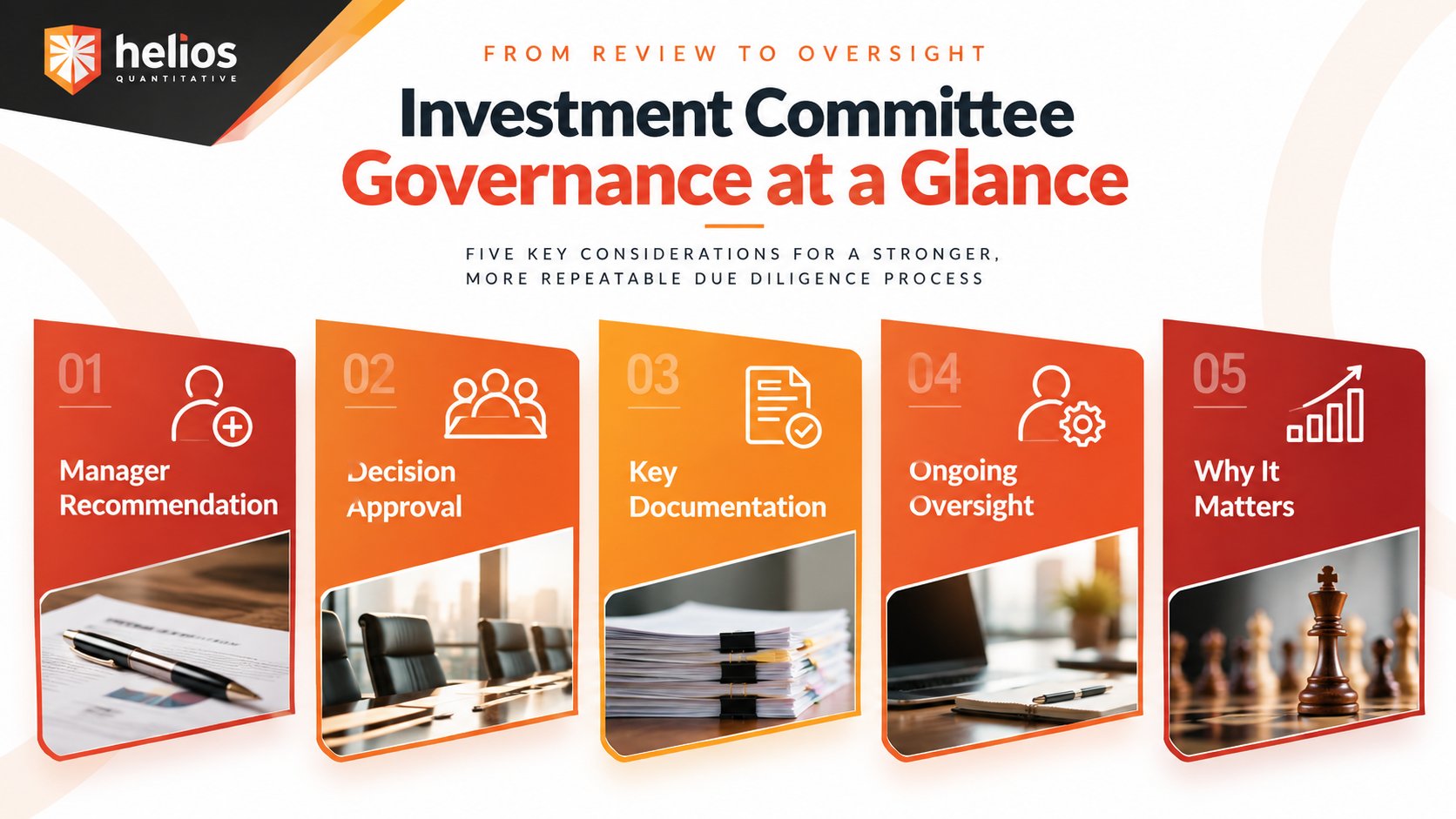
The firm should identify who is responsible for sourcing the manager, completing the initial research, and presenting the investment case.
That responsibility may sit with a CIO, analyst, portfolio manager, advisor, or investment committee member. Whoever owns the recommendation should be able to explain the manager’s intended portfolio role, the evidence supporting the thesis, the main risks identified during diligence, and how the strategy compares with other candidates considered.
A recommendation should also distinguish between a manager that is attractive on its own and one that actually improves the portfolio. That helps keep the discussion tied to the mandate rather than recent performance or familiarity with the manager.
Approval authority should be defined before managers reach the final stage of review. Some firms require a formal investment committee vote, while others assign final authority to a CIO or designated portfolio management team.
The approval process should confirm that the manager fits the intended mandate, that material investment and operational risks have been reviewed, and that the firm understands what will be monitored after allocation.
For larger RIAs, documenting approval authority also helps avoid inconsistent decisions across advisors or business units. A manager should not enter one part of the platform under materially different standards unless the firm has a clear reason for doing so.
The due diligence file should capture the information needed to understand and revisit the decision later. That typically includes:
Investment thesis and intended portfolio role
Quantitative and qualitative research
Material risks identified during review
Operational due diligence findings
Key assumptions behind the allocation
Approval decision and responsible decision-makers
Any monitoring conditions established at approval
The documentation should be concise enough to remain useful. A large file of manager materials is less valuable if the firm cannot quickly identify why the strategy was selected and what would cause that view to change. For firms formalizing these records, Helios’ Compliance Documentation can support more consistent documentation around models, holdings, portfolio decisions, research rationale, and investment committee materials.
Responsibility should remain clear after approval. The firm should identify who monitors performance, portfolio characteristics, personnel changes, process developments, ownership changes, operational issues, and other factors that could affect the original investment thesis.
The same structure should define who can escalate concerns, place a manager on a watch list, recommend additional diligence, or bring a replacement decision to the investment committee. This is especially important when several people participate in the research process. The firm should assign clear ownership for follow-up so monitoring responsibilities do not fall between team members.
A documented process supports continuity as the firm adds advisors, strategies, and client assets. If the person who originally selected a manager leaves the firm, the next investment committee should still be able to understand the original rationale and compare it with current evidence.
It also gives the committee a more consistent basis for watch-list, retention, and replacement decisions. When a manager underperforms, experiences a personnel change, or begins to drift from its stated process, the firm can return to the original thesis rather than reconstructing the decision from memory. That makes manager oversight easier to scale and reduces dependence on a small number of individuals as the investment platform becomes more complex.
Read Next: Investment Process Documentation: The Missing Link Between Performance and Governance
Manager due diligence often breaks down when firms apply their process inconsistently. An RIA may have access to performance data, manager presentations, due diligence questionnaires, and operational materials while applying different standards from one manager to the next or failing to connect the research back to the portfolio mandate. These are some of the most common failure points:
The practical safeguard is a consistent decision framework. The criteria used to approve a manager should also shape how that manager is monitored, challenged, and reassessed over time. That gives the investment committee a clearer basis for distinguishing normal short-term variation from changes that may affect the original investment thesis.
At Helios, we support the investment research, quantitative analysis, portfolio evaluation, and governance components of an RIA’s manager due diligence process. Our ETF, Mutual Fund, and Stock Research can help firms evaluate performance, risk, consistency, and portfolio characteristics alongside their own qualitative and operational review of the manager.
We also look at manager selection in the context of the broader portfolio. That means assessing how a strategy may affect allocation, concentration, diversification, and overall portfolio construction rather than reviewing each investment in isolation. This can help an investment committee determine whether a manager actually improves the portfolio role it was selected to fill.
For firms that need broader support across research, portfolio construction, monitoring, governance, and advisor resources, our Outsourced CIO Services can extend the investment capabilities available to the internal team. This support can help RIAs apply a more consistent process as the number of managers, strategies, and client portfolios grows.
A strong investment manager due diligence process gives an RIA a clear record of why a manager was selected, what role the strategy is expected to play, and which developments would justify a deeper review. That record becomes especially valuable when performance changes, key personnel leave, portfolio characteristics drift, or the firm needs to explain a decision years after the original approval.
For investment committees, consistent evaluation standards make manager decisions easier to revisit. Managers should be evaluated against a defined mandate, reviewed across investment and operational factors, and monitored using criteria established before problems emerge. That makes it easier to separate temporary underperformance from changes that genuinely weaken the original investment thesis.
For growing RIAs, the process also has an operational benefit. A well-documented framework reduces dependence on individual memory, helps new committee members understand past decisions, and makes manager oversight easier to maintain as the number of strategies and client portfolios expands.
Helios supports this work through ETF, Mutual Fund, and Stock Research, portfolio analysis, and broader investment oversight capabilities. For firms looking to add more depth and consistency to manager evaluation, the process should remain reliable from initial selection through monitoring, challenge, retention, or replacement.
A due diligence checklist should cover the manager’s investment strategy, team, track record, portfolio construction, risk controls, fees, liquidity, operations, service providers, conflicts, and documentation. The RIA should also record the manager’s intended portfolio role, the investment thesis, material red flags, and the criteria that will be used for ongoing monitoring.
Due diligence questionnaires can help standardize information gathering and provide structured inputs for the broader analysis.
Due diligence in private equity generally requires greater attention to areas such as valuation practices, liquidity, leverage, fund structure, service providers, and the manager’s approach to underlying portfolio companies. RIAs may also review the private placement memorandum, audited financial statements, disclosures, fund economics, and the manager’s experience across prior funds.
For public-market fund managers, the RIA typically has more frequent portfolio and performance data available. Private investments can require more qualitative and operational analysis because valuations and underlying holdings may be updated less frequently.
Quantitative due diligence helps an RIA evaluate performance, risk, drawdowns, consistency, exposures, and other measurable characteristics of a manager or strategy. Qualitative due diligence examines the investment team, philosophy, decision-making process, organizational stability, and whether the manager continues to operate as expected.
Used together, these approaches give the investment committee a more complete view of how results were produced and whether the manager still fits the intended portfolio role.
Assessing a manager should start with how the results were produced. RIAs can examine whether the manager’s past performance is consistent with the stated investment strategy, what risks were taken, how the portfolio behaved in difficult markets, and whether the investment team and process remain intact.
The review should also consider organizational stability, portfolio concentration, style consistency, liquidity, operational controls, and potential conflicts. Strong financial performance is more meaningful when the firm understands the process and risks behind it.
Ongoing due diligence should follow a schedule appropriate to the strategy and investment vehicle, with additional reviews when material changes occur. Those triggers might include personnel departures, ownership changes, style drift, valuation concerns, unusual performance, changes in liquidity, or new operational red flags.
The manager selection process should therefore establish monitoring expectations at approval. That gives the investment committee a consistent basis for deciding when routine oversight is sufficient and when deeper diligence is warranted.

Explore how advisors outsource investment management, compare asset management platforms, and evaluate portfolio support options.

Understand outsourced asset management costs, pricing structures, and what advisors should compare across investment managers.

Model portfolio management best practices for advisors. Improve investment oversight, portfolio governance, and scalable wealth management.