1 min read
Model Portfolio Construction for Advisors: Building Consistent, Scalable Portfolios
Model portfolio construction helps advisors scale portfolio management by establishing a repeatable framework for asset allocation, risk management,...
.png?width=258&height=145&name=Helios%20Web%20Images%20800x450%20(9).png)
How Advisors Can Use Market Commentary to Strengthen Client Relationships — Not Overwhelm Them
12 min read

Model portfolio management is the ongoing process of monitoring, maintaining, and governing model portfolios after they have been built. It helps advisors keep portfolios aligned with investment objectives, manage portfolio changes consistently, and deliver a repeatable investment process across client accounts.
The need for disciplined model portfolio management continues to grow. Cerulli projects that asset allocation model portfolio assets will reach $2.9 trillion by 2026 as advisory firms increasingly adopt model-based investment approaches to improve efficiency and scale.
For advisors, the challenge is no longer whether to use model portfolios. It is whether the firm's investment process can consistently support portfolio reviews, governance, rebalancing, documentation, and client-specific customization as the business grows. Strong model portfolio management turns investment oversight into a scalable business process rather than a series of individual portfolio decisions.
P.S. Effective model portfolio management depends on more than periodic rebalancing. It requires a disciplined research process, consistent governance, and repeatable investment decisions. Helios supports advisory firms with Quantitative Investment Models designed to help advisors maintain investment consistency while scaling portfolio oversight across growing practices.
Model portfolio management is the ongoing process of overseeing, maintaining, and improving model investment portfolios after they have been constructed. It includes monitoring portfolio performance, evaluating investment research, rebalancing allocations, updating holdings, documenting investment decisions, and ensuring portfolios remain aligned with their intended investment objectives and risk parameters.
Unlike portfolio construction, which focuses on designing a portfolio, model portfolio management is about operating that portfolio over time. It provides advisors with a structured framework for making consistent investment decisions across multiple client accounts while adapting to changing market conditions, new research, and evolving client needs.
As advisory firms grow, effective model portfolio management becomes increasingly important. Without a disciplined management process, firms often struggle with inconsistent investment decisions, portfolio drift, excessive customization, and operational inefficiencies that become more difficult to manage as assets under management increase.
A model portfolio is a standardized investment portfolio designed to serve clients with similar investment objectives, risk tolerance, and financial goals. Model portfolio management is the governance framework that keeps those portfolios current, consistent, and aligned with their intended purpose. An effective management process typically includes:
Monitoring portfolio performance and risk exposures.
Reviewing investment holdings and research.
Portfolio rebalancing when allocations drift from target weights.
Evaluating new investment opportunities.
Documenting investment decisions and governance reviews.
Communicating material portfolio changes to advisors and clients.
Rather than treating every client portfolio as a separate investment exercise, advisors use a structured management process to maintain consistency while allowing for appropriate client-specific customization where necessary.
Portfolio construction and model portfolio management are closely related, but they serve different purposes within the investment process.
Construction answers the question, "What should this portfolio look like today?"
Model portfolio management answers the more important long-term question, "How should this portfolio evolve as markets, research, and client needs change?"
For many advisory firms, this distinction becomes more significant as the business grows. Designing a model portfolio is a one-time event. Managing multiple model portfolios across hundreds of client relationships requires repeatable processes, clearly defined governance, and disciplined investment oversight.
Read Next: Model Portfolio Construction for Advisors: Building Consistent, Scalable Portfolios
As advisory firms grow, model portfolio management becomes less about maintaining individual portfolios and more about managing an investment business. Every portfolio review, allocation change, and investment decision affects operational efficiency, governance, advisor capacity, and the consistency of the client experience. A disciplined management process helps firms maintain investment quality while creating the structure needed to scale with confidence.
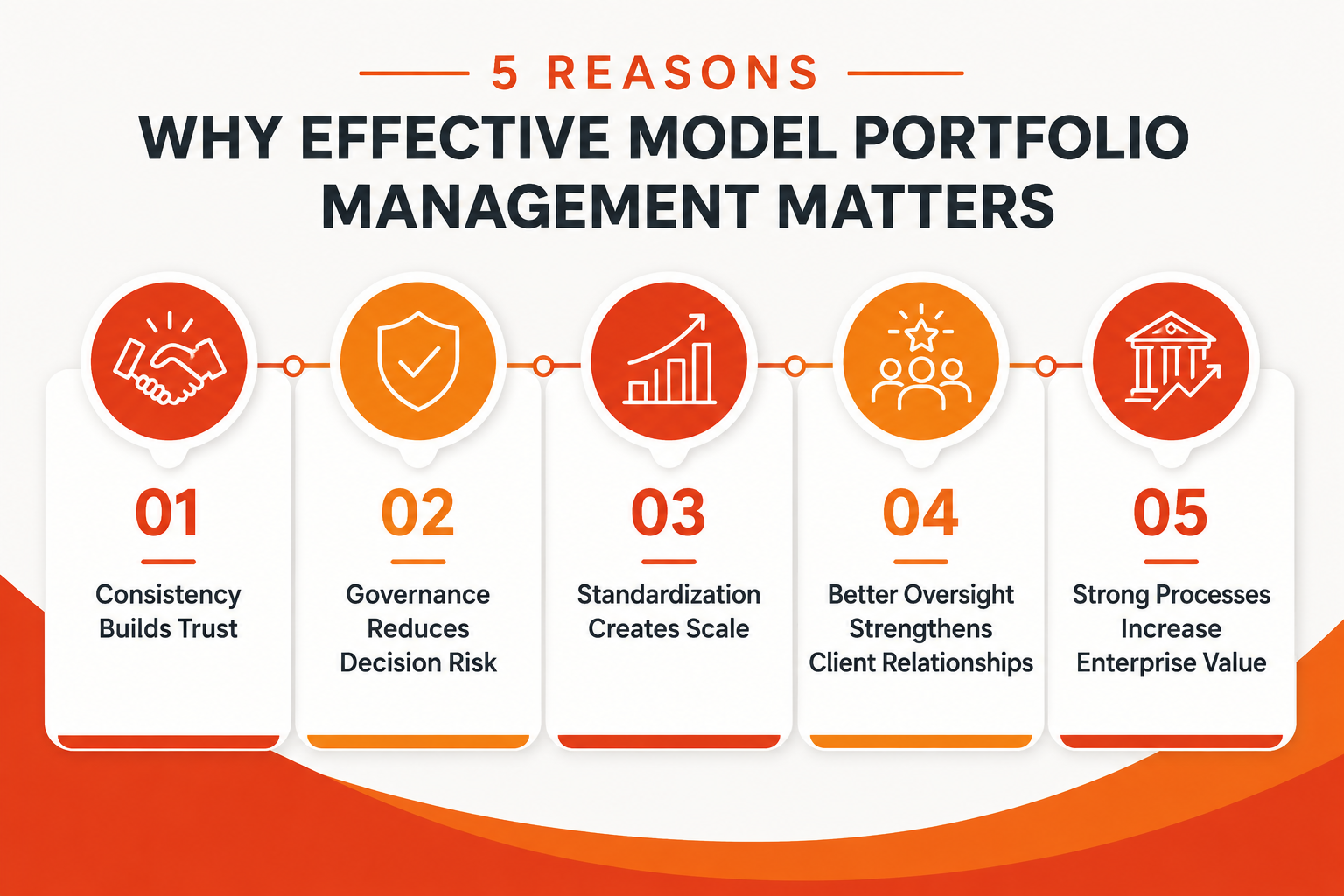
Consistency is one of the greatest advantages of using a model portfolio, but it requires ongoing management to maintain. Research updates, portfolio rebalancing, and investment changes should be implemented through a structured process rather than individual judgment for each account.
When clients with similar investment objectives receive a consistent investment experience, advisors can communicate portfolio decisions with greater confidence and reinforce the firm's investment philosophy. Consistency also reduces unnecessary variation across portfolios, making investment oversight more transparent and repeatable.
Read More: How Advisors Can Turn Risk Management Into a Repeatable Model Portfolio Process
Strong investment decisions rely on more than market insight. They rely on a governance framework that defines how portfolios are reviewed, who approves investment changes, and how those decisions are documented.
Clear governance helps advisory firms reduce inconsistent decision-making, improve accountability, and maintain a disciplined investment process. As more advisors contribute to portfolio management, standardized oversight becomes essential for preserving investment integrity across the practice.
Growth naturally increases operational complexity. More clients, more portfolios, and greater customization can quickly overwhelm even experienced investment teams if every portfolio is managed independently.
Model portfolio management introduces standardized workflows that allow firms to centralize research, implement portfolio updates efficiently, and manage larger books of business without increasing manual investment work. The result is a more scalable investment process that supports growth while maintaining consistency.
Clients expect more than portfolio performance. They expect investment decisions to be disciplined, well-documented, and aligned with their long-term financial objectives.
Regular portfolio reviews, ongoing monitoring, and consistent communication help advisors explain investment changes with confidence, particularly during periods of market volatility. Strong oversight demonstrates that portfolio decisions are driven by a repeatable investment process rather than short-term market reactions.
Well-managed model portfolios create benefits that extend beyond investment management. They reduce founder dependency, simplify advisor onboarding, support succession planning, and make investment responsibilities easier to delegate across the organization.
As advisory firms mature, a documented and repeatable model portfolio management process becomes a strategic business asset. It strengthens operational resilience, improves governance, and creates an investment platform that supports long-term growth without compromising investment discipline.
Read Next: Scaling a Financial Advisory Practice: 5 Levers That Increase AUM and Enterprise Value
A single investment decision does not drive effective model portfolio management. It is supported by a series of interconnected disciplines that help advisory firms maintain investment consistency, strengthen governance, and build a scalable investment process. While every firm's approach will differ, the following components form the foundation of a disciplined model portfolio management framework.
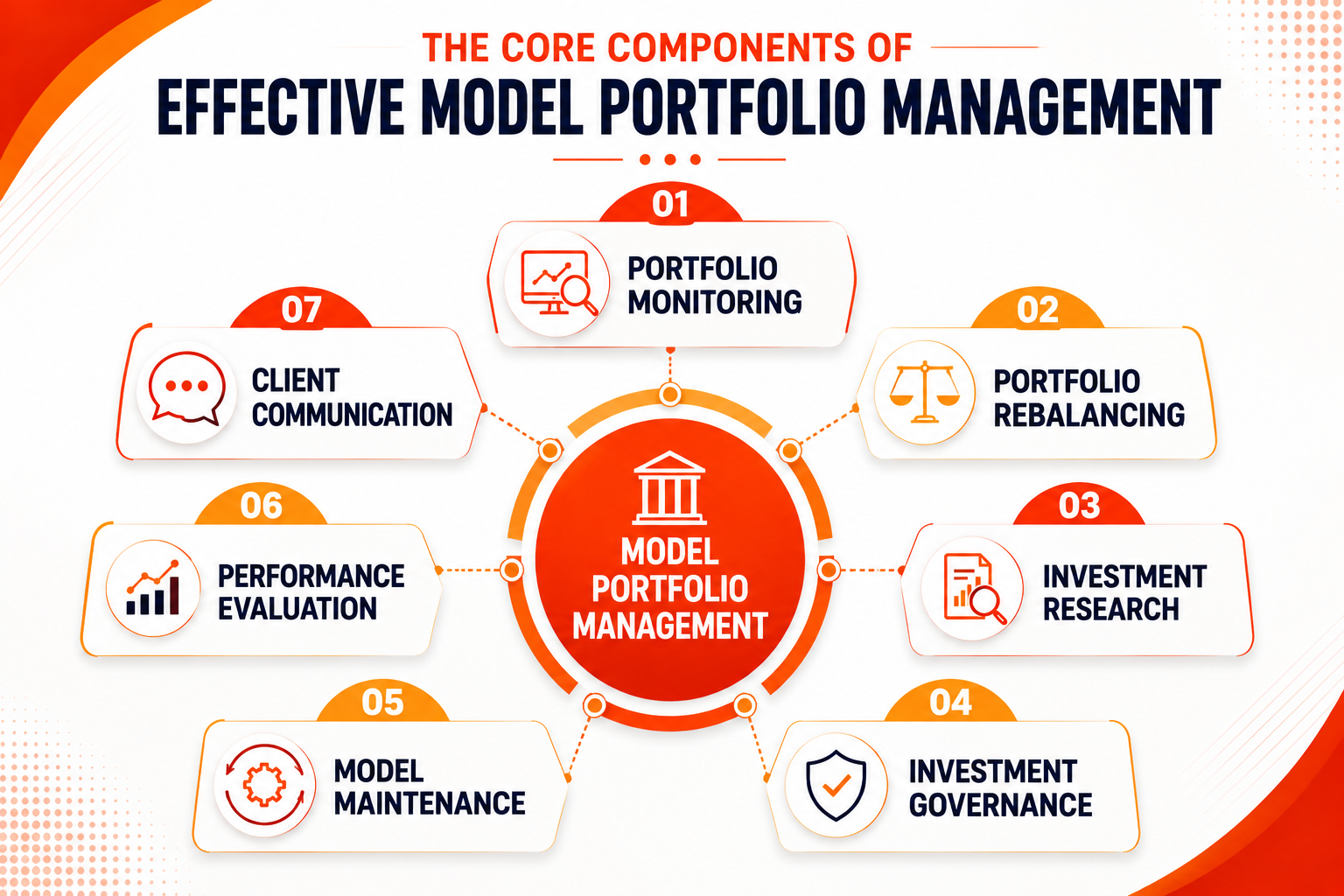
Portfolio Monitoring: Regularly review portfolio allocations, risk exposures, underlying holdings, and portfolio drift to ensure each model continues to align with its intended investment objective. Effective monitoring helps advisors identify meaningful changes without reacting to every market fluctuation.
Portfolio Rebalancing: Maintain strategic asset allocation through a documented rebalancing process rather than emotion or arbitrary schedules. Consistent portfolio rebalancing helps preserve the portfolio's intended risk profile while ensuring investment decisions remain disciplined.
Investment Research: Base portfolio changes on ongoing research instead of short-term market movements. Regularly evaluate existing holdings, assess new investment opportunities, and confirm that every position continues to support the model's long-term investment objectives.
Investment Governance: Define how portfolios are reviewed, who approves model changes, how investment decisions are documented, and how updates are communicated across the firm. Strong governance creates accountability and helps standardize investment oversight as advisory practices grow.
Model Maintenance: Review model portfolios periodically to determine whether allocations, assumptions, or holdings require refinement. Effective maintenance focuses on thoughtful evolution rather than frequent activity, ensuring models remain relevant as markets and client needs change.
Performance Evaluation: Look beyond portfolio returns by evaluating risk-adjusted performance, diversification, allocation effectiveness, and whether the portfolio continues to perform its intended role across different market environments.
Client Communication: Explain both what changed and why it changed. Consistent communication reinforces the firm's investment philosophy, strengthens client confidence, and demonstrates that portfolio decisions are guided by a repeatable investment process rather than reacting to market headlines.
Model portfolio management is most effective when it follows a structured, repeatable process. Rather than making investment decisions in isolation, advisors should establish a consistent workflow that guides how portfolios are monitored, evaluated, updated, and reviewed over time. A disciplined process helps reduce subjectivity, strengthen governance, and maintain consistency across client portfolios.
Although every advisory firm develops its own methodology, the underlying process remains largely the same. Investment objectives provide the foundation, ongoing monitoring identifies when further analysis is needed, research determines whether action is warranted, implementation ensures consistency across portfolios, and regular reviews help strengthen the investment process over time.
This continuous cycle enables advisors to move beyond reactive portfolio management and toward a disciplined investment framework that can support both client outcomes and long-term business growth.
Without a documented management process, investment decisions can become inconsistent as firms grow. A repeatable framework helps advisors maintain investment discipline, improve operational efficiency, strengthen governance, and deliver a more consistent client experience. It also creates a scalable foundation that supports advisor delegation, investment committee oversight, and sustainable practice growth without compromising portfolio quality.
Read Next: 7 Proven Ways to Improve Investment Process in Wealth Management
One of the biggest misconceptions about model portfolio management is that effective management requires frequent portfolio changes. In reality, the opposite is often true. Well-managed model portfolios are designed to remain stable over time, with changes driven by research and investment discipline rather than short-term market movements.
The challenge for advisors is recognizing the difference between routine market volatility and developments that genuinely warrant action. A disciplined review process helps ensure portfolio updates are purposeful, documented, and aligned with the portfolio's long-term objectives.
While every advisory firm will establish its own review criteria, several situations commonly prompt a closer evaluation of a model portfolio.
The portfolio no longer aligns with its intended investment objective or risk profile. Market movements, allocation drift, or changing correlations between asset classes may gradually alter how the portfolio behaves.
New investment research challenges an existing holding or allocation. Changes should be supported by evidence, not recent performance or market headlines.
A strategic asset allocation review identifies opportunities for improvement. Long-term market assumptions, economic conditions, or changes in available investment vehicles may justify refining the model.
Client needs evolve in ways that affect the model's suitability. While model portfolios are designed for groups of similar investors, periodic reviews help ensure they continue to reflect the needs of the clients they are intended to serve.
The investment committee determines that a documented portfolio change is appropriate. Material adjustments should follow an established governance process with clear approval, implementation, and communication procedures.
The key principle is consistency. Advisors should avoid making portfolio changes simply because markets have become volatile or a single asset class has recently outperformed. Instead, every adjustment should support the model's long-term investment objectives and fit within a documented investment management process.
Many advisory firms develop a disciplined investment philosophy long before they develop a disciplined investment process. As the practice grows, manual workflows, inconsistent portfolio reviews, and undocumented investment decisions can gradually limit scalability.
Evaluating your model portfolio management process is not about finding perfection. It is about identifying whether the systems supporting your investment decisions are prepared to grow alongside your business.
If you answered "no" or "not consistently" to several of these questions, the challenge may not be your investment philosophy. It may be the management process supporting it.
As advisory firms grow, scalable model portfolio management becomes less about making better investment decisions and more about creating a repeatable investment process that supports governance, delegation, operational efficiency, and long-term client service.
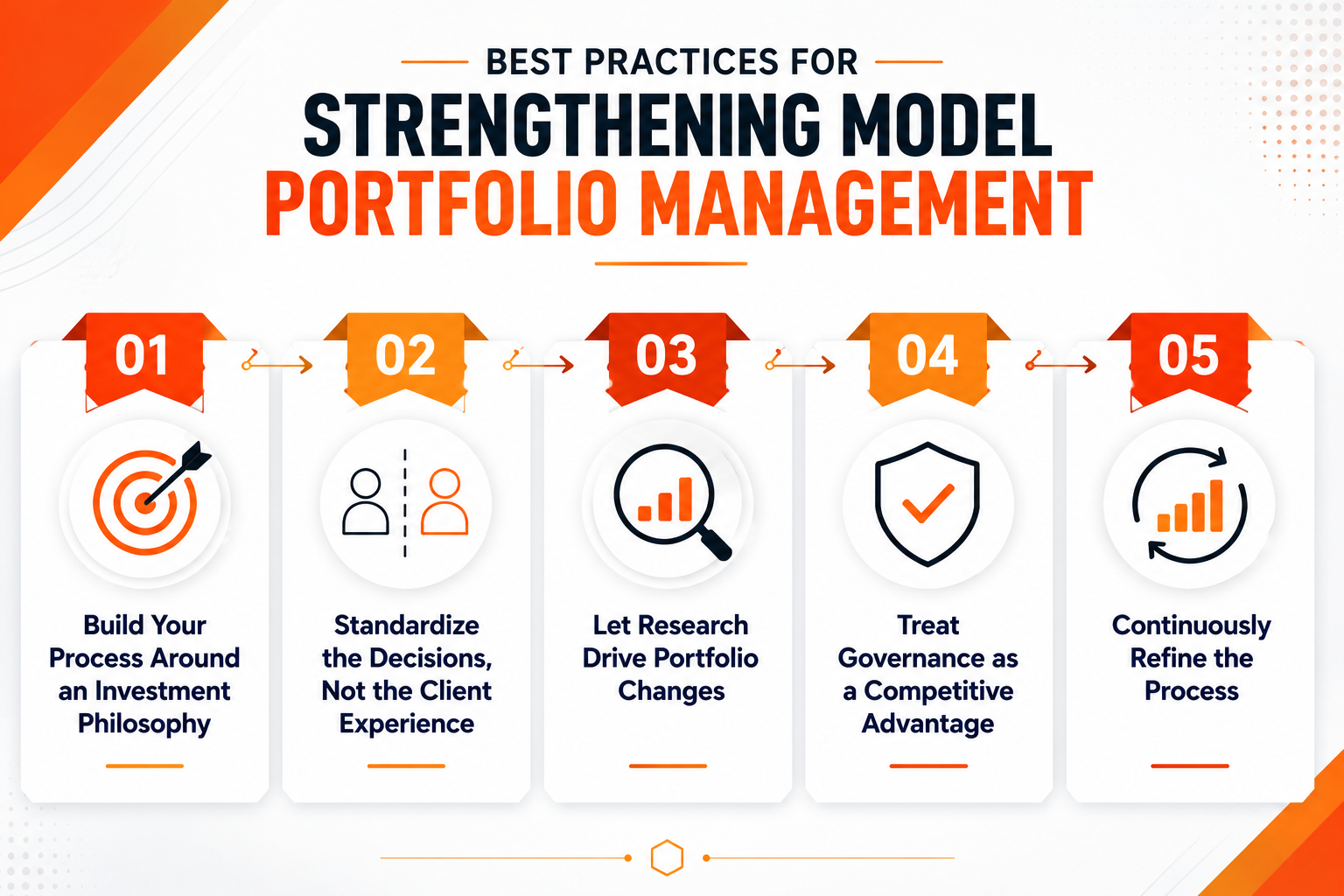
Strong model portfolio management is rarely the result of a single improvement. It is the outcome of consistently applying sound investment principles across research, governance, implementation, and client communication. As advisory firms grow, these best practices help create an investment process that remains scalable, repeatable, and aligned with long-term client objectives.
Every portfolio decision should be guided by a clearly defined investment philosophy rather than changing market sentiment. When advisors establish documented principles for portfolio construction, asset allocation, security selection, and risk management, individual investment decisions become more consistent and easier to defend.
A well-defined philosophy also provides continuity as advisory teams grow, helping ensure investment decisions remain aligned regardless of who implements them.
One of the biggest misconceptions about model portfolio management is that standardization eliminates personalization.
In reality, standardization should apply to the investment process, not necessarily the client relationship. Advisors can maintain a consistent approach to research, governance, and portfolio oversight while still tailoring financial planning, communication, and implementation to each client's unique circumstances.
That balance allows firms to scale investment management without making the client experience feel standardized.
Read More: How to Build Model Portfolios for Clients: Balancing Customization and Consistency
Markets create constant noise. Research creates discipline.
Rather than adjusting portfolios in response to headlines or recent performance, advisors should establish a structured research process that evaluates whether new information genuinely changes the investment thesis. Every material portfolio change should answer a simple question:
"Does this improve the portfolio's ability to achieve its stated investment objective?"
If the answer is unclear, maintaining the existing allocation may be the better decision.
Investment governance is often viewed as a compliance exercise, but leading advisory firms recognize it as an operational advantage.
Clear decision-making authority, documented investment committee responsibilities, and consistent review procedures improve accountability while making the investment process easier to scale. Strong governance also reduces dependence on individual advisors by embedding institutional knowledge into documented processes.
Over time, that consistency becomes part of the firm's value proposition.
Model portfolio management should evolve through continuous improvement rather than constant change.
Every portfolio review, investment decision, and client conversation creates an opportunity to strengthen the overall management process. Advisors should periodically evaluate whether existing workflows remain efficient, whether governance responsibilities are still appropriate, and whether operational bottlenecks are limiting scalability.
The objective is not simply to manage portfolios more effectively. It is to build an investment process that becomes stronger, more resilient, and more scalable over time.
As advisory firms grow, model portfolio management often becomes more than an investment responsibility. It becomes an operational challenge requiring dedicated research, disciplined governance, consistent portfolio oversight, and efficient implementation across an expanding client base. What works for a smaller practice may not scale as assets, advisors, and client expectations grow.
For many firms, the goal is not to replace their investment philosophy but to strengthen the process behind it. Additional investment resources can improve consistency, reduce operational complexity, and create a more scalable framework for managing model portfolios.
That's where our Outsourced CIO Services come in. We partner with RIAs, independent advisors, family offices, and enterprise wealth management firms to support model portfolio management with institutional research, quantitative investment models, portfolio oversight, governance, and disciplined implementation.
Read Next: How to Know If OCIO Solutions Make Sense for Your Advisory Firm
Effective model portfolio management is not measured by how often portfolios change or how many models a firm maintains. It is measured by the strength of the investment process behind every decision. A disciplined approach to research, governance, portfolio oversight, and implementation helps advisory firms deliver greater consistency, improve operational efficiency, and build an investment program that can scale alongside the business.
Key Takeaways
Strong model portfolio management begins with a clearly defined investment philosophy and a repeatable management process.
Consistent governance, research, and portfolio oversight are just as important as investment selection.
Scalable investment processes allow advisory firms to grow without sacrificing consistency or the client experience.
Regular evaluation and continuous improvement help ensure model portfolios remain aligned with long-term investment objectives.
As your firm grows, so do the demands on your investment process. Whether you're refining an existing model portfolio program or building one from the ground up, our Outsourced CIO Services provide the institutional research, portfolio oversight, and governance support needed to strengthen investment management while allowing your team to focus on what matters most: delivering exceptional outcomes for your clients.
Ready to strengthen your model portfolio management process? Schedule a conversation to learn how Helios' Outsourced CIO Services can help you build a more disciplined, scalable investment program.
The terms model portfolio and model investment portfolio are often used interchangeably. Both describe a professionally managed investment framework built around a specific investment objective and risk profile. These portfolios typically include diversified asset classes, such as equities, fixed income, ETFs, and mutual funds, giving financial advisors a consistent foundation for managing client portfolios.
It depends on your firm's investment resources, governance, and long-term objectives. Building an internal portfolio model offers greater control over investment strategies but requires ongoing research, portfolio oversight, and governance. Third-party model portfolios can streamline investment management by providing professionally managed portfolio solutions, allowing advisors to focus more on clients while maintaining investment discipline.
There is no single rebalancing schedule that fits every firm. Advisors should establish a documented portfolio rebalancing process based on their investment philosophy, strategic asset allocation, and client objectives. Models are commonly reviewed on a schedule or when allocations drift beyond established thresholds, helping maintain the intended investment objective and risk profile.
Yes. While model portfolios provide a standardized investment framework, they can be customized to reflect a client's financial goals, risk tolerance, tax management needs, asset location preferences, or investment restrictions. The goal is to balance personalization with operational consistency as assets under management (AUM) grow.
Model portfolios help advisory firms improve consistency, strengthen investment governance, and scale their investment process. They provide a structured approach to asset management, making it easier to implement investment strategies, diversify across asset classes, and manage client portfolios efficiently. This allows financial professionals to spend more time on financial planning and client relationships while maintaining a consistent level of service.

1 min read
Model portfolio construction helps advisors scale portfolio management by establishing a repeatable framework for asset allocation, risk management,...

1 min read
Building model portfolios for clients requires more than selecting investments and assigning target allocations. Advisors need a repeatable process...

1 min read
Portfolio management for financial advisors is usually handled through one of four models: the advisor manages portfolios directly, an internal...